
Lingzhi (Ganoderma lucidum, also called reishi) is absolutely growable at home, but it is slower and more particular than oyster or shiitake mushrooms. Expect a full grow cycle of three to five months from inoculation to harvest. If you go in with realistic expectations and respect the species' needs for heat, high humidity, and patience, you can produce impressive, medicinal-quality conks without a commercial setup. Here is the complete workflow, from picking your approach to drying your finished mushrooms.
How to Grow Lingzhi Mushroom at Home Step by Step
Marcus Holloway
22 Apr 2026
Know what you're growing and pick your method
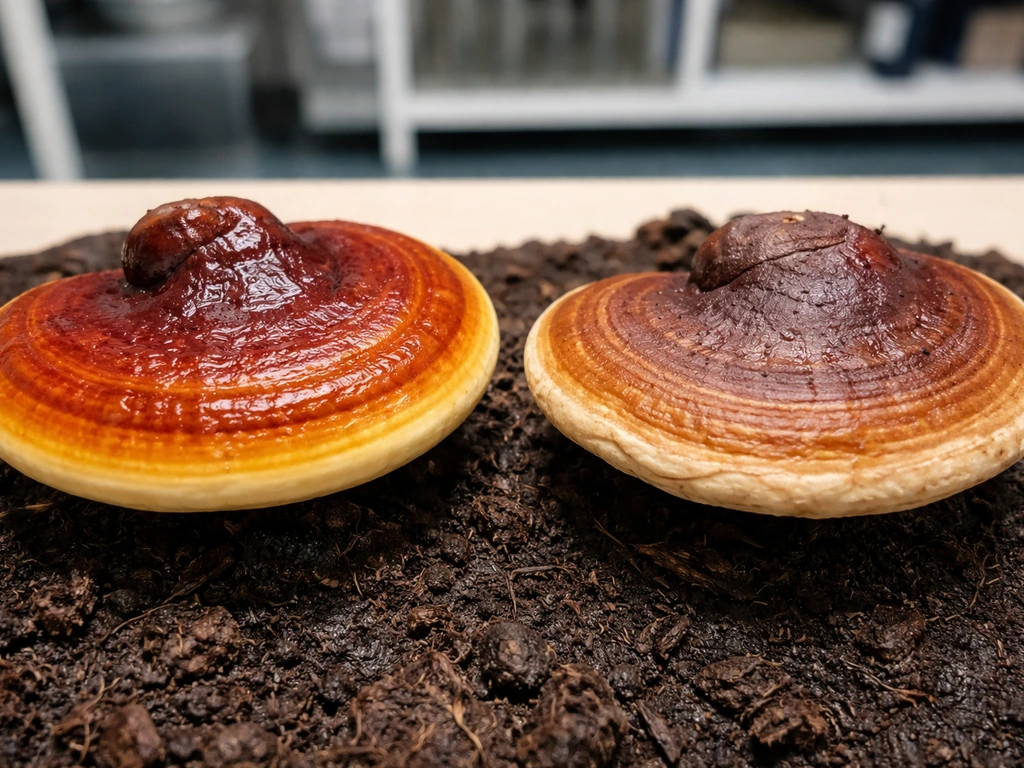
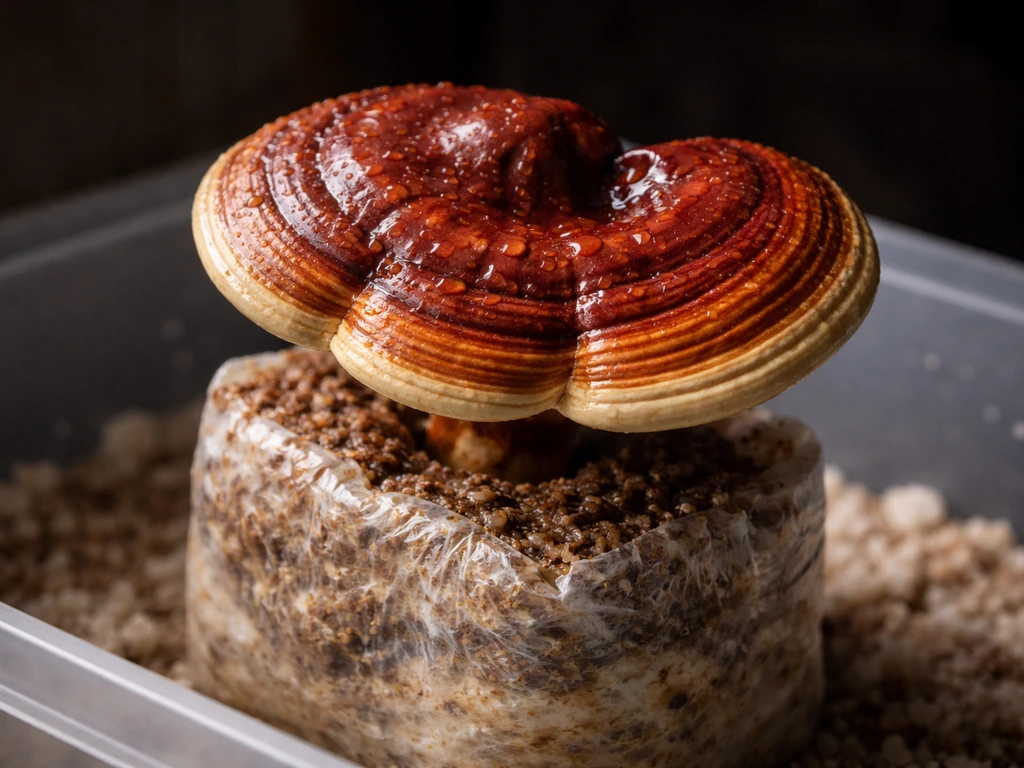
Before you spend money on supplies, make sure you can positively identify Ganoderma lucidum and understand what you are actually trying to cultivate. Lingzhi produces a glossy, varnished-looking conk (laccate surface) in reddish-brown tones with a tawny to russet stipe that is typically about 1.5 times the cap diameter. The spore print is reddish-brown, and the spores themselves are ovoid with a warty surface (roughly 8 to 11 by 6 to 8.5 micrometers). The underside is cream to tan pore surface, not gills.
There are a few lookalikes worth knowing. Ganoderma tsugae looks nearly identical but associates with hemlock; its flesh below the glossy crust is white, while true G. lucidum flesh tends to be buff or tan. Ganoderma carnosum is another one that only appears on Abies (fir) wood, so substrate and host tree are useful differentiators. More critically, commercial products labeled as G. lucidum are frequently mislabeled. Studies have found that many items sold as reishi are actually G. sichuanense, G. resinaceum, or other laccate Ganoderma species. This matters when sourcing spawn: buy from a reputable supplier who has verified culture identity, not just someone selling 'reishi' with no documentation.
For home growing, you have two main approaches: indoor bags/blocks or outdoor log/stump cultivation. Indoor bag cultivation on supplemented sawdust gives you the most control, faster results, and is the better choice for beginners or anyone in a climate with cold winters. Outdoor log cultivation is slower (you may wait 12 to 18 months for first fruiting) but requires almost no active management once inoculated and suits growers who want a low-maintenance, multi-year setup. This guide focuses primarily on indoor bag cultivation since it is the most practical and reproducible method for most home growers.
Sourcing spawn (and the legal realities)
You have two starting options: grain spawn or a ready-to-inoculate culture (agar plate or liquid culture). For most home growers, grain spawn from a domestic supplier is the easiest path. Avoid spores for cultivation; unlike species such as cordyceps where working with spores is common in research settings, reishi is almost always cultivated from verified mycelial cultures because spore-grown strains can be inconsistent and the risk of getting a mis-identified species compounds when you start from spores alone. If you're specifically aiming to learn how to grow cordyceps, look for a cordyceps-focused workflow since the starting culture, incubation, and substrate targets differ from reishi.
If you want to import spawn from another country, know that the USDA-APHIS requires the recipient to hold a valid PPQ 526 permit for regulated fungal organisms. This is not a small paperwork hurdle, so unless you have a specific reason to source internationally, buy domestic spawn. USDA APHIS maintains a Regulated Plant Pest List and notes that action may be required against pests not listed depending on the circumstances. There are plenty of reputable US and European suppliers who maintain verified G. lucidum strains. Look for suppliers who state the strain name, its host wood origin, and ideally offer a certificate of culture identity.
Grain spawn (rye, wheat berries, or popcorn) is the most common form for bag inoculation. Liquid culture syringes work well too and are slightly faster to colonize. Either way, inspect your spawn before use: it should smell clean and earthy, the mycelium should be white and dense, and there should be no green, black, orange, or pink patches, which indicate contamination. If you see contamination, discard the whole batch. Contaminated spawn is one of the most common ways a grow fails before it even starts.
Substrate: what reishi actually wants
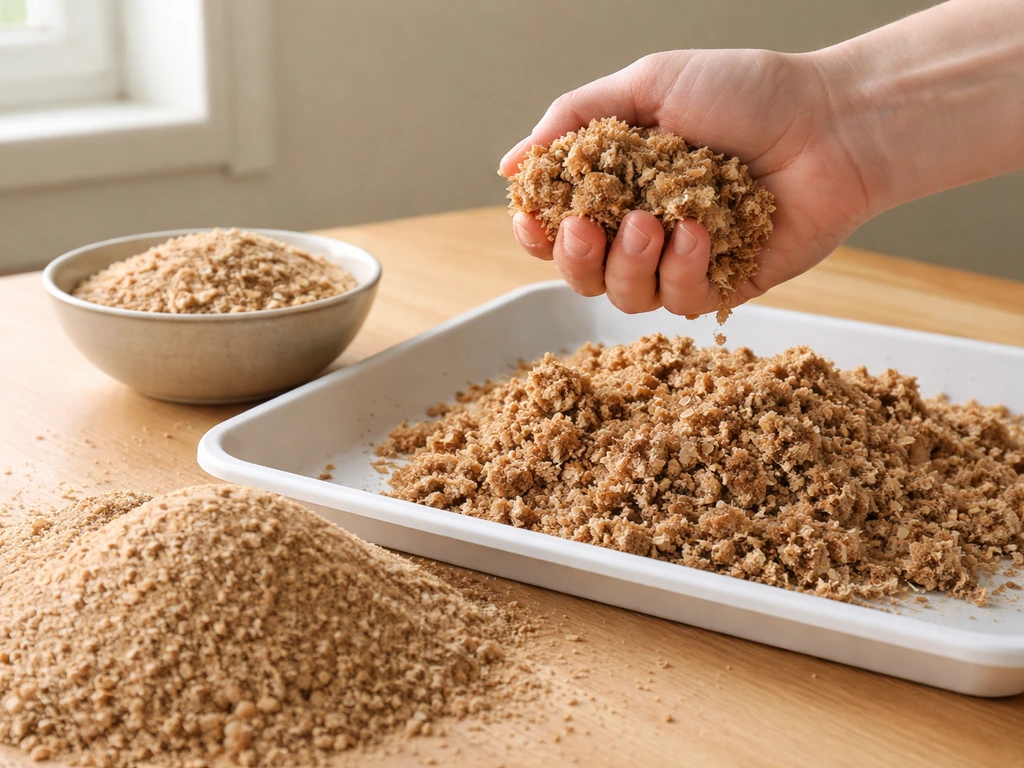
Lingzhi is a wood-rotting fungus that strongly prefers hardwood. Oak sawdust is the gold standard, but you can also use supplemented mango, beech, alder, or mixed hardwood sawdust. Softwood sawdust from conifers (pine, fir) contains terpenes and resins that can inhibit colonization, so avoid them or use only in small amounts (under 20%). A well-tested substrate formula is 80% oak sawdust and 20% wheat bran by dry weight. The wheat bran adds nitrogen and carbohydrates that accelerate colonization, but it also raises contamination risk, which is why you must sterilize, not just pasteurize.
Target moisture content is 60 to 70%. To check this without a meter, take a handful of mixed substrate and squeeze hard. A few drops of water should drip out; if water streams out freely, it is too wet. If nothing drips and the substrate falls apart when you open your hand, it is too dry. This squeeze test is an imperfect but practical field check. Once you hit the right moisture, you are ready to fill bags and sterilize.
Sterilization, not pasteurization
Because reishi is a slow colonizer and the substrate is supplemented (wheat bran raises the nutrient level and contamination risk), you must fully sterilize. Pasteurization is not sufficient for supplemented hardwood sawdust. Use a pressure cooker or pressure canner at 15 PSI (121°C / 250°F) for a minimum of two hours. For larger loads or denser bags, go up to two and a half hours. Let the bags cool completely to room temperature (ideally below 25°C / 77°F) before inoculating. This cooling step is critical; hot substrate will kill your spawn.
Inoculation and incubation
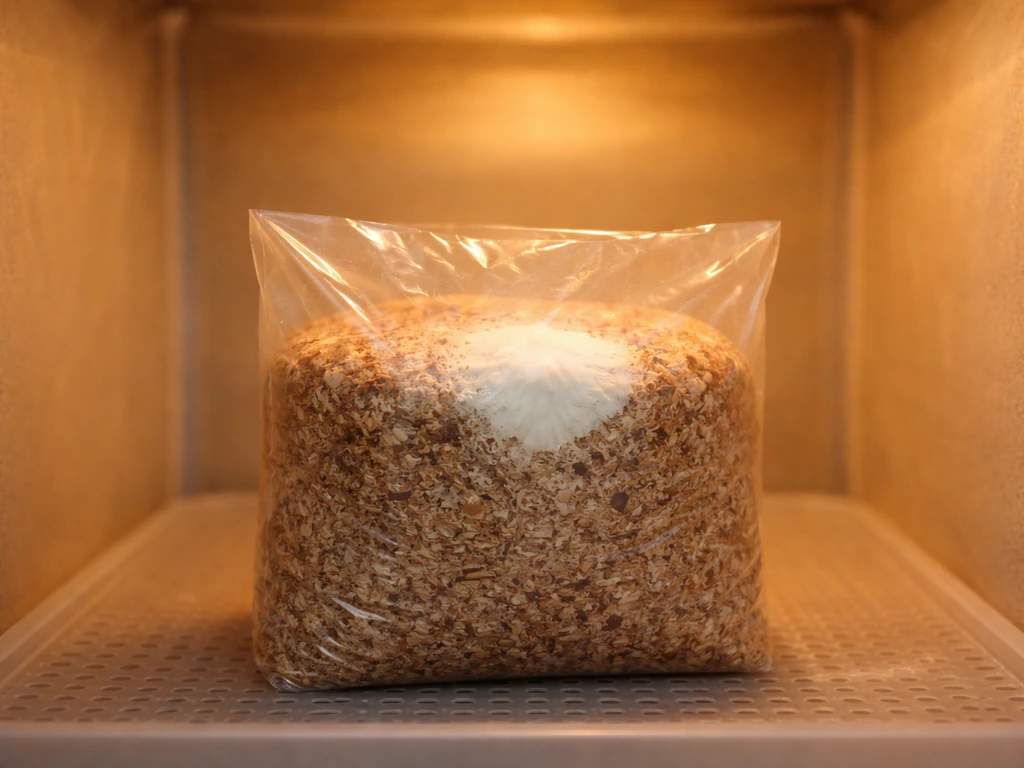
Sterility during inoculation is non-negotiable. Wipe your work surface with 70% isopropyl alcohol, flame-sterilize your scalpel or needle between transfers, and work as quickly and cleanly as possible. Still-air boxes (a clear plastic tote with arm holes cut in) work well for home growers who do not have a flow hood. If you are using grain spawn, add roughly 10 to 15% spawn by weight relative to the substrate. Seal the bags immediately after inoculating using a gas-exchange filter patch or a loose polyfill plug that allows CO2 out without letting contaminants in.
During incubation, reishi wants warmth. The target incubation temperature is 24 to 29°C (75 to 84°F). Below 20°C the mycelium crawls along at a frustrating pace. You do not need high humidity during incubation since the sealed bag maintains its own moisture; just keep the environment warm and dark. Colonization of a fully supplemented sawdust block typically takes six to twelve weeks. Reishi is genuinely slow compared to oyster mushrooms or king stropharia. The mycelium will appear white and fairly stringy, and it may show orange-brown metabolite drops (called 'reishi juice') which is normal and not contamination.
Check your bags regularly during the first two weeks. Contamination usually reveals itself early, within the first one to two weeks, as green (Trichoderma), black, or orange patches that are distinctly not white mycelium. If contamination appears, remove that bag from your incubation area immediately to prevent spores from spreading to healthy bags.
Setting up for fruiting
Once your block is fully colonized (the whole substrate looks white and feels firm), it is time to switch to fruiting conditions. This transition is the trigger. Move the block to your fruiting chamber, open or cut the bag to expose the colonized surface, and dial in the environment. Reishi needs a meaningful shift in conditions to start pinning.
| Parameter | Incubation | Fruiting |
|---|---|---|
| Temperature | 24–29°C (75–84°F) | 24–29°C (75–80°F) |
| Relative Humidity | Not critical (bag sealed) | 90–100% |
| CO2 | Not critical (bag sealed) | Below 2000 ppm |
| Light | Dark or dim | 500–1000 lux (indirect, 12 hrs/day) |
| Fresh Air Exchange | Minimal (filter patch sufficient) | Regular FAE, 4–6x per day minimum |
Humidity above 90% is critical for normal cap development. If humidity drops, you will get antler-like, elongated growths instead of flat caps. These antler forms happen because reishi is extremely CO2-sensitive: high CO2 causes elongated stipes, while proper fresh air exchange combined with good humidity produces the classic round, flat conk. A grow tent with an ultrasonic humidifier and an automatic humidity controller is the most reliable home setup. You can also mist manually three to four times per day but be consistent because reishi does not forgive neglect in this stage.
Light is genuinely important for reishi, more so than for many other species. It is phototropic, meaning the growing edge orients toward the light source. Aim for 500 to 1000 lux of indirect light on a 12-hour timer. A simple LED shop light or grow light works perfectly. Direct, intense light is not necessary and can stress the fruitbody.
Expect four to eight weeks from the start of fruiting conditions to a harvestable conk. The full fruitbody can take up to two months to completely mature. From inoculation to harvest, budget three to five months total. Subsequent flushes from the same block are generally not reliable: most blocks produce one solid fruiting and then are spent. A few setups (particularly kit-grown blocks) may produce a second smaller flush after a one to two week rest and rehydration period, but do not count on it.
Harvesting, drying, and storing for medicinal quality
The harvest timing window matters a lot for medicinal use. Watch the edge of the growing cap. Reishi has a distinctive white or cream-colored growing margin while it is actively expanding. When this white edge narrows significantly, becomes very thin, and starts to lose its white color, the mushroom is approaching maturity and is ready to harvest.
If you want a step-by-step guide for the whole process, see our full instructions on how to grow chaga mushroom. At full maturity the conk will start releasing a fine reddish-brown spore dust. Harvesting just before or at this stage gives you the best balance of bioactive compound development and manageable spore cleanup. If you wait too long, you get a thick coating of spores everywhere, which is messy and can be a respiratory irritant.
To harvest, twist and pull or cut the conk cleanly at the base of the stipe. Reishi fruitbodies are woody and hard, not soft like gourmet mushrooms, so do not expect the same handling. Fresh reishi should be processed quickly because the high moisture content makes it susceptible to bacterial degradation.
Drying and storage
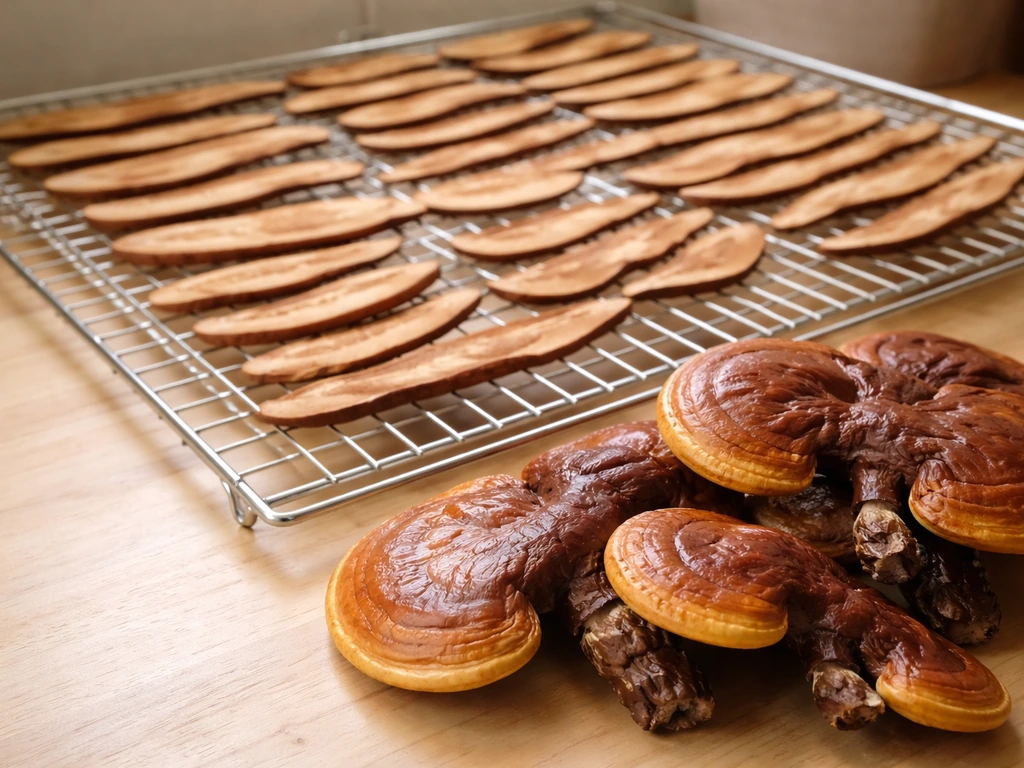
For medicinal-quality use, proper drying is essential. Slice the conk into 5 to 10mm slabs (a bread knife or even a hand saw works for large, dense conks). Dry at 40 to 50°C (104 to 122°F) in a food dehydrator until the pieces are completely hard and snap cleanly with no flex. This usually takes 8 to 12 hours for thin slices, longer for thick pieces. Oven-drying on the lowest setting with the door slightly ajar also works but is less consistent. Do not skip this step: insufficiently dried reishi will mold in storage even if it feels dry to the touch.
Once fully dried, store in an airtight glass jar with a food-grade desiccant packet in a cool, dark location. Properly dried and stored reishi holds its quality for one to two years. Label the jar with the harvest date and strain. If you are making tea or extract, the dried slices can be simmered directly. If you are making powder, grind the dried slices in a spice grinder and store the powder in the same airtight conditions.
Troubleshooting: what went wrong and how to fix it
Contamination
Green mold (Trichoderma) is the most common contamination in reishi grows. It almost always traces back to insufficient sterilization, contaminated spawn, or a break in sterile technique during inoculation. If you see green within the first two weeks, remove and discard the bag. Do not try to cut out the contaminated section since Trichoderma spores spread fast. Review your sterilization time and pressure, and check your spawn source. If contamination is appearing repeatedly, your inoculation environment may be the problem: more alcohol wipes, a cleaner still-air box, or working faster will help.
No growth or very slow colonization
Reishi is slow, so 'no growth' in the first two weeks is normal. If you see nothing after three to four weeks and the block smells clean, the most likely culprit is temperature: your incubation space may be too cool. Reishi really does need 24 to 29°C to colonize at a reasonable pace. A seedling heat mat under the bags can help. Also check that your substrate moisture was in the right range: overly dry substrate colonizes poorly.
Antler growth instead of flat caps
Elongated, antler-like growth with no cap development is a CO2 problem. A study in PubMed found that restricted ventilation, which raises CO2, is linked to the formation of antler-type Ganoderma lucidum fruiting bodies. Your fruiting chamber needs more fresh air exchange. Increase the number of daily ventilation sessions or add a small fan on a timer. Check that your humidity is also staying above 90% because dropping humidity alongside high CO2 compounds the problem. Antler reishi is not waste: it contains similar compounds to cap-form reishi and can still be harvested and dried, but if you want the classic conk shape, fix the airflow.
Block drying out
If your block is losing moisture and the surface looks shrunken or cracked, your fruiting chamber humidity is too low or your fresh air exchange is too aggressive without compensating humidity. Dial back the FAE slightly and increase misting frequency. You can also soak a badly dried-out block in clean, unchlorinated water for a few hours and then return it to fruiting conditions, though this works better as a rehydration between flushes than as a rescue mid-fruiting.
Low yield or no fruiting after full colonization
If the block is fully colonized but pins never appear, the trigger conditions were not sharp enough. Make sure you actually opened the bag or cut an exposure point on the colonized surface: reishi will not pin through sealed plastic. Also confirm you increased humidity above 90% and introduced adequate light. Some growers find that a 24-hour cold shock (dropping temperature to 18 to 20°C briefly) helps trigger pinning, though reishi is less cold-dependent in this way than oyster mushrooms.
Suspicious species identity
If your conks look wrong (wrong color, texture, or spore print), circle back to your spawn source. As noted earlier, commercial reishi products and even some spawn suppliers have species identity problems. If you want verified G. lucidum, buy from a supplier who provides documented strain information. Growing verified cultures matters especially if you are growing for medicinal use, since the bioactive profiles of different laccate Ganoderma species vary.
Your next steps
If you are ready to start, here is a practical action list to move forward today:
- Order verified G. lucidum grain spawn or liquid culture from a reputable domestic supplier. Ask for the strain name and any culture documentation.
- Source hardwood sawdust (oak is ideal) and wheat bran, aiming for an 80/20 mix by dry weight.
- Mix your substrate to 60 to 70% moisture, fill polypropylene grow bags, and sterilize at 15 PSI for at least two hours.
- Set up a warm incubation space at 24 to 29°C, inoculate under sterile conditions, and seal the bags.
- Wait six to twelve weeks during colonization. Check weekly for contamination but otherwise leave the bags alone.
- Once fully colonized, move to your fruiting chamber. Set humidity to 90 to 100%, temperature to 24 to 29°C, CO2 below 2000 ppm, and light at 500 to 1000 lux on a 12-hour timer.
- Harvest when the white growing edge thins and disappears. Slice and dry thoroughly at 40 to 50°C before storing in an airtight jar.
Lingzhi rewards patience more than most mushrooms you will grow. Monkshood is a totally different plant than reishi, and learning its specific cold and moisture needs is key to success how to grow monkshood. It is not the species to start with if you want fast results, but if you want a genuinely medicinal mushroom you grew yourself, the process is straightforward once you understand what the species needs at each stage.
If you are wondering how to grow Ganoderma mushroom at home, the most important parts are choosing verified culture, using a hardwood-based sterilized substrate, and dialing in fruiting humidity and fresh air exchange. If you are also interested in other slow-growing medicinal species, the cultivation approach for reishi shares some similarities with growing cordyceps and chaga, though each of those has its own specific substrate and environmental requirements worth understanding separately before diving in.
If you want the home process for cordyceps specifically, follow a dedicated guide on how to grow cordyceps at home for the right substrate and incubation conditions. If you are also curious about how to grow chaga, you will want to focus on its specific substrate and colder, more natural conditions compared with reishi. If you want the details on how to grow chaga mushroom, check the section on its specific substrate and colder, more natural conditions.
If you specifically want to grow chanterelle mushrooms, you will need a different setup focused on ectomycorrhizal partners, soil or specialized substrates, and seasonal conditions.
FAQ
Can I grow lingzhi from a spore print or dried reishi I find at the store?
You generally should not. For home cultivation, reishi is usually grown from verified mycelial cultures (grain spawn or agar/liquid culture). Starting from spores or unknown dried material often leads to inconsistent strains, long timelines, and a high chance of mislabeled Ganoderma species, which matters a lot for medicinal outcomes.
What’s the safest way to tell if my moldy bag is contamination or just “reishi juice”?
“Reishi juice” is typically orange-brown metabolite drops and occurs on otherwise healthy, actively colonizing tissue. Green patches (especially Trichoderma), black/inky growth, and brightly colored blotches (orange, pink, or unusual multicolor colonies) indicate true contamination. If anything green appears within the first couple of weeks, remove the entire bag promptly.
My bags fully colonized, but the conks are small or they never really form flat caps. What did I probably get wrong?
The most common causes are not enough fresh air exchange or humidity dips during fruiting. High CO2 leads to antler-like, elongated growth instead of flat conks. Make sure fruiting humidity stays above 90%, and increase ventilation in short, frequent bursts rather than leaving the chamber stagnant.
How do I avoid drying out the substrate during incubation or fruiting?
During incubation, sealed bags usually maintain moisture, so focus on correct initial moisture (the squeeze test). During fruiting, the issue is more about chamber stability. If you see surface shrinkage or cracking, raise humidity and reduce overly aggressive fresh-air exchange, then mist consistently (missing mist cycles can still ruin cap development).
Should I reuse spent blocks for another harvest?
Usually no. Reishi blocks typically produce one solid fruiting and then become spent. Some setups may give a second smaller flush after a rest and rehydration period, but it is not reliable. If you try for a second flush, rehydration works best when the block is still structurally intact and the environment stays clean.
Is it okay to harvest before the spore dust starts releasing?
Yes, and in many cases it’s preferred. Harvest when the white or cream growing margin narrows and starts losing its white color, before heavy spore release coats everything. Waiting too long increases cleanup time and can make the area dusty and irritating, especially if you dry indoors.
What happens if I inoculate before the sterilized bags cool completely?
It can kill or stress the spawn. Always cool to below about 25°C (77°F) before inoculation, otherwise colonization may stall or fail. If you suspect you overheated the substrate, don’t “fix it later,” the damage is usually done at the time of inoculation.
How do I reduce contamination when my spawn smells fine but my bags fail anyway?
Spawn can be clean, yet contamination still happens during inoculation. Work faster, wipe surfaces with 70% isopropyl alcohol, sterilize tools between transfers, and use a still-air box. Also double-check pressure and timing for sterilization, since supplemented hardwood sawdust needs true sterilization, not just pasteurization.
Do I need light intensity for lingzhi, and can I use only darkness?
Light matters. Reishi is phototropic, and without adequate indirect light it may develop poorly or orient growth oddly. Use roughly 500 to 1000 lux on a 12-hour timer, and avoid direct intense light that can stress fruitbodies.
What’s the best way to dry lingzhi to prevent mold during storage?
Aim for complete hardness and a clean snap, not just a “dry to the touch” state. Slice thin (about 5 to 10mm) for more even drying, dry around 40 to 50°C, then store in an airtight glass jar with a desiccant packet in a cool, dark place. If pieces retain any flex, they can mold in storage even after they seem mostly dry.
Can I harvest antler-shaped reishi and use it medicinally?
Yes. Antler-like growth can still contain similar bioactive compounds to cap-form conks, and you can dry it and process it the same way. If you want classic conks next time, fix CO2 and airflow first, then maintain humidity above 90% during the entire pinning and expansion period.
Is a second flush ever worth trying, and how should I prepare the block?
It can be worth a small experiment, but treat it as optional. Give the block a rest and rehydration period, then reintroduce fruiting triggers (high humidity and fresh air exchange). If pins never appear, review whether you truly opened the bag or cut exposure points, since reishi will not pin through sealed plastic.
Can I grow lingzhi outdoors instead of indoors, and what’s the tradeoff?
Outdoor cultivation on logs or stumps is possible and often low maintenance, but it is slow. First fruiting can take 12 to 18 months, and you have less control over humidity and temperature swings. Indoors is usually better if you want predictable results and a clear schedule.