
You can absolutely grow cordyceps at home, but the species matters enormously. Cordyceps militaris is the one you want: it grows on grain substrates in jars, fruits under blue light, and delivers a harvest in roughly 6 to 10 weeks. The wild Himalayan variety (Ophiocordyceps sinensis) that commands hundreds of dollars per gram? Forget it for home growing. It requires a specific insect host and high-altitude conditions that nobody is replicating in a spare bedroom. Stick with C. militaris and you have a genuinely achievable home grow project.
How to Grow Cordyceps at Home: Cordyceps Militaris Guide
Marcus Holloway
14 May 2026
Is Cordyceps militaris the right species (and what you can expect at home)
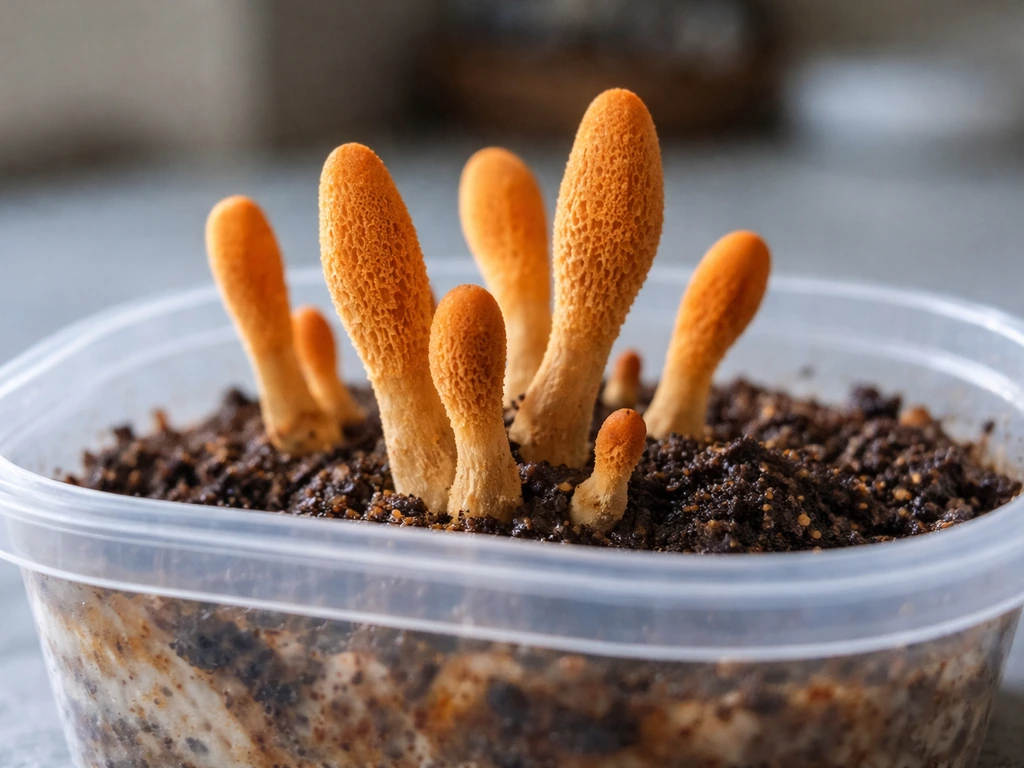
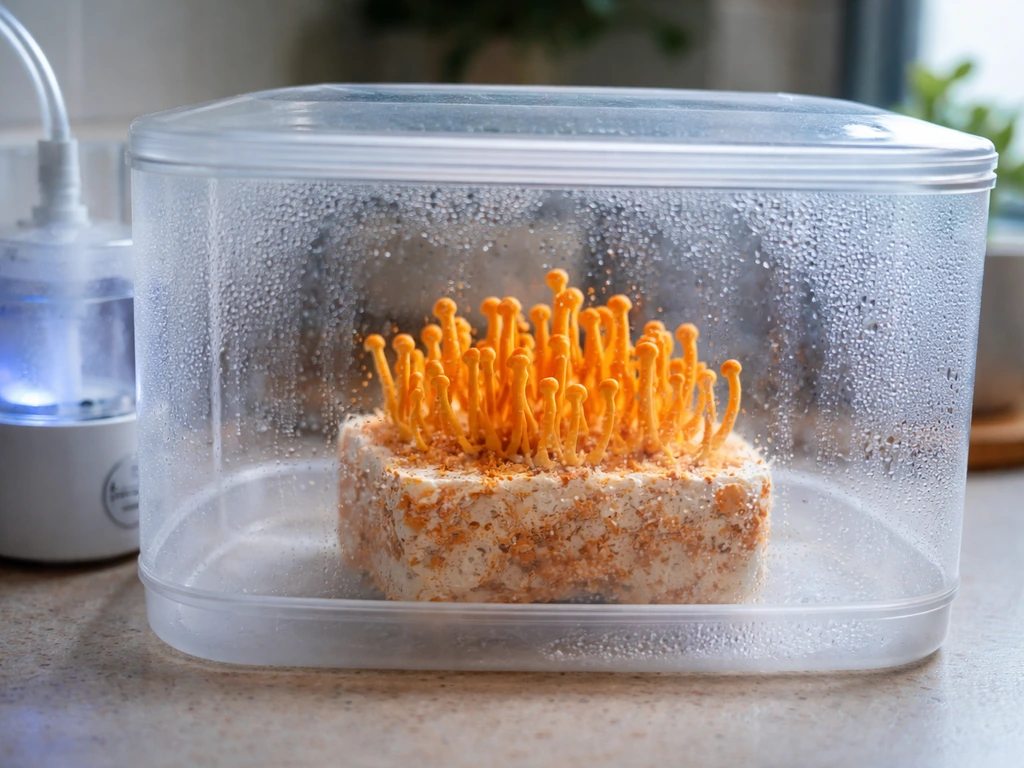
Cordyceps militaris is the cultivated cordyceps. It produces the orange-gold club-shaped fruiting bodies (called stroma) that you see in extracts and supplements, and it contains the same key bioactive compounds, including cordycepin, that make cordyceps medicinally interesting. Brown rice substrate studies have reported cordycepin yields of around 814 mg per gram of dried fruiting body, which is genuinely comparable to what commercial growers target.
Realistically, a beginner home grower working with pint jars can expect roughly 2 to 5 grams of dried fruiting bodies per jar per cycle. That is not a huge haul, but it is real, usable cordyceps that you grew yourself. The stroma will turn a vivid orange-yellow as they mature, which is one of the more satisfying sights in home mushroom cultivation. The total timeline from inoculation to harvest runs about 6 to 10 weeks, split between a colonization phase and a fruiting phase. More on those timelines below.
One honest caveat: C. militaris is more demanding than oyster mushrooms or lion's mane. It needs light (specific light, not just ambient), precise temperatures, and a sterile substrate. If you have grown other mushrooms before, you already have most of the skills. If this is your first grow, it is doable, but plan for a learning curve on your first or second cycle.
Materials and setup checklist for an at-home grow
Before you start, get everything lined up. Running out of something mid-process is a contamination risk waiting to happen.
- Pressure cooker or autoclave (capable of reaching 121°C / 15 psi) — this is non-negotiable for substrate sterilization
- Wide-mouth pint mason jars with modified lids (polyfill or Tyvek filter patch for gas exchange)
- Cordyceps militaris liquid culture or agar culture from a reputable supplier — liquid culture is the easiest starting point for beginners
- Brown rice (long grain or short grain both work) or pearl barley as substrate
- A still air box (SAB) or laminar flow hood for inoculation
- Isopropyl alcohol (70%) and a still flame or alcohol lamp for flame-sterilizing tools
- A grow chamber: a clear plastic tub, a martha tent, or even a dedicated small shelf with humidity control works fine
- Blue LED grow light or a blue-dominant LED strip capable of delivering 500 to 1,000 lux at jar surface
- A thermometer/hygrometer combo
- A small ultrasonic humidifier or a humidity controller with a humidistat
- A small fan for air circulation (not blowing directly on jars)
You do not need a full lab setup. A pressure cooker from the kitchen, a clear tote from a hardware store, and a cheap LED grow light will get you there. The one thing you genuinely cannot skip is the pressure cooker. Pasteurization is not sufficient for cordyceps substrate, you need full sterilization at 121°C and 15 psi, and anything less is a Trichoderma invitation.
Substrate selection and preparation for Cordyceps militaris
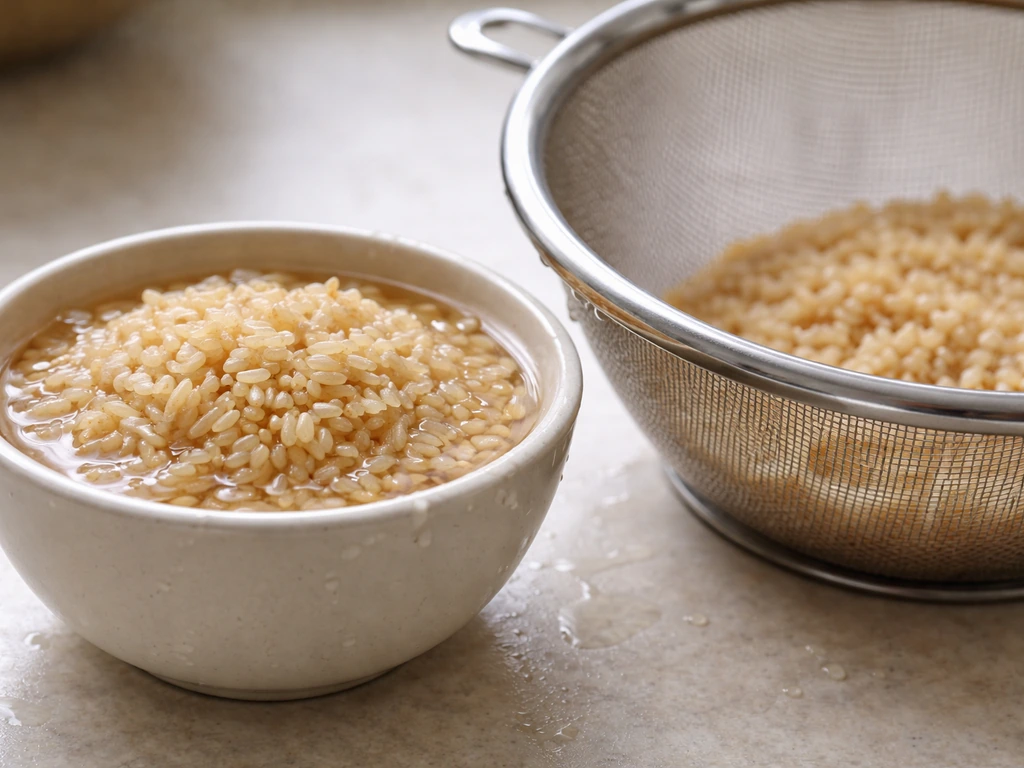
Brown rice is the standout substrate for home C. militaris grows. Research comparing grain types found brown rice consistently outperforms wheat and oats for both fruiting body mass and cordycepin content. Pearl barley is a solid backup if you cannot source brown rice, and some growers add a small amount of a nitrogen supplement (around 1% by weight of something like nutritional yeast or peptone) to push yields, though plain brown rice works well on its own for a first grow.
How to prepare and sterilize your substrate
- Rinse your brown rice in cold water until the water runs clear, then soak it for 30 to 60 minutes.
- Drain thoroughly and allow to surface-dry for 15 to 20 minutes — you want moist grains, not wet ones. Overly wet grain is a contamination magnet.
- Fill pint jars to about two-thirds capacity, leaving headspace for mycelium growth and gas exchange.
- Loosely cap with a modified lid (polyfill plug or Tyvek patch covered by a foil flap) to allow pressure equalization during sterilization.
- Load jars into your pressure cooker and sterilize at 121°C / 15 psi for 90 to 120 minutes. Some protocols use shorter times (50 minutes for small jars), but 90 minutes is a safe target for home growers who cannot verify their pressure cooker's accuracy.
- Allow jars to cool completely to room temperature (at least 4 to 6 hours, or overnight) before inoculating. Inoculating warm jars kills your culture and risks condensation contamination.
One thing I learned the hard way: do not rush the cooling step. I once inoculated a jar that felt cool on the outside but was still warm inside, and the culture died. The grain should feel room temperature or slightly cool when you touch the outside of the jar before you proceed.
Spawning/starting the culture and colonization steps
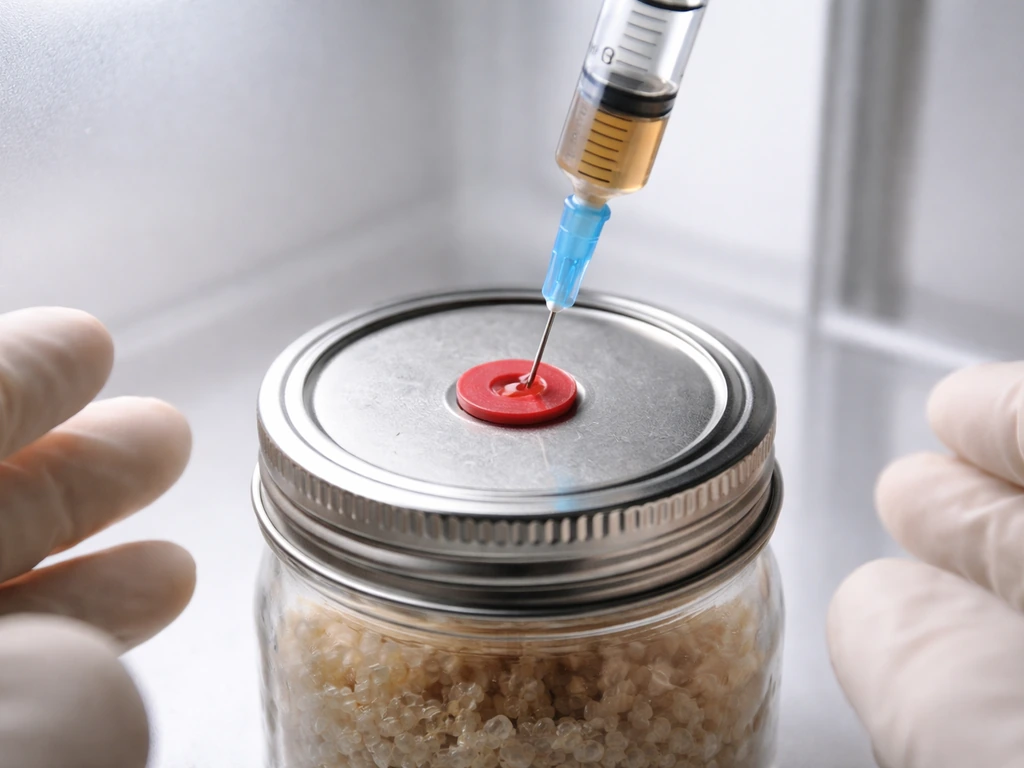
Liquid culture syringes are the most beginner-friendly starting point. They let you inoculate directly through a self-healing injection port (or through a polyfill lid) without opening the jar. If you are working from an agar wedge, you will need to transfer into the jar inside a still air box or flow hood, which adds a step but is very manageable.
Inoculation process
- Wipe down your still air box or flow hood surface with 70% isopropyl alcohol and let it evaporate for a few minutes before starting.
- Flame-sterilize your inoculation needle until it glows red, then let it cool for 10 seconds before it contacts anything.
- Wipe the injection port or lid with alcohol before puncturing.
- Inject 2 to 4 mL of liquid culture per pint jar, distributing across the grain surface if possible.
- Gently shake or swirl the jar to distribute the inoculant.
- Label with the date and strain, then move to your colonization space.
Colonization conditions and timeline
During colonization, C. militaris wants darkness and stable warmth. Keep jars in a dark location at 18 to 22°C (65 to 72°F). At 20°C, expect full colonization in 2 to 4 weeks. You will see white mycelium spreading through the grain, sometimes with faint yellowish tinges as it matures. Do not disturb the jars during this phase, just check on them periodically for signs of contamination (green, black, or pink patches, or foul smells).
Resist the urge to add light during colonization. Light is the trigger for the vegetative-to-fruiting transition, and introducing it too early disrupts colonization. Wait until the grain is fully covered with mycelium before flipping to fruiting conditions.
Fruiting/production conditions and how to manage the environment
Once colonization is complete, it is time to initiate fruiting. This phase lasts 3 to 6 weeks and requires several deliberate environmental changes from the colonization setup. Getting these right is what separates a jar full of mycelium from a jar full of orange clubs. If you are specifically looking for how to grow monkshood, focus on its preferred growing conditions and consistent moisture rather than the indoor timing used for cordyceps orange clubs. If you are wondering how to grow chanterelle mushrooms, the key is to match their outdoor-style conditions and provide the right substrate and moisture orange clubs.
| Parameter | Colonization Phase | Fruiting Phase |
|---|---|---|
| Temperature | 18–22°C (65–72°F) | 16–20°C (61–68°F) |
| Light | Complete darkness | 12 hrs on / 12 hrs off, blue or blue-red LED, 500–1,000 lux at jar surface |
| Humidity (RH) | 60–70% ambient | 80–90% RH |
| Fresh air exchange | Minimal (filter lids provide passive exchange) | Daily or twice-daily exchange; gentle fan circulation |
| CO2 level | Moderate acceptable | Low — excess CO2 stunts club development |
Light: the most critical fruiting trigger
C. militaris has a blue-light photoreceptor that drives the vegetative-to-fruiting transition. Blue light is not optional here, it is physiologically required. A blue LED grow strip or a blue-dominant white LED providing 500 to 1,000 lux at the surface of your jars, on a 12-hour on / 12-hour off timer, is the standard approach. If your clubs are coming out pale, thin, or barely forming, light intensity is usually the first thing to check and correct.
Humidity and fresh air exchange
High humidity (80 to 90% RH) keeps the stroma from drying out as they elongate. An ultrasonic humidifier connected to a humidistat is the cleanest way to maintain this. At the same time, you need regular fresh air exchange to prevent CO2 buildup. Stale, CO2-rich air is one of the main reasons clubs abort mid-development or stay short and stunted. Open your chamber for a few minutes twice a day, or run a small fan on a timer to pull in fresh air. Just do not blast the clubs directly with high-velocity airflow, gentle circulation is the goal.
Temperature during fruiting
Drop the temperature slightly for fruiting compared to colonization. The 16 to 20°C range is the sweet spot. Temperatures above 22°C during fruiting can cause poor morphology and reduced yields. If your grow space runs warm in summer, a small air conditioner or a basement location helps. This temperature drop also mimics the seasonal cue that triggers outdoor cordyceps fruiting, so it works with the biology, not against it.
Harvesting, cleanup, and repeat grow workflow
Harvest when the stroma (clubs) are fully elongated and the tips are starting to show a slightly darker or more developed coloration, before the stroma begins to deteriorate or release spores. Twist or cut them at the base with clean scissors. For a pint jar, expect 2 to 5 grams of dried material per cycle, depending on your strain, substrate nutrition, and environmental precision.
Fresh C. militaris fruiting bodies contain over 80% moisture, so they are perishable. Use them fresh within 1 to 2 days, or dry them at 35 to 45°C in a food dehydrator until completely brittle, then store in an airtight jar away from light and humidity. Dried cordyceps stored this way will keep for months.
Running a second flush or second cycle
After the first harvest, some growers get a second flush from the same jar by returning it to fruiting conditions with continued humidity and light management. Yields on second flushes are typically lower. If the grain substrate looks exhausted or contamination appears, retire the jar, sterilize it, and start fresh. Because C. militaris cycles are relatively quick (6 to 10 weeks), you can easily run 4 to 6 cycles per year and dial in your process with each one. Consider staggering multiple jars inoculated a week apart so you have rolling harvests rather than one large batch.
Troubleshooting common problems (contamination, no growth, weak yields)
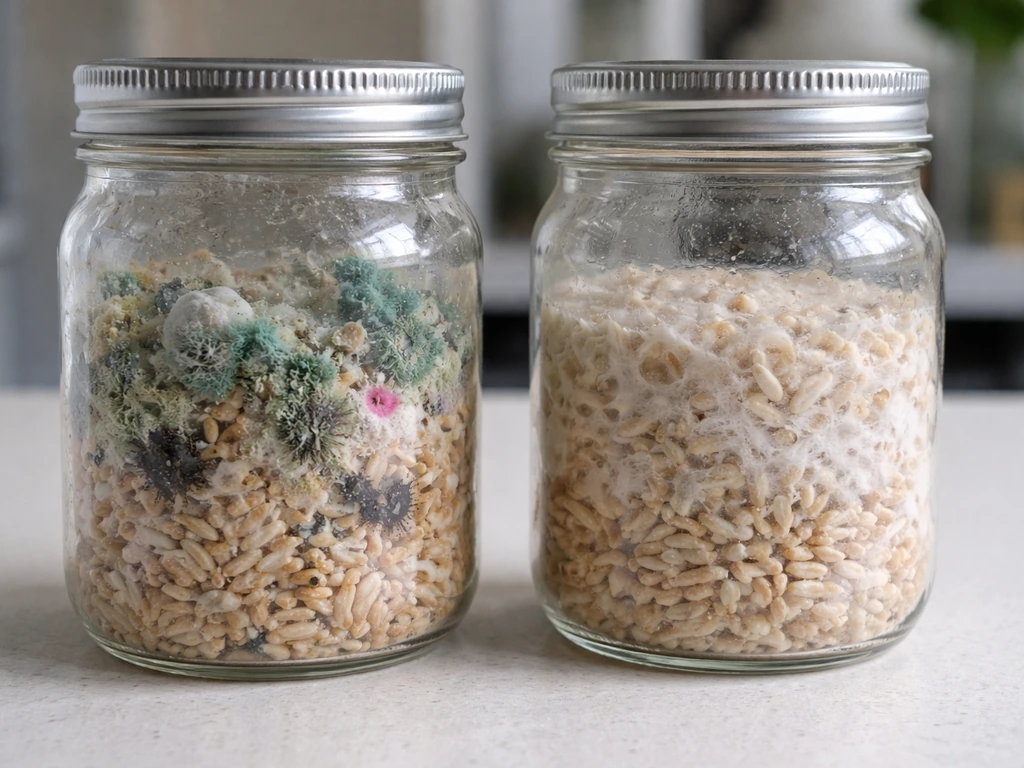
Contamination (green, black, or pink mold)
Trichoderma is the most notorious contaminant in cultivated C. militaris, including Trichoderma gamsii, which has been identified as a pathogen specifically targeting C. militaris grows. It shows up as green patches and spreads aggressively. If you see it, isolate the jar immediately in a sealed bag and dispose of it outside your grow space. Do not open a contaminated jar inside your grow area. Prevention comes down to three things: thorough sterilization (90 to 120 minutes at 15 psi, no shortcuts), clean inoculation technique (still air box or flow hood, alcohol-wiped surfaces), and not over-watering or over-humidifying your substrate preparation.
No growth or very slow colonization
If you see no mycelial growth after 2 weeks, first check that your culture is actually viable. Old or poorly stored liquid culture can die before you use it. The fix is to source fresh culture from a reputable supplier and store it in the fridge (not frozen) until use. Also verify your temperature: below 16°C, colonization slows dramatically. If your substrate looks very dry, the grain may have been too dry going in, aim for moisture-rich but not wet grain next time.
No fruiting bodies forming after colonization
This is almost always a light problem. Check that your LED is actually delivering blue wavelengths (cool white LEDs with a strong blue peak work; warm white LEDs do not). Measure lux at the jar surface if you can, you need at least 500 lux. Also confirm you are on a 12/12 photoperiod and that the temperature has dropped into the 16 to 20°C fruiting range. Sometimes just relocating jars closer to the light source fixes the problem.
Thin, pale, or aborted clubs
Thin or poorly colored stroma usually point to one of three issues: CO2 buildup (increase your fresh air exchange immediately), temperature running too high (above 22°C), or light intensity being too low. Check all three before assuming your substrate or culture is the problem. Pale clubs that are otherwise growing normally often deepen in color when light intensity is increased.
Mycelium but no clubs even after 3 to 4 weeks in fruiting conditions
Occasionally a jar colonizes fully but just refuses to fruit. This can happen with older or less-vigorous cultures, or if the substrate dried out significantly during colonization. Try misting the inside of the jar lid (not the substrate surface directly) to raise localized humidity, and double-check your light and temperature parameters. If it still does not fruit after another week, that jar is probably not going to perform well, make a note for next time and move on.
Growing cordyceps at home is a genuinely rewarding project once you understand what the fungus actually needs: sterilized grain, a dark colonization phase, then a well-lit, humid, CO2-managed fruiting chamber. Get those fundamentals right and the orange clubs take care of themselves. If you are interested in other medicinal and specialty species, some growers who tackle C. militaris also explore ganoderma (reishi) and chaga cultivation, which have their own substrate and environmental requirements worth comparing.
Chaga is a different medicinal mushroom, so its substrate and environmental needs are not the same as cordyceps chaga cultivation. If you are also looking for how to grow chaga, the setup is different from cordyceps and starts with the right host and substrate chaga cultivation. If you are also wondering how to grow ganoderma lucidum (reishi), the substrate and fruiting conditions will differ from cordyceps ganoderma (reishi).
If you want to go beyond cordyceps and learn how to grow lingzhi mushroom (reishi) at home, you can compare its different substrate and fruiting needs to what you are already doing. If you want to grow ganoderma mushroom (reishi) too, you will need to shift to the right wood-based substrate and a different set of humidity and fresh-air targets ganoderma (reishi).
Start with one cycle, document your conditions, and you will know exactly what to adjust by the time you load up your second batch of jars.
FAQ
Can I grow cordyceps at home without a pressure cooker by using “pasteurized” substrate instead?
For C. militaris, you really should not treat pasteurization as a substitute. The substrate needs full sterilization at 121°C (15 psi) because Trichoderma can survive milder heat and then outcompete your culture. If you cannot run a pressure cooker, use a different species or wait until you can sterilize properly.
What jar size and number should I start with for how to grow cordyceps at home?
Begin with pint jars and 2 to 4 jars per batch. Smaller batch sizes make contamination failures less painful, and they give you a clear baseline for how your room temperature, light placement, and fresh-air setup perform. Once you get consistent colonization and fruiting, scale up.
How do I know if my culture syringe is still viable when nothing happens after 2 weeks?
Old liquid culture can die silently. Besides sourcing fresher culture, check storage conditions (refrigerated, not frozen, and not held warm for days). Also confirm your colonization temperature is at least 18°C, because cold rooms can stall growth even with viable spores or mycelium.
Do I need to open the jars during inoculation or during colonization?
During colonization, avoid opening jars since every opening increases contamination risk. If you start from liquid culture, inject through a self-healing port or polyfill lid so you can keep everything sealed. If you do transfers from agar, use a still-air box or flow hood and minimize how long jars stay open.
What’s the right way to handle jar cooling before inoculating when the outside feels room temperature?
Feel is not enough. Jars can be cool on the outside while the grain center is still too warm, and that can kill the culture. Let jars cool fully to room temperature, then proceed. If unsure, wait longer before inoculating.
Can I substitute a different grain if brown rice is hard to find?
Brown rice is the best first choice, but pearl barley is a workable backup. If you must experiment, keep the first run simple, because different grains can change colonization speed, moisture behavior, and how consistently you get orange-gold stroma and cordycepin output.
What if my stroma is forming but it’s pale, thin, or barely growing?
Check three variables in order: blue light reaching the jars (target at least 500 lux at the surface), a 12-hour on or 12-hour off schedule, and fruiting temperature (16 to 20°C). Pale clubs often improve once light intensity and timing are corrected, even if the substrate looks healthy.
Why do my jars colonize fully but never fruit?
Common causes include light introduced too early or wrong lighting later, too much CO2 buildup, or fruiting temperature not actually dropping into the 16 to 20°C window. If colonization is complete, confirm your chamber is set up for humidity plus fresh air exchange and only then adjust light and temperature together.
How should I manage humidity without over-wetting or causing contamination?
Aim for high humidity (about 80 to 90% RH) in the fruiting area, but do not pour water onto grain surfaces. Keep humidity in the chamber using an ultrasonic humidifier with a humidistat if possible. Over-wetting the substrate can increase contamination and can also lead to poor morphology.
Is fresh air exchange really necessary, and how much airflow is “safe”?
Yes, fresh air exchange matters because CO2 buildup is a major reason clubs abort or become stunted. Use gentle circulation, timers, or brief chamber openings to refresh air, avoid blasting the stroma directly with high-velocity airflow, since drying and surface disruption can happen quickly.
When is the best time to harvest how to grow cordyceps at home?
Harvest when the stroma are fully elongated and the tips show more developed, slightly darker coloration, before they start deteriorating or releasing spores. Use clean scissors or twist at the base. Waiting too long increases spoilage risk and can reduce quality for drying.
What should I do with fresh fruiting bodies, and how quickly can I dry them?
Fresh cordyceps are perishable due to high moisture content. Use them within 1 to 2 days, then dry at 35 to 45°C until brittle. Store dried product in an airtight container away from light and humidity to avoid flavor and potency loss.
Can I get a second flush from the same jar every time?
Sometimes, but yields are usually lower, and it depends on whether the substrate is still viable and contamination-free. For a second flush, return to the same fruiting conditions (light, humidity, fresh air, and the fruiting temperature range). If the grain looks exhausted or you see contamination, retire the jar.
What are the most common mistakes that lead to Trichoderma in C. militaris grows?
Most outbreaks come from rushed sterilization, poor inoculation technique, or fruiting setups that create wet, stale conditions. Sterilize fully at 121°C (15 psi) without shortcuts, keep work clean with wiped surfaces and a still-air or flow hood when opening is unavoidable, and avoid over-humidifying the substrate itself.
How can I prevent “no light” problems when learning how to grow cordyceps at home?
Verify your light source actually provides a blue component, warm-white LEDs are often insufficient even if they look bright. Measure or estimate lux at the jar surface, and confirm a 12/12 photoperiod. If clubs are pale, thin, or delayed, moving the jars closer to the light often fixes it before you change anything else.