
On a prepared indoor substrate bag, turkey tail mushrooms typically take 2 to 4 weeks from pinning to first harvest, with colonization adding another 4 to 8 weeks beforehand depending on conditions. Outdoors on logs, the picture is completely different: expect a spawn run of 9 to 18 months before fruiting even begins, and then roughly 3 months from pinning to harvestable brackets. Those two timelines are so different that the most common confusion is just people comparing the wrong clock to their setup. Pin down which method you are using first, and the rest makes sense.
How Long Does It Take to Grow Turkey Tail Mushrooms
Marcus Holloway
31 May 2026
What 'growing' actually means in the timeline
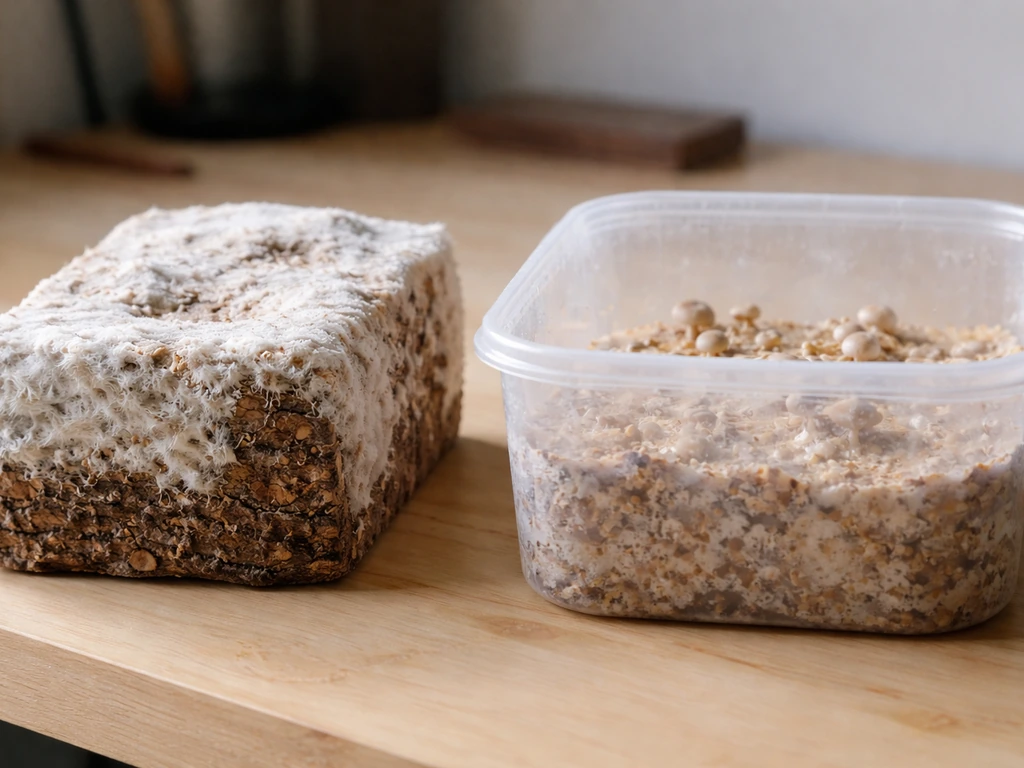
Turkey tail growth happens in two completely separate phases, and mixing them up is the number one reason growers think something is wrong when nothing actually is. If you are wondering how long it takes to grow mushrooms, it helps to identify whether you are in colonization or fruiting first. The first phase is colonization (also called the spawn run or incubation). This is when the mycelium is silently spreading through the substrate. You will not see mushrooms.
You will not even see much if the substrate is inside a bag. This phase is entirely about the white fungal network taking over the wood. The second phase is fruiting, which is when environmental conditions shift and the mycelium forms primordia (pins) and then develops into the fan-shaped brackets you are after. Both phases have their own timelines, their own ideal conditions, and their own failure modes.
When someone asks how long turkey tail takes to grow, they usually mean the whole thing from inoculation to harvest, so that is how this guide frames it, but you need to understand where you are in the process to troubleshoot correctly.
The Svamphuset/ABICART Turkey Tail plug and dowel instruction sheet also notes that the time from inoculation to the first harvest differs depending on the chosen wood and climate, rather than being a single universal number time from inoculation to first harvest.
If you want a more specific estimate, review how long turkey tail takes from inoculation to the first harvest for indoor bags versus outdoor logs.
Typical timeline to first pins by setup and method
The honest answer is that the timeline swings wildly based on your method. Here is a realistic breakdown of what to expect from each common approach.
| Method | Colonization (Spawn Run) | Pinning After Fruiting Conditions | Harvestable Brackets | Total From Inoculation |
|---|---|---|---|---|
| Indoor bag/block (prepared substrate) | 4–8 weeks | 1–3 weeks | 2–4 weeks after pins | ~2–4 months |
| Outdoor log (plug dowels) | 9–18 months | Variable by season | ~3 months after pinning | 12–24+ months |
| Outdoor wood chip bed | 6–12 months | Spring or fall trigger | 2–3 months after pinning | 8–18 months |
| Force fruiting a previously colonized log | Already colonized | 1–3 weeks after cold soak | 2–4 weeks after pins | Weeks from soak |
The Agriallis cultivation research documented a first harvest after just 28 days under optimized lab conditions using their best substrate formulation. That is an outlier, but it tells you what is physically possible when everything lines up. In real home setups, shooting for 8 to 12 weeks total (indoor bag method) is a reasonable expectation. Outdoor log growers should budget at least a year before expecting anything. One documented grow on a sweetgum log showed first fruiting appearing about a year after inoculation, yielding around 3 pounds of turkey tail from a single 26-pound log. Patience is genuinely part of the outdoor process.
Key variables that speed up or slow down growth
Temperature
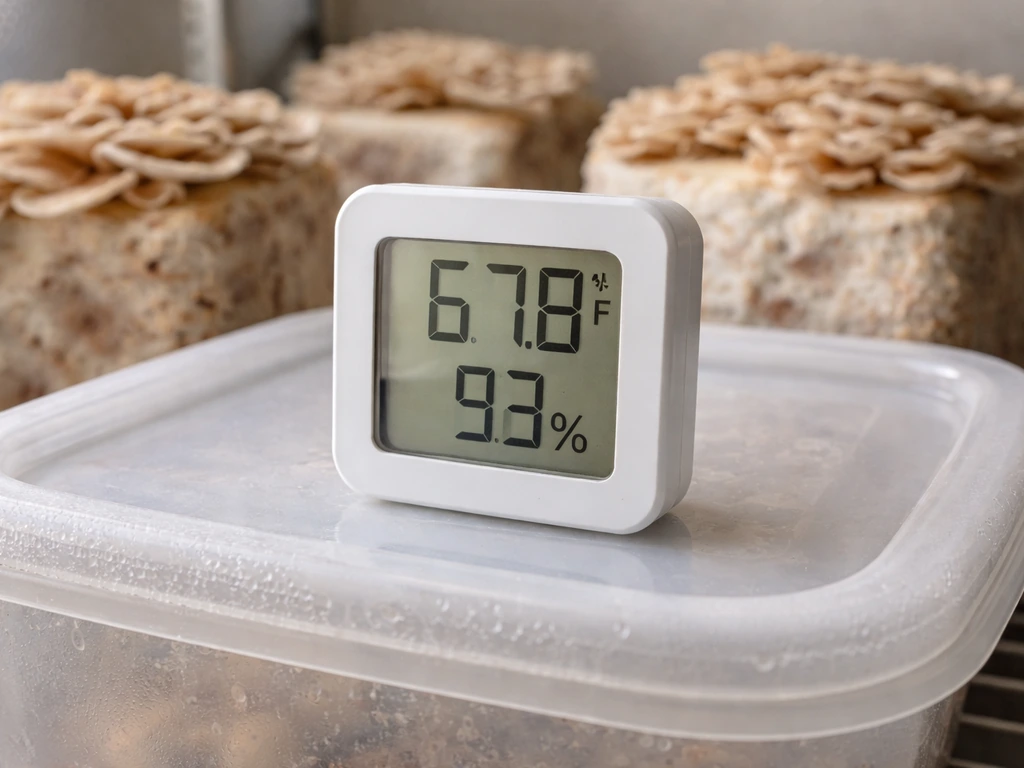
Turkey tail colonizes best between 21 and 27°C (70–80°F). For fruiting, drop to 15–21°C (60–70°F). The Agriallis research used a fruiting target of 20°C plus or minus 10 degrees, which is a wide window but confirms turkey tail is fairly forgiving compared to more finicky species. What kills schedules is temperature inconsistency, not just being a few degrees off. Wild swings stress mycelium and stall colonization. If your grow space dips below 15°C regularly during colonization, add a seedling heat mat under the bag and expect to add 2 to 4 weeks to your timeline.
Moisture and humidity
During fruiting, you want 85 to 95% relative humidity consistently. Both ATTRA's cultivation guidelines and the Agriallis research report this as the target window. Below 80%, pins stall and dry out. Above 97%, you invite contamination. For outdoor logs, the main lever is simply keeping logs shaded and moist, especially during dry spells. Drill holes at 4 cm depth with an 8 mm bit (10 cm apart), plug them with spawn dowels, seal with wax, and then commit to regular watering during dry periods. That moisture maintenance is baked into the timeline.
Fresh air exchange (FAE) and oxygen
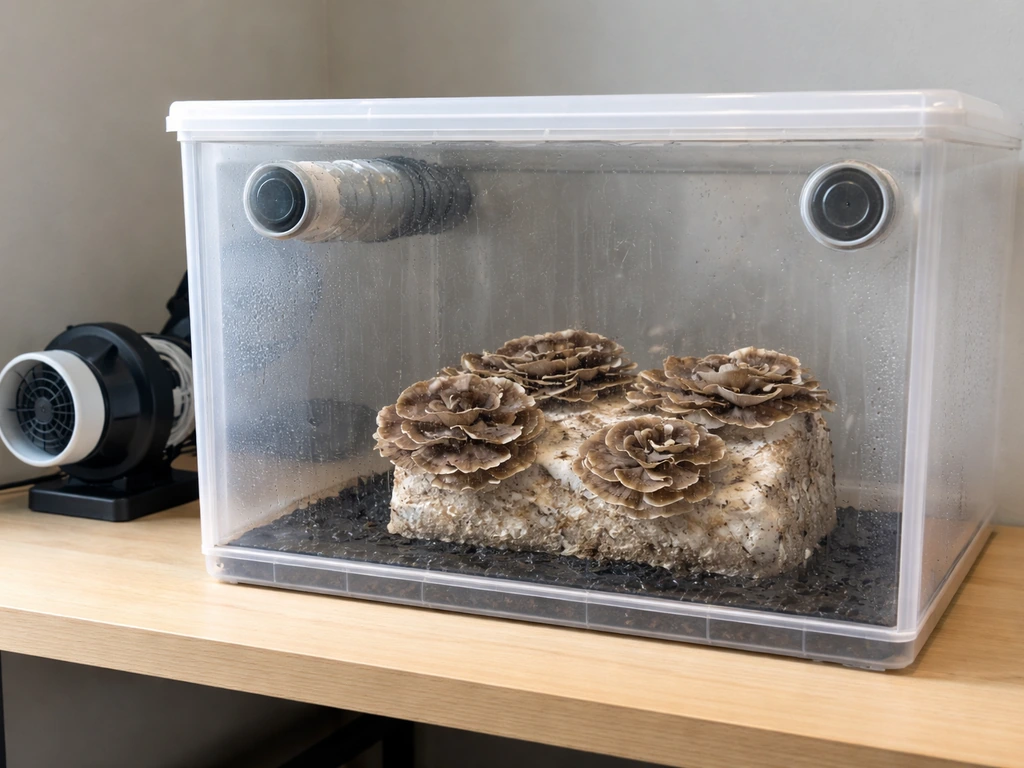
Turkey tail needs good airflow during fruiting more than many species. Stagnant, CO2-heavy air leads to elongated, underdeveloped brackets rather than the beautiful fan-shaped growth you want. Indoors, even a small fan on a timer running a few times per day, pointed away from the block rather than directly at it, makes a real difference. Outdoors this mostly takes care of itself, but avoid setting logs against walls or in enclosed corners where air does not move.
Light
Turkey tail does not need light for colonization, but it needs it for proper fruiting orientation and color development. Aim for 8 to 12 hours of bright indirect light per day during fruiting. A window with diffused natural light works well. Direct sun can dry out the surface and overheat the block. This is one variable people often overlook because they have been running their colonizing bags in a dark cupboard and forget to change the setup when they transition to fruiting.
Spawn rate and substrate type
Higher spawn rates speed up colonization by giving the mycelium a head start over competing organisms. For indoor bags, a spawn rate of 15 to 20% by weight is a solid target. For logs, the plug dowel spacing matters: 10 cm apart is the standard recommendation, and going tighter (7 cm) will accelerate the spawn run noticeably, especially on harder hardwoods like oak. Turkey tail strongly prefers hardwoods. Oak, maple, sweetgum, and alder are excellent. Avoid softwoods like pine, which contain resins that inhibit growth. Indoors, hardwood sawdust supplemented with wheat bran colonizes faster than pure sawdust alone, though heavy supplementation raises contamination risk, so keep bran additions to 10 to 15% of dry weight.
How to hit the fastest healthy schedule: step by step
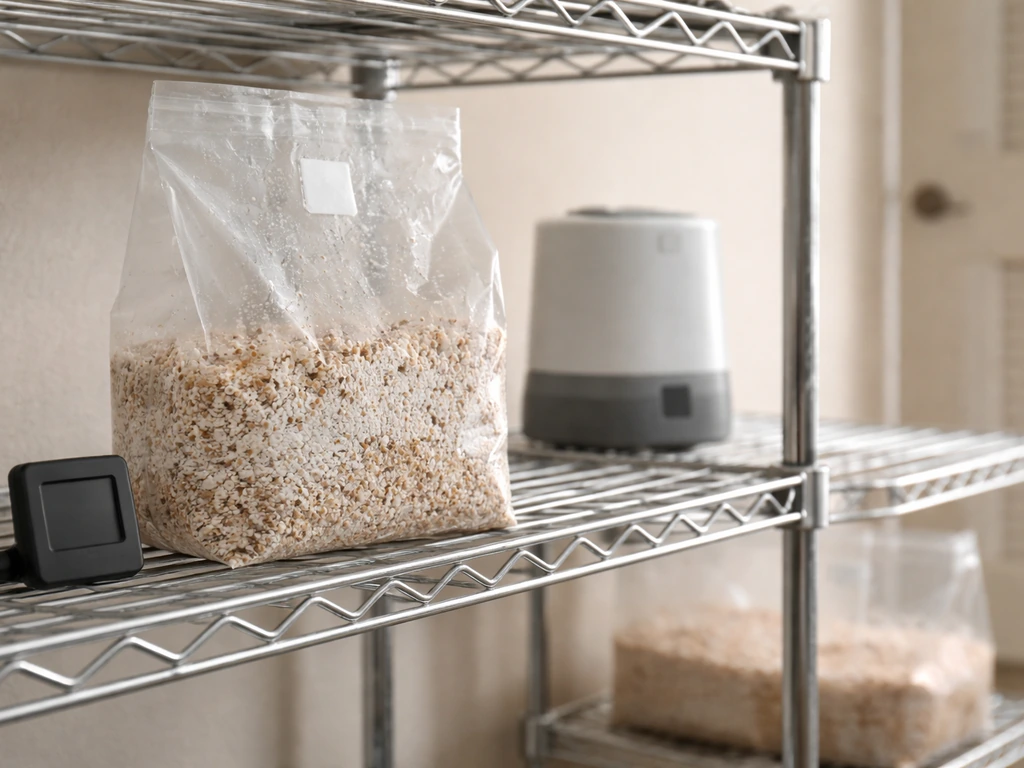
- Choose your method deliberately. If you want mushrooms this year, go with an indoor bag or a pre-colonized grow kit. If you are planting outdoor logs, accept that you are investing for next year or the year after.
- For indoor bags: mix hardwood sawdust with 10–15% wheat bran, sterilize at 15 psi for 2.5 hours, cool completely before inoculating, and target a 15–20% spawn rate.
- Colonize bags at 21–27°C in a dark, stable-temperature space. Check weekly for signs of contamination (green, black, or pink patches). Healthy colonization looks like white to off-white fuzzy mycelium spreading steadily.
- For outdoor logs: inoculate fresh-cut hardwood logs (within 6 weeks of cutting) by drilling 8 mm holes 4 cm deep, spaced 10 cm apart in a diamond pattern. Insert one plug dowel per hole and seal with cheese wax immediately.
- Keep logs shaded (70% shade cloth works well) and moist throughout the spawn run. Water during dry spells, especially in summer.
- Once bags are fully colonized (white throughout, no bare patches), cut a window in the bag or remove the top, move to your fruiting setup at 15–21°C, 85–95% humidity, and provide 8–12 hours of indirect light plus gentle airflow.
- Once outdoor logs have been producing for a season, you can trigger additional fruiting by soaking them in cold water for 12 hours (never longer than 24 hours). This mimics the natural rainfall trigger.
- Harvest brackets when the color pattern is vivid and the edges are still growing (lighter, cream-colored margins). Do not wait for the edges to turn brown and curl.
Indoor vs outdoor setup: realistic time ranges side by side
Indoor growing on prepared substrate bags is fundamentally a controlled, accelerated version of what happens naturally on logs in a forest. To grow magic mushrooms from scratch, you need to start with a clear plan for your method, sterilization or sourcing, and consistent environmental controls grow magic mushshrooms from scratch. You are creating ideal conditions year-round instead of waiting for nature to cooperate. The trade-off is that indoor setups require more active management and sterile technique, and each bag produces for a shorter total window before it is exhausted. Outdoor logs are a longer investment but they produce repeatedly for years with minimal intervention, and the mushrooms often have better structure and color from natural conditions.
Outdoors, the USDA identifies turkey tail's natural fruiting season as spring through fall, though it can fruit in winter in mild climates or during rainy seasons in warmer regions. This matters because even a perfectly colonized outdoor log will not fruit on demand out of season without forcing. If you inoculate a log in spring 2026, a realistic first fruiting expectation is fall 2026 at the earliest on the most responsive logs, and more likely spring 2027 for most setups. Indoors, the season does not matter. You control the trigger.
| Factor | Indoor Bag/Block | Outdoor Log |
|---|---|---|
| Total time to first harvest | 2–4 months | 12–24+ months |
| Colonization control | High (temperature, darkness) | Low (weather dependent) |
| Fruiting trigger | You control it | Season and moisture dependent |
| Production duration per unit | 2–4 flushes over months | Years of annual production |
| Contamination risk | Higher (needs sterile prep) | Lower (natural competition managed by hardwood) |
| Hands-on effort | Higher daily management | Low maintenance after inoculation |
| Best for | Fastest first harvest | Long-term yield and low effort |
Harvest timing and how long it keeps producing
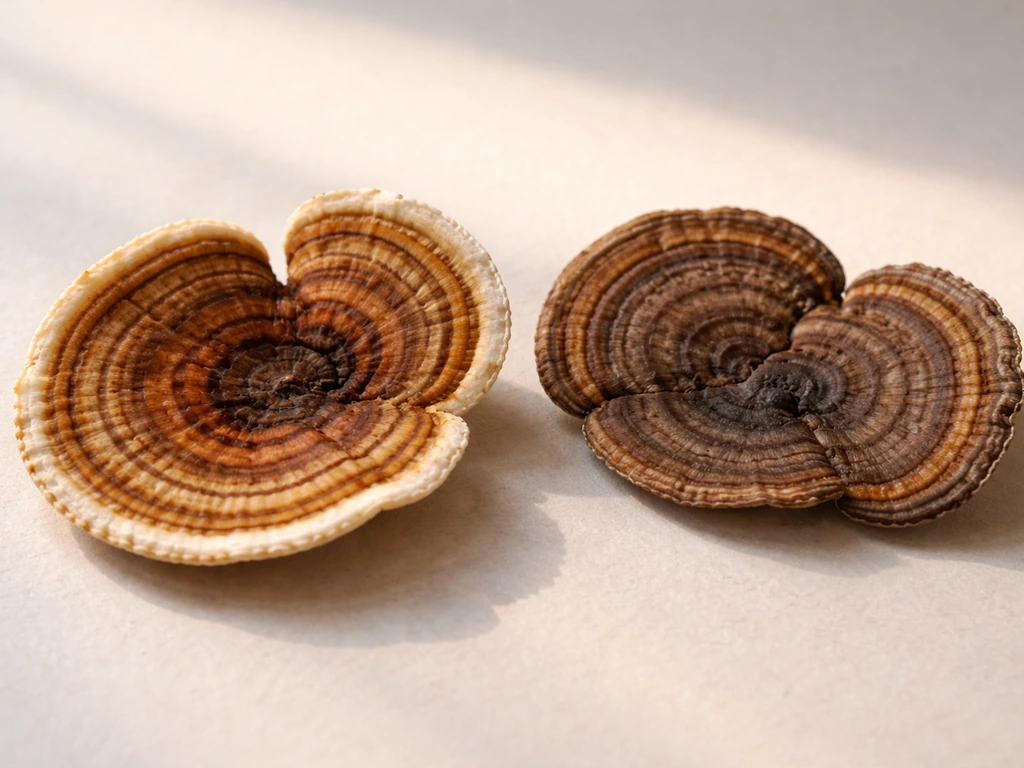
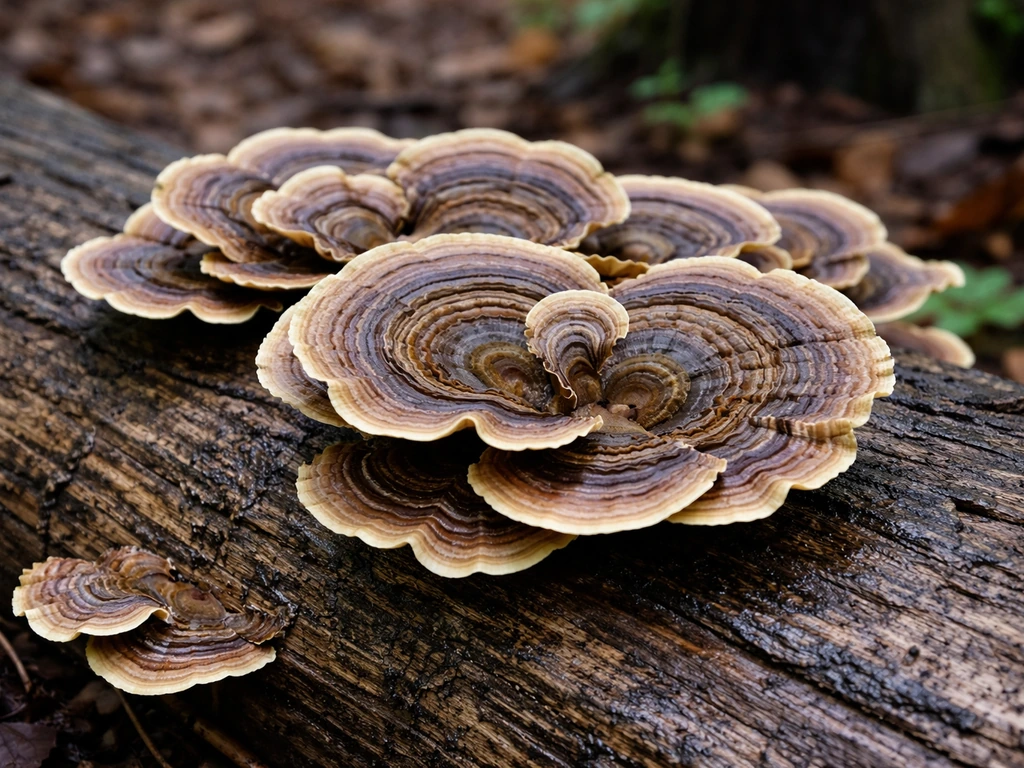
Turkey tail brackets are ready to harvest when the concentric color bands are vivid and distinct, and the growing edge (the pale outer margin) is still present. Once the edges darken, dry out, and curl upward, the bracket has passed peak and the medicinal and culinary quality drops. From pinning to that ideal harvest window is roughly 2 to 4 weeks indoors and up to 3 months on logs, which aligns with the OSU Extension guidance that harvestable mushrooms appear about three months after primordia form on log setups. The longer outdoor development produces tougher, denser brackets.
After harvesting, give the block or log time to recover. For indoor bags, expect 2 to 4 flushes before the substrate is spent. Soak the block in cold water for a few hours between flushes to rehydrate and encourage the next pinset. For outdoor logs, production can continue for 3 to 5 years or more as the mycelium works through the wood.
The cold water soak technique (12 hours max) is useful for triggering fruiting on already-colonized logs outside of peak season. Wylde Center also recommends using a cold water soak to help trigger “force fruiting,” limiting the soak to no more than 24 hours after a log has fruited once cold water soak technique (12 hours max).
Never soak longer than 24 hours or you risk suffocating the mycelium and inviting rot.
Troubleshooting delays
Colonization is taking too long or has stalled
If your indoor bag has not shown significant mycelial growth after 3 to 4 weeks, temperature is almost always the culprit. Check that the bag is actually sitting at 21 to 27°C and not in a cooler corner of the room where ambient temperature reads higher than actual substrate temperature. A cheap probe thermometer directly against the bag helps here.
Also check for contamination: any color other than white or light cream (especially green from Trichoderma) means you need to remove that bag immediately before it spreads. For outdoor logs, slow colonization in the first season is normal and not a sign of failure. If you see no mycelium at the end-face of the log after 18 months, check moisture levels and confirm you used fresh hardwood, not softwood or old, dry wood.
Fully colonized but no pins forming
This is a fruiting trigger problem. Turkey tail needs a shift in conditions to initiate pinning: blank" rel="noopener noreferrer">a temperature drop (moving from 24°C colonization to 18°C fruiting), increased humidity, fresh air exchange, and light. It can also help to understand how long it takes to grow magic mushrooms from start to pinning, since timelines depend heavily on conditions temperature drop (moving from 24°C colonization to 18°C fruiting).
If you are wondering how long it takes to grow psychedelic mushrooms, the key is whether your setup has the right colonization and fruiting trigger conditions Turkey tail needs a shift in conditions to initiate pinning. If your block is fully white and sitting in the same bag in the same dark warm spot where it colonized, nothing will happen.
If you want a faster start, focus on the fruiting trigger because it directly affects how long it takes to grow mushrooms initiate pinning. The transition is the trigger. If you are wondering how long it takes to grow shiitake mushrooms, the same idea applies: growth stalls are often caused by the conditions not being shifted at the right time fruiting trigger. If you are growing shiitake instead of turkey tail, the timeline can be different because shiitake needs a specific fruiting trigger and conditions to pin and produce well how long does it take to grow shiitake mushrooms. Open the bag, introduce the environmental shift, and give it 1 to 3 weeks.
Outdoors, if your log is colonized but not pinning, check whether you are outside the natural fruiting window (spring to fall) and whether the log is staying consistently moist. A cold water soak on a colonized log can trigger fruiting when conditions are borderline.
Pins formed but growth has stalled
Stalled pins usually mean humidity dropped below 80% or CO2 built up too much. Mist the walls of your fruiting chamber (not the pins directly) and increase fresh air exchange. If pins dried and turned brittle, they are lost, but the mycelium can form a new pinset if you rehydrate the block, maintain humidity, and wait another week or two. This is frustrating but common in setups with inconsistent humidity control.
Contamination showing up
Green mold (Trichoderma) is the most common contamination in turkey tail grows and it spreads fast. If you spot it on an indoor bag, isolate and discard the bag immediately. Do not try to scrape it off or save the block. Your grow space may also be contaminated, so wipe down all surfaces with 70% isopropyl alcohol. For outdoor logs, green mold on the surface is usually surface-level and does not mean the interior mycelium is compromised, especially on well-colonized logs. Move the log to better air circulation and reduce moisture on the surface (shade without trapping humidity). Wax coverage on the inoculation holes is your first line of defense for logs.
Brackets forming but looking thin, pale, or malformed
Pale, thin, or poorly banded brackets are a light and airflow issue. Bump up light exposure to 8 to 12 hours of indirect light and improve fresh air exchange. The vivid concentric color bands turkey tail is known for develop in response to adequate light and good airflow. Growing in a windowless space with no FAE almost always produces washed-out, poorly formed brackets, even if the mushroom itself is healthy.
FAQ
If I keep my indoor bag at the same temperature the whole time, will it still fruit?
Yes, but the clock you care about is the interval after you actually start fruiting conditions. For indoor bags, once you introduce the fruiting trigger (cooler temps, higher humidity, fresh air, and light), pins typically show up within 1 to 3 weeks, then first harvest is usually another 2 to 4 weeks. If you count from inoculation without switching environments, the timeline will look “wrong” even when the grow is normal.
What happens if I only change the light but not humidity or temperature?
It depends on whether colonization is finished. A fully white, well-colonized bag that is still dark warm will not pin, because turkey tail needs a condition shift (especially temperature drop plus humidity and fresh air). If you only change light but not humidity or temperature, you may see slow, weak pinning or stalled development. The fastest path is changing the full trigger package, not one variable at a time.
How can I tell if my bag is truly colonized versus just partly colonized?
A “fully colonized” bag should not be evaluated by color alone. Check for an even, solid white mass and ensure it is not soft, slimy, or giving off sour odors. If the mycelium is colonized but fruiting still stalls, look first at fruiting triggers (humidity consistency above 80%, CO2 removal via airflow, and temperature near 15 to 21°C during fruiting).
Can I speed up outdoor logs to fruit in winter?
For logs, timing is highly seasonal, but you can’t force reliable out-of-season fruiting just by waiting after inoculation. If you inoculate in spring, earliest fruiting is often fall, and many logs wait until the next spring even if colonization succeeded. If it is close to a known fruiting window but nothing appears, the practical lever is moisture (consistent dampness without stagnant water) and occasional triggering through a cold-water soak on already-colonized logs.
Should I measure time from inoculation, pinning, or first harvest?
Don’t rely on bag “progress” markers that happen during colonization, like seeing little white spots, if your goal is harvest timing. The pinning stage is the better reference point. If your bag is colonized but not pinning, your delay is usually in the trigger transition, and once conditions are correct, you can often see change within 1 to 3 weeks even if inoculation was much earlier.
If I miss the “ideal” time, is it still worth harvesting?
Harvest timing affects quality more than yield. Turkey tail is best when bands are vivid and the outer pale margin is still present. If edges darken, dry, and curl up, brackets pass peak and you should harvest soon rather than waiting longer, because medicinal and culinary quality trends downward after that window.
I know my room is sometimes cool during the day, how much does that really slow things down?
Yes, and it usually extends the timeline rather than ruining the grow. If colonization temps are below the ideal range repeatedly, you can add 2 to 4 weeks, and fruiting may also be less uniform. The fix is to keep the substrate itself near 21 to 27°C during colonization, not just the room air, then switch cleanly to the cooler fruiting range.
If my pins stall or dry out, can I restart the pinset?
Low humidity during fruiting commonly causes stall and drying, but you might still recover. If pins turned brittle and dried out, that pinset is gone, but the mycelium can form a new pinset after rehydration and humidity stabilization. Plan for another week or two after you correct humidity and airflow before expecting a fresh wave.
Will mold or contamination affect how long it takes, or is it only a quality issue?
Spore and contamination control affect success rate, not just speed. For example, once green mold establishes on an indoor bag, trying to scrape it usually fails and it spreads fast, so discarding is the practical speed-saving move because it prevents contaminating other bags. On outdoor logs, surface green mold is often less catastrophic than it looks, but improving airflow and reducing surface saturation can help maintain the schedule.