
From inoculation to your first harvest, shiitake mushrooms grown on indoor blocks typically take 8 to 16 weeks total. The same idea of a multi-stage timeline also applies when figuring out how long psychedelic mushrooms take to grow. That breaks down into roughly 6 to 12 weeks of colonization (the mycelium quietly taking over your substrate) plus another 1 to 2 weeks from fruiting trigger to harvest.
How Long Does It Take to Grow Shiitake Mushrooms Indoors?
Marcus Holloway
30 Apr 2026
On logs outdoors, the wait stretches much longer: 6 months on the short end, up to 2 years before your first flush. If you're growing indoors on a sterilized sawdust block, 10 to 14 weeks is a realistic target for most home growers. how long to grow magic truffles 10 to 14 weeks is a realistic target for most home growers..
Wine cap mushrooms can follow a similar wood-loving pattern, but the exact timing depends on how you grow them and your conditions 10 to 14 weeks. If you are growing wine cap mushrooms, the “how long” depends on whether you are using logs outdoors or a prepared substrate indoors Wine cap mushrooms can follow a similar wood-loving pattern.
The full shiitake timeline from start to harvest
It helps to think of shiitake cultivation in distinct stages rather than one long wait. Each stage has its own conditions, and each one has a predictable duration you can plan around.
| Stage | What's happening | Typical duration (indoor block) |
|---|---|---|
| Inoculation | Spawn mixed into sterilized or pasteurized substrate, sealed in bag | Day 1 |
| Colonization (spawn run) | Mycelium spreads through substrate in darkness | 5 to 10 weeks |
| Browning / consolidation | White mycelium thickens and turns brown ("popcorning") | 2 to 6 weeks (overlaps late colonization) |
| Fruiting trigger | Block removed from bag, cold shock or soak applied | 12 to 24 hours |
| Pinning | First tiny pins appear | 3 to 7 days after trigger |
| Maturation | Pins develop into full mushrooms | 2 to 7 days after pinning |
| Rest between flushes | Block rehydrated and rested before next flush | 1 to 2 weeks |
The browning stage trips up a lot of first-time growers because it looks like nothing is happening. Cornell's guidance actually recommends leaving your blocks on the shelf for about 6 to 7 weeks after full colonization, waiting until the blocks have fully "popcorned" and gone brown before you attempt to fruit them. Rushing past this stage is one of the most common reasons people get weak or no pins on their first attempt.
Log production: the long game
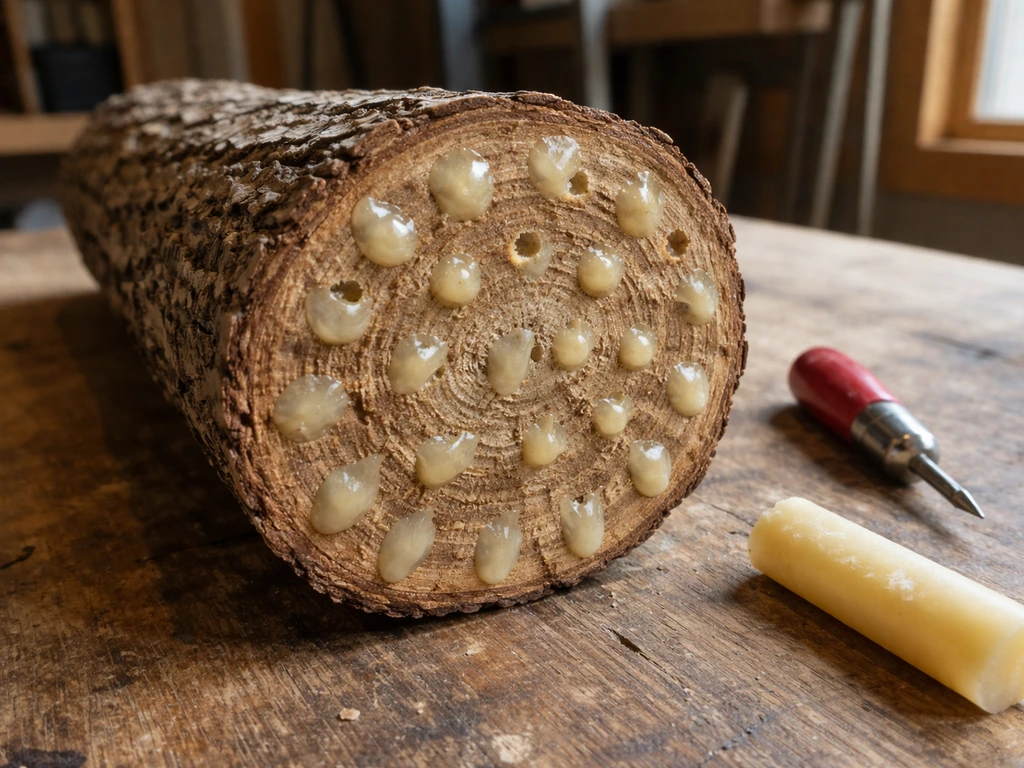
If you're going the traditional log route, reset your expectations. After you drill, inoculate, and wax your hardwood log, the mycelium needs 9 to 18 months to fully colonize the wood before it's ready to fruit. Most growers will see their first natural flush somewhere between 6 months and 2 years depending on log species, size, moisture, and ambient temperature.
Outdoor log fruiting generally won’t begin for about 6 to 9 months after inoculation, depending on wood type and shiitake strain Outdoor log fruiting won’t begin for about 6 to 9 months after inoculation. The upside is that a well-colonized log keeps producing for 3 to 4 years with regular forcing (soaking the log for 12 to 24 hours triggers a flush about 10 days later).
If you want logs, inoculate them within 1 to 3 weeks of felling the tree while the wood is still fresh and the bark is intact.
Indoor shiitake schedule: what your fruiting room actually needs
Growing shiitake indoors on blocks is faster and more controllable than logs, but it requires you to manage a few environmental variables that matter a lot during fruiting. Get these right and your timeline shrinks. Get them wrong and your block will just sit there doing nothing or grow long-stemmed, cap-less mushrooms.
Temperature
Shiitake strains are grouped into high, mid, and low temperature varieties, and matching your strain to your environment makes a real difference. Most common home-grow strains fruit well between 55°F and 75°F (13°C to 24°C). During colonization, slightly warmer temperatures (around 70°F to 75°F) speed up the mycelium. For fruiting, a drop of 5°F to 10°F acts as a natural trigger. If your house is warm year-round, look for a warm-weather strain rather than fighting your environment.
Humidity
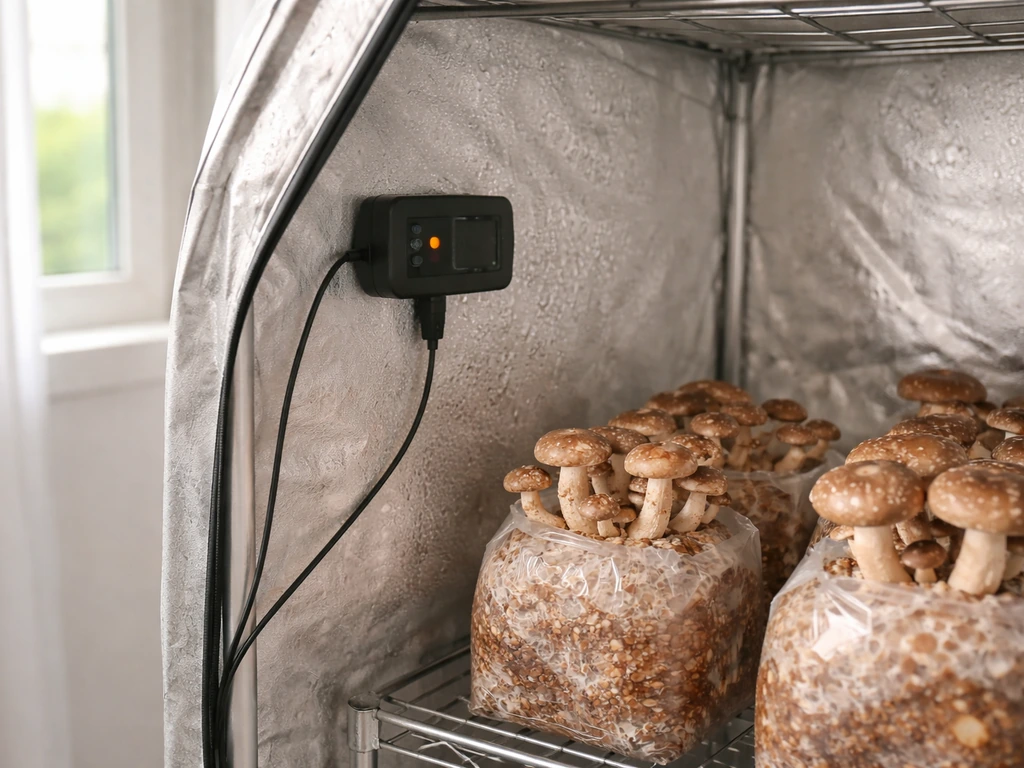
During fruiting, you need humidity between 80% and 95%. This is non-negotiable for good pin sets. One practical approach for home growers is to mist the block directly 2 times per day for the first 3 to 4 days after initiating fruiting, then maintain ambient humidity with a small ultrasonic humidifier or a humidity tent made from a clear plastic bag propped open. A cheap hygrometer clipped near your block will save you a lot of guesswork.
Fresh air exchange and CO2
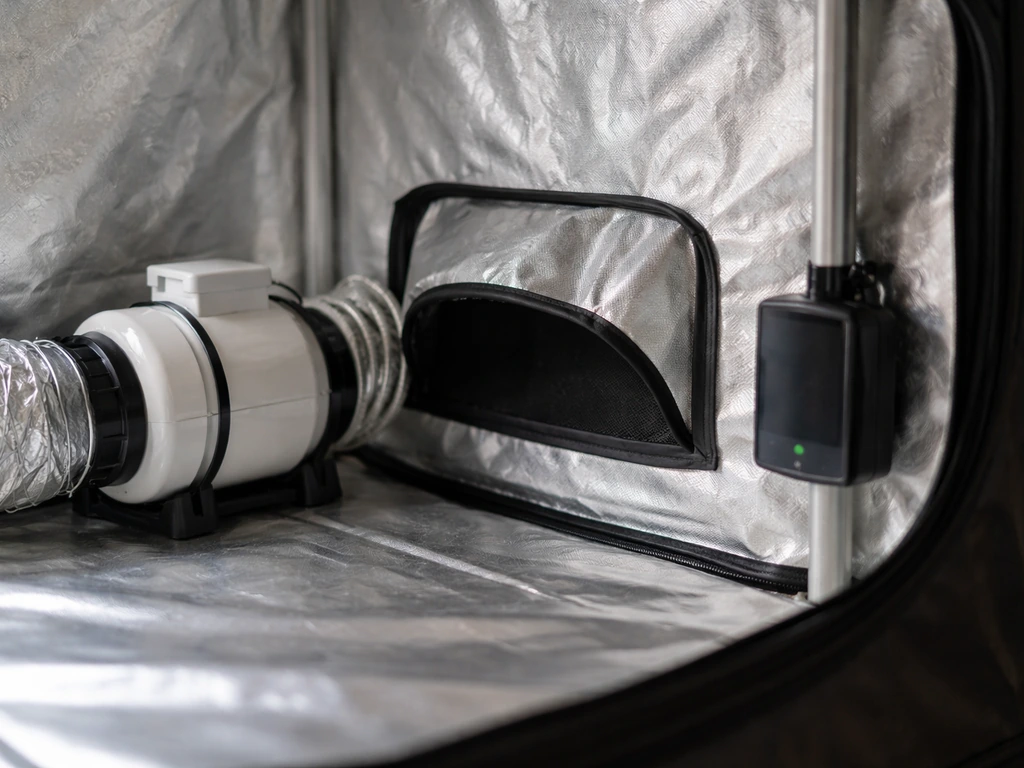
This is where a lot of home setups fail silently. CO2 above 1,000 to 1,200 ppm slows pinning, causes long thin stems, and can make caps open prematurely. During colonization, CO2 buildup isn't a big problem because the bag traps it and mycelium tolerates it fine. But once you pull the block out to fruit, fresh air exchange becomes critical.
You don't need a fancy HVAC system. Even fanning the fruiting area manually a few times a day, or cutting small holes in a tent and running a low-speed fan nearby, keeps CO2 in a safe range. The key is not to aim the fan directly at the block, which will dry it out, but to keep air gently circulating around it.
Light
Your shiitake doesn't photosynthesize, so light isn't a growth driver. During colonization, darkness is fine and actually preferred. For fruiting, indirect light on a simple 12-hour timer is enough to cue the mushrooms. A standard LED shop light or even a window with indirect natural light works well. Don't overthink this one.
What makes your timeline faster or slower
Several decisions you make before inoculation, and a few during colonization, will either compress or stretch your timeline by weeks.
Sterilized vs. pasteurized substrate
Sterilized blocks (pressure cooked at 15 PSI for 2.5 to 3 hours) give your shiitake spawn a clean start with no competing organisms. Colonization is faster and more reliable. Pasteurized blocks (heated to around 160°F to 180°F for 1 to 2 hours) are easier to prepare but leave behind heat-resistant bacteria and mold spores that can outcompete shiitake mycelium, especially if your spawn rate is low or your technique isn't airtight. If you want the shortest indoor timeline, sterilize your substrate.
Spawn rate and spawn type
More spawn means faster colonization, full stop. A spawn rate of 15% to 20% by dry weight is a reasonable target for home blocks. Grain spawn colonizes faster than sawdust spawn because the individual grains distribute evenly through the substrate and give the mycelium more starting points. Plug spawn (used mostly for logs) is slower than grain but more forgiving for outdoor applications.
Substrate formulation
Shiitake is a wood-loving species and does best on hardwood sawdust supplemented with wheat bran or rice bran at around 10% to 20% of the mix by weight. Higher supplementation speeds colonization and boosts yields, but it also raises contamination risk on non-sterilized substrate. A common home-grower formula is 85% hardwood sawdust, 10% wheat bran, and 5% gypsum (gypsum helps with moisture distribution and pH). Keep field capacity moisture at around 55% to 60%.
Incubation temperature
Colonizing your block at 70°F to 75°F (21°C to 24°C) is the sweet spot for most shiitake strains. Below 65°F the mycelium slows dramatically, and this is the most common reason home grows run 3 to 4 weeks longer than expected. A simple seedling heat mat under your colonizing blocks can make a significant difference if your basement or grow room runs cool.
Steps that actually move the needle on timing
Here's how to set yourself up for the fastest, most reliable indoor timeline from the start.
- Use sterilized hardwood sawdust blocks with 15 to 20% grain spawn inoculation rate.
- Incubate in darkness at 70°F to 75°F with minimal disturbance until the block is fully white.
- Wait for the browning/consolidation phase to complete fully before attempting to fruit, even if it takes an additional 4 to 6 weeks after white colonization.
- Initiate fruiting with a cold shock: move the block to a cooler area (55°F to 65°F) or soak it in cold water for 12 to 24 hours.
- Remove from soak, cut or remove the grow bag, and place in your fruiting environment at 80% to 95% humidity with fresh air exchange.
- Monitor daily. Mist the block surface if it looks dry; fan or ventilate if you see long, thin stems forming (a sign of high CO2).
- Harvest before the veil under the cap fully tears, when the caps are still slightly curled under.
How to tell if your shiitake is on track
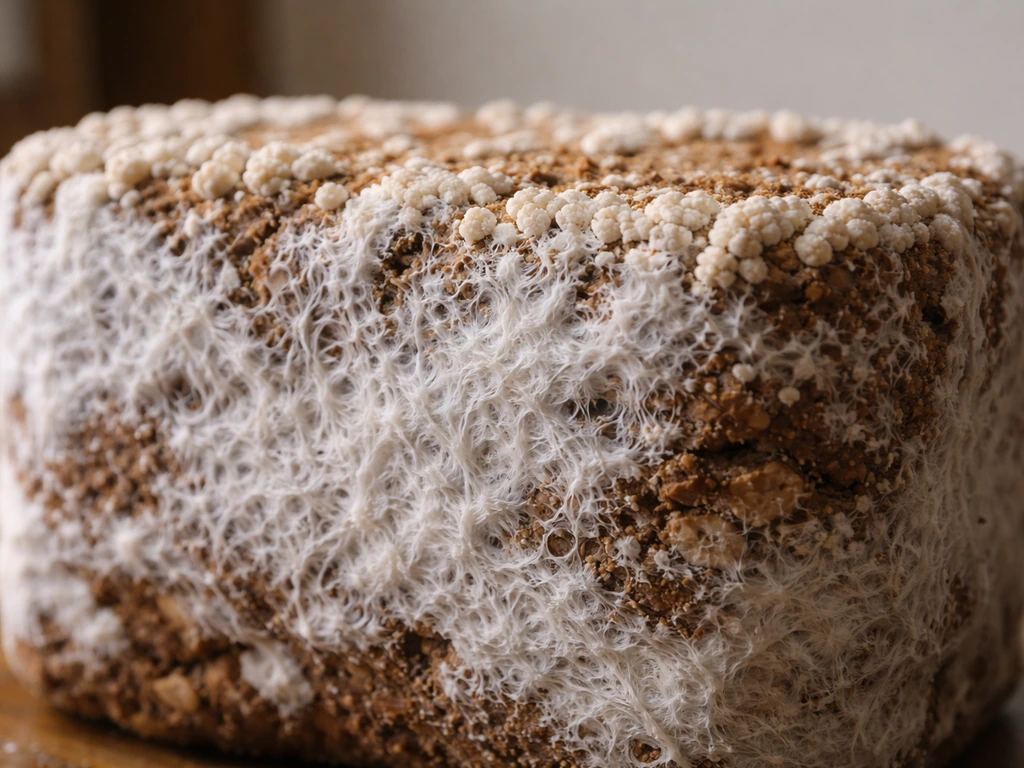
During colonization, healthy shiitake mycelium looks white and rope-like, often with a slightly fuzzy or stringy texture. It should be spreading steadily from your spawn points outward through the block. If you see green, black, or orange patches, that's contamination and you need to remove the block from your grow space immediately to prevent it spreading.
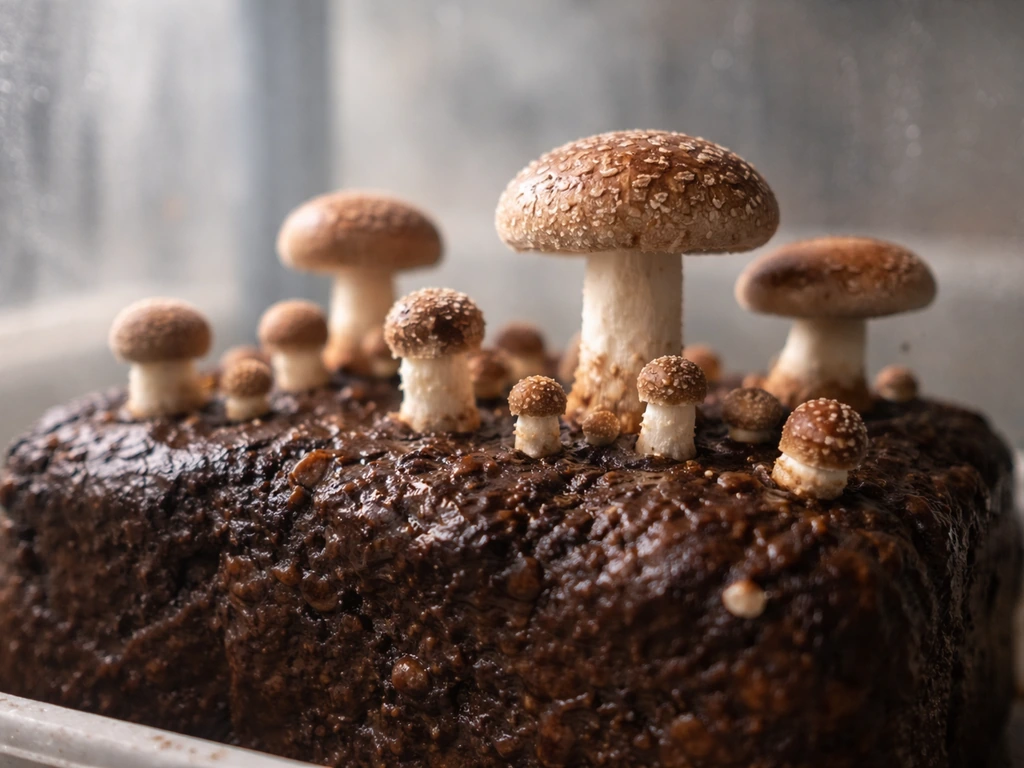
The "popcorning" stage is your best visual cue for readiness. The white mycelium starts to form bumpy, irregular brown patches across the surface of the block. Once the entire exterior has consolidated into a dark, firm brown layer, the block is ready to fruit. If you try to fruit too early, before this browning is complete, you'll likely get a weak pin set or nothing at all.
After fruiting initiation, look for tiny white pins appearing at the surface within 3 to 7 days. Once pins appear, mushrooms typically reach harvest size in another 2 to 7 days depending on temperature and humidity. Harvest when the caps are still cupped under and before the veil breaks. Letting them go too long drops your shelf life fast and signals the block to slow down.
Harvest timing, flushes, and what comes after
One of the best things about shiitake on indoor blocks is that you get multiple flushes from a single block. After your first harvest, give the block a 1 to 2 week rest period. To restart fruiting, rehydrate the block by submerging it in clean cold water for 12 to 24 hours, then return it to your fruiting conditions. Some growers skip full submersion and do a cold shower instead, but soaking gives more consistent results in my experience.
One thing to keep in mind after the first harvest: the block is now fully exposed without its grow bag, so it dries out faster and is more vulnerable to contamination. This is when your humidity management becomes even more important. FreshCap's guidance makes a good point here: the blocks need more attention for subsequent flushes because you no longer have the bag protecting them. Misting more frequently and keeping them in a well-humidified tent or chamber makes a real difference for flush number two and three.
A healthy shiitake block typically produces 2 to 4 flushes before yields drop off significantly. The total harvest window from first pin to final flush is usually 6 to 10 weeks. For an overall indoor production-cycle expectation on synthetic medium, an American Mushroom Institute extension/educational PDF describes roughly a blank" rel="noopener noreferrer">3 to 4 month turnaround from inoculation to cleanup and discusses flush timing in that framework. If you're asking how long it takes to grow magic mushrooms, the timeline is often quite different and depends heavily on species and your growing conditions total harvest window from first pin to final flush. After that, the block is spent and can go into your compost or garden bed.
Flush spacing and planning your grows
- First flush: 1 to 2 weeks after fruiting trigger
- Rest period between flushes: 1 to 2 weeks (rehydration soak included)
- Second and third flush: same 1 to 2 week window after rehydration
- Total productive life of an indoor block: approximately 3 to 5 months from inoculation
If you want a continuous supply, stagger your inoculation dates by 2 to 3 weeks so different blocks hit their fruiting stage at different times. It takes a little planning up front but means you're harvesting fresh shiitake on a rolling basis rather than getting slammed with everything at once and then nothing for weeks.
Shiitake vs. other species: how the timing compares
Shiitake takes longer than oyster mushrooms (which can fruit in as little as 2 to 4 weeks from inoculation) but is considerably faster than species like turkey tail, which grows very slowly on wood and isn't typically grown for a quick indoor harvest. Turkey tail is a slower wood species, so if you are comparing grow times, you may also be asking how long does it take to grow turkey tail mushrooms. If you're working on turkey tail too, expect a much longer wood colonization period than shiitake and plan your setup for slow, steady growth. If you're comparing shiitake to other edible species and wondering where it sits on the speed spectrum, it's a medium-commitment grow: more patient than oysters but far more rewarding in flavor and yield per block.
The colonization and fruiting concepts here apply broadly across wood-loving species, so building your shiitake technique gives you a solid foundation for tackling other long-colonization species like lion's mane or reishi down the line.
FAQ
If I want the fastest indoor timeline, what conditions actually make me hit the 8-week end of the range?
Yes, but timing changes by strain and environment. If your house stays around 70°F to 75°F and you can keep humidity in the 80% to 95% range, you can often target the lower end (closer to 8 weeks) for indoors, assuming the block fully popcorning and browning before you initiate fruiting.
How do I know when my shiitake block is actually ready to fruit, if I’m worried I’m early?
A realistic way to avoid wasted cycles is to check readiness by surface change, not by calendar. If the block exterior is not uniformly browned and firm, fruiting it early usually leads to fewer pins or long-stem mushrooms, even if colonization looked complete.
What should I troubleshoot if I don’t see pins 3 to 7 days after fruiting initiation?
If pins do not appear within about a week of starting fruiting, first verify humidity and fresh air exchange. Low humidity is the most common cause, but high CO2 is also common, especially if the area is sealed or you are not fanning a tent.
Can I start fruiting immediately after my block seems fully colonized, or is there a waiting step people miss?
Don’t judge by the bag during incubation. Some blocks look “done” but need the post-colonization shelf phase, about 6 to 7 weeks after full colonization, to complete popcorning. Skipping that waiting period is a frequent reason for weak or failed pin sets.
What happens to the schedule if my grow area is cooler at night than during the day?
Temperature swings can cause uneven progress. If your setup repeatedly drops below about 65°F during colonization, growth slows enough to extend your timeline by several weeks, and you may see slower, patchy browning even if the block eventually finishes.
Is running a fan 24/7 okay during fruiting, or can it slow things down?
You can, but it is easy to overdo. During fruiting, direct blasts of air often dry the surface and can stall pin formation. Instead, keep gentle circulation, use a humidity tent if needed, and avoid pointing fans straight at the block.
My mushrooms are growing with long stems and almost no caps. What adjustment usually fixes this fastest?
If you get long-stemmed, cap-less mushrooms, look for a humidity and airflow mismatch. Cap development depends on stable 80% to 95% humidity and adequate fresh air exchange, so raising humidity and improving gentle exchange usually helps before you change anything else.
How can I get a more continuous supply instead of a single big harvest spike?
Staggering inoculation by 2 to 3 weeks helps most, but you can also extend the harvest window by not harvesting the first flush all at once if your setup allows. Pick when caps are still cupped and the veil has not broken, then allow the block’s rest and rehydration cycle to keep flush timing predictable.
Do the same time estimates apply to flushes after the first harvest?
After the first harvest, timelines for the next flush depend heavily on rehydration and humidity maintenance. Most blocks need a 1 to 2 week rest, then soaking 12 to 24 hours before returning to fruiting conditions, and the second flush may be slower if the block dries too much.
If I switch from sterilized to pasteurized blocks, should I expect the grow time to change, or mostly just the failure rate?
Yes, but it tends to change the risk profile more than the schedule. Lower contamination means the mycelium can colonize efficiently, while contamination often delays the timeline entirely because you may need to discard the block and start over.