
Growing Tremella fuciformis (silver ear or snow fungus) at home is absolutely doable, but it requires one thing most guides skip entirely: you need two fungi, not one. If you want to try something entirely different, you can also learn how to grow truffles at home, but the process and requirements are much more specialized than silver ear blank" rel="noopener noreferrer">[Tremella cultivation](/truffle-cultivation/how-to-grow-truffles-at-home).
How to Grow Tremella Mushroom at Home: Step by Step
Marcus Holloway
4 May 2026
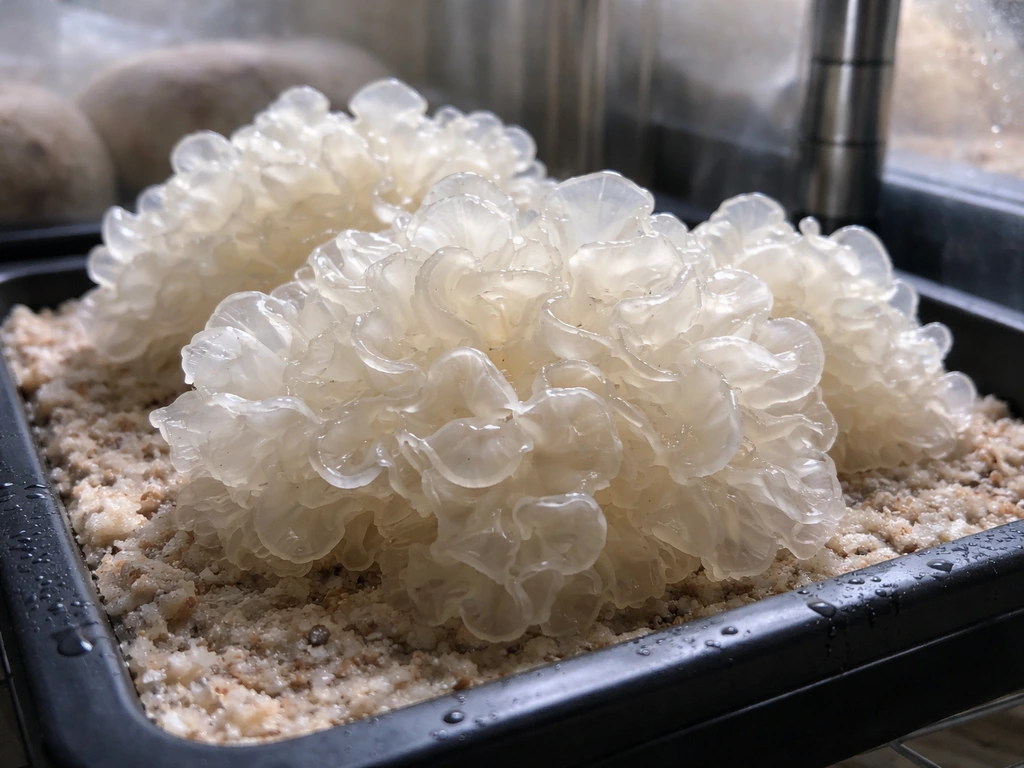
If you are specifically trying to learn how to grow black truffle, the process and requirements are very different from silver ear cultivation. Tremella is a parasite that feeds on another wood-rotting fungus called blank" rel="noopener noreferrer">Annulohypoxylon stygium (or a closely related species).
Without that host fungus present in your substrate, your Tremella spawn will colonize weakly and never fruit, no matter how perfect your humidity or temperature is. Once you understand that relationship and set things up correctly, Tremella is a genuinely rewarding grow with beautiful gelatinous clusters and a relatively forgiving fruiting window.
What Tremella actually is and why it grows differently
Tremella fuciformis is a basidiomycete jelly fungus native to tropical and subtropical forests, and it is classified as a mycoparasite. In the wild it grows on dead wood, but it is not breaking down that wood directly. It is parasitizing another fungus (Annulohypoxylon stygium or related Annulohypoxylon species) that is already colonizing the wood. The Tremella feeds off the host fungus's mycelium, and the edible, translucent, brain-like clusters you see are Tremella's fruiting bodies emerging from that relationship. Fruiting body formation in Tremella fuciformis is obligately dependent on its blank" rel="noopener noreferrer">companion Annulohypoxylon stygium. If you want to explore a different high-value gourmet species, this guide also covers how to grow black truffle mushrooms.
This is the key biological fact that separates Tremella cultivation from growing, say, oyster mushrooms or shiitake. With oysters you prepare substrate, inoculate, incubate, fruit. Done. With Tremella, you are cultivating a two-species system. Your growing block needs to contain both Tremella fuciformis mycelium and Annulohypoxylon mycelium, colonizing the same substrate, before fruiting is possible. Some commercial spawn suppliers sell a combined dual-species inoculant for exactly this reason. If you buy single-species Tremella spawn only and expect fruiting, you are going to be waiting indefinitely and wondering what went wrong.
The edible result is worth the extra complexity. Silver ear mushrooms have a mild, slightly sweet flavor and a distinctive crunchy-gelatinous texture that holds up in soups and desserts. They are widely used in traditional Chinese cooking and valued medicinally for their polysaccharide content. They also store reasonably well when dried.
Indoors or outdoors, logs or sawdust blocks
Before you buy anything, decide on your approach. Each method has real trade-offs depending on your space, climate, and how much control you want.
Indoor sawdust block growing (recommended for beginners)
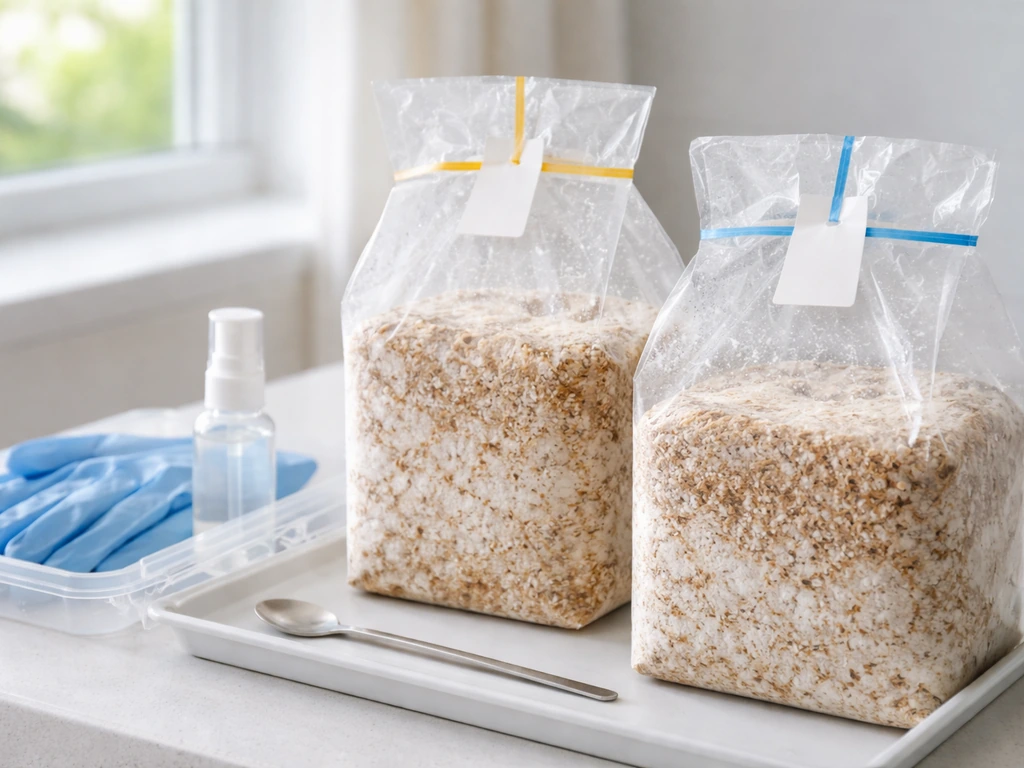
This is the method I recommend for most home growers starting out. You prepare or buy a supplemented sawdust block, inoculate with dual-species spawn (Tremella plus Annulohypoxylon), incubate indoors, and then fruit in a humidity tent or grow chamber. You get full control over temperature, humidity, and light. The main downside is that you need to source dual-species spawn, which requires a bit of searching. Colonization takes 60 to 90 days, which feels slow compared to oysters, but fruiting itself happens over 2 to 3 weeks once triggered.
Outdoor log cultivation
Tremella can be cultivated on logs outdoors, similar to shiitake log culture. Freshly cut hardwood logs are inoculated with dual-species plug or sawdust spawn, sealed with wax, and left in a shaded outdoor spot. This is a lower-maintenance approach but the timeline stretches to 6 to 18 months before first fruiting and success depends heavily on your local climate. You need warm, humid summers (consistent temps of 22 to 28°C and high ambient humidity). If you live somewhere with hot, wet summers, outdoor log cultivation is a satisfying long-game method. If your climate is dry, stick with indoor blocks.
| Method | Timeline to first fruit | Climate control needed | Best for |
|---|---|---|---|
| Indoor sawdust block | 60 to 90 days incubation, then 2 to 3 weeks fruiting | High (humidity tent or chamber) | Beginners, year-round growing, drier climates |
| Outdoor log | 6 to 18 months | Low (relies on ambient conditions) | Warm humid climates, hands-off growers |
For most readers, the indoor sawdust block method gives you the fastest, most controllable results. The rest of this guide will focus primarily on that method, with log-specific notes where they differ.
Supplies, spawn sourcing, and wood species
The spawn situation
This is where most Tremella cultivation attempts fall apart. You need dual-species spawn that contains both Tremella fuciformis and Annulohypoxylon stygium (or Annulohypoxylon archeri, a closely related companion species used in cultivation). Some suppliers label this clearly as 'Tremella dual-culture spawn' or 'silver ear combined spawn.' Others sell Tremella spawn without specifying whether the host fungus is included, which is a red flag. Contact the supplier directly and ask: 'Does this spawn include both Tremella fuciformis and the companion Annulohypoxylon fungus?' If they cannot answer that question, look elsewhere.
Commercial spawn kits from specialty mushroom suppliers in Asia (particularly those supplying the Chinese and Taiwanese market) are often the most reliable because Tremella cultivation is well-established there. Some Western suppliers have started offering dual-culture kits as interest has grown. Ready-to-fruit kit blocks are also available and are a good option if you just want to see the species fruit before committing to full cultivation.
Full supplies checklist
- Dual-species Tremella spawn (Tremella fuciformis + Annulohypoxylon companion fungus) in sawdust or grain form
- Hardwood sawdust (oak, sweetgum, or similar broad-leaf hardwood, not pine or cedar)
- Wheat bran or rice bran as a supplement (10 to 20% by weight of dry sawdust)
- Gypsum (1 to 2% of dry substrate weight, helps with moisture retention and pH buffering)
- Polypropylene grow bags with filter patches, or mason jars with filtered lids
- Pressure cooker (for sterilization) or large pot capable of sustained steam
- Alcohol, gloves, and still-air box or flow hood for inoculation
- Spray bottle for humidity maintenance
- Humidity tent, Martha tent, or grow chamber for fruiting
- Thermometer and hygrometer
- For log method: freshly cut hardwood logs (4 to 8 inches diameter, 3 to 4 feet long), plug or sawdust spawn, cheese wax
Choosing the right wood
Tremella grows in nature on dead hardwood, with the host Annulohypoxylon fungus colonizing the same wood. If you are specifically interested in how to grow white truffle, the process is very different from silver ear and requires particular conditions and sourcing. For sawdust blocks, use oak, sweetgum, tulip poplar, or other broad-leaf hardwoods. Avoid softwoods (pine, cedar, spruce) as the resins inhibit fungal growth.
For logs, oak is the gold standard and tends to be widely available. Freshness matters for logs: use wood that was cut within the past 4 to 6 weeks and has not begun to dry out excessively, since you want the wood to still carry moisture and avoid contamination from competing wild fungi taking hold before your spawn does.
Preparing your substrate
Sawdust block recipe and preparation
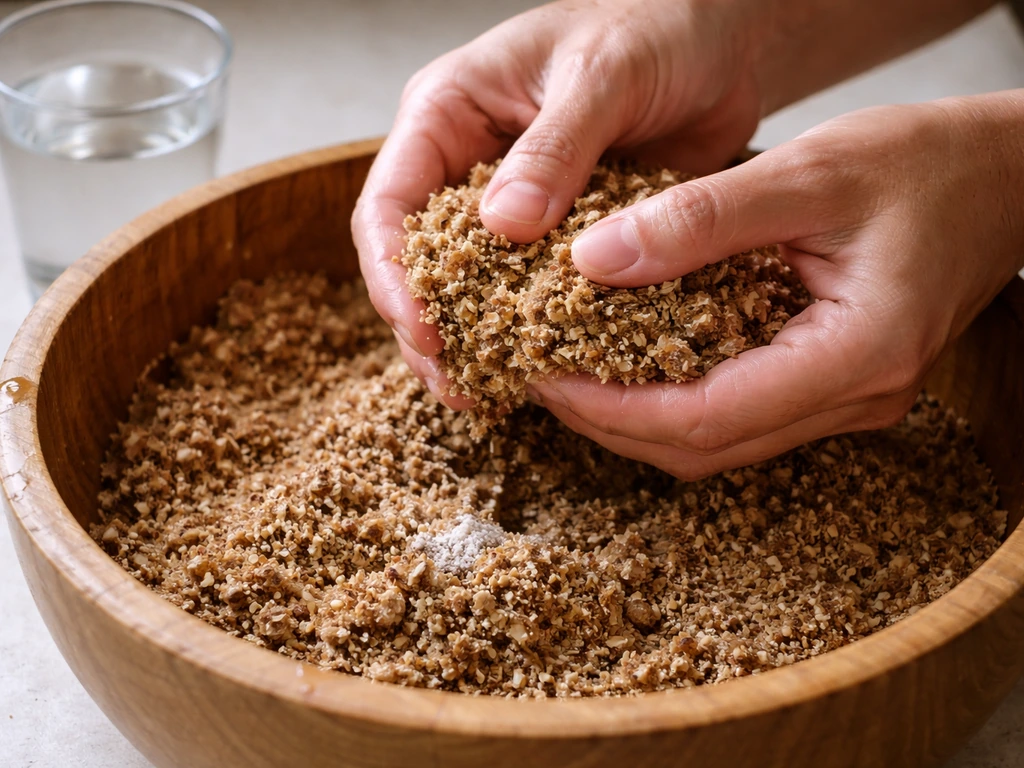
- Mix hardwood sawdust with 15% wheat bran (by dry weight) and 1 to 2% gypsum.
- Add water until field capacity is reached — the mixture should hold its shape when squeezed but release only a few drops of water, not a stream. Target moisture content is around 60 to 65%.
- Pack the mixture firmly into polypropylene bags or wide-mouth mason jars. Pack tightly to reduce air pockets, which invite contamination.
- Add a filter patch collar to bags, or use a polyfill-stuffed jar lid to allow gas exchange.
- Sterilize by pressure cooking at 15 PSI for 2.5 to 3 hours for quart jars, or 3 to 4 hours for 5-pound bags. Pasteurization alone (90°C for several hours) is not sufficient for a Tremella substrate because the long colonization period gives contaminants too much opportunity to gain a foothold.
- Allow the substrate to cool completely to room temperature (below 25°C) before inoculating. This usually means overnight.
Log preparation
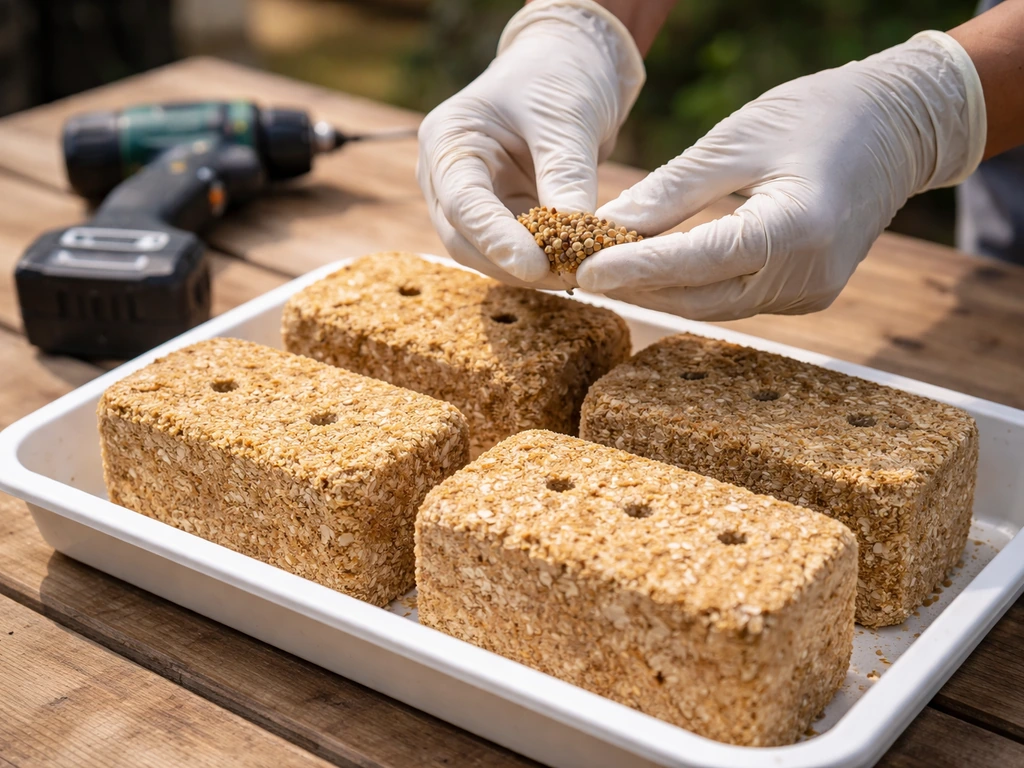
For outdoor logs, freshly cut hardwood is your substrate. No additional preparation is needed beyond drilling inoculation holes. Drill holes 1.25 inches deep in a diamond pattern, spaced about 6 inches apart along the length of the log. You will fill these with plug spawn or sawdust spawn and seal with cheese wax. The log should be moist but not waterlogged. If it has dried out, soak it in clean water for 12 to 24 hours before inoculation.
Inoculation and incubation
Inoculation
Clean technique here is critical because of Tremella's long incubation period. Any contaminant you introduce at inoculation has 60 to 90 days to outcompete your Tremella spawn. Work in a still-air box if you do not have a flow hood. Wipe down all surfaces with 70% isopropyl alcohol. Flame sterilize your inoculation tool, let it cool, then inoculate quickly.
For sawdust blocks or jars: break up your spawn and add it at a rate of about 10 to 20% of the total substrate weight. Higher spawn rates help Tremella compete and colonize faster. Mix the spawn thoroughly through the top third of the block or layer it throughout if your technique allows, then seal. For logs: fill each hole with spawn and cap immediately with melted cheese wax to prevent drying and contamination. Cover the entire cut end of the log with wax as well.
Incubation conditions and timeline
Keep inoculated blocks at 22 to 28°C (72 to 82°F). Tremella colonizes best at the warmer end of that range, around 25 to 28°C, which is warmer than most other cultivated mushrooms prefer. If your incubation space is too cool (below 20°C), colonization slows dramatically and contamination risk rises. Do not let temperatures exceed 30°C for extended periods as this can damage mycelium.
Humidity during incubation should be moderate (65 to 75%). You do not need high fruiting-level humidity at this stage. Keep blocks out of direct light, darkness or dim indirect light is fine. Fresh air exchange is not critical during incubation the way it is for oysters, but you do not want completely stagnant air either. The mycelium will appear white to cream-colored and somewhat cottony. You may also see the Annulohypoxylon mycelium, which can look darker or brownish and is normal, it means both fungi are growing. Full colonization of a 5-pound block takes 60 to 90 days. Logs can take 6 to 12 months to show signs of full colonization.
Fruiting conditions, harvesting, and what to expect
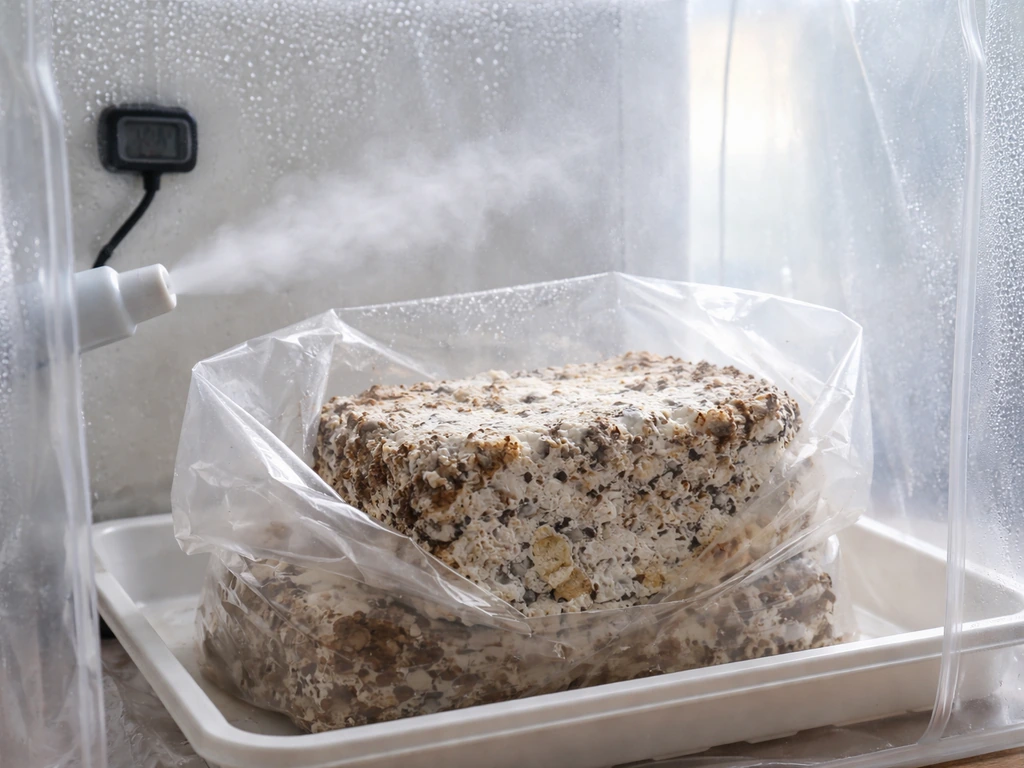
Triggering fruiting
Once the block is fully colonized, you trigger fruiting by moving it to high-humidity conditions and introducing fresh air. Cut or open the grow bag to expose the surface, or make X-shaped cuts in the bag for pins to emerge through. Place the block in a fruiting chamber or humidity tent. The environmental targets for fruiting are specific and matter a lot:
- Temperature: 22 to 26°C (72 to 79°F). Tremella fruits at warmer temperatures than most cultivated species.
- Relative humidity: 85 to 95%. This is non-negotiable. Tremella is gelatinous and will dry out and abort easily without sustained high humidity.
- Fresh air exchange: Tremella tolerates higher CO2 than many mushrooms, but you still need some FAE. Aim for 4 to 6 air exchanges per day in a grow tent setup.
- Light: 12 hours of indirect light per day helps initiate and direct pin formation, though Tremella does not need intense light. A simple LED on a timer works well.
- Misting: Mist the surface of the block (not the forming pins directly) 2 to 3 times per day to maintain surface moisture.
Harvesting
Tremella pins emerge as small, yellowish or cream-colored bumps and expand over 10 to 20 days into the characteristic layered, brain-like clusters. Harvest when the clusters are fully expanded but before they begin to yellow or collapse. Gently twist and pull the entire cluster from the block surface, or use a clean knife to cut at the base. Do not leave stumps, as these can rot and invite contamination.
After harvesting, rest the block for 1 to 2 weeks with reduced misting, then resume fruiting conditions for a second flush. Most blocks will give 2 to 3 flushes before exhaustion. Expect roughly 100 to 200 grams of fresh Tremella per 5-pound block per flush under good conditions. Drying yield is much lower by weight but dried silver ear stores well in an airtight container for months.
Troubleshooting failures and scaling up
Contamination (green, black, or pink mold on the block)
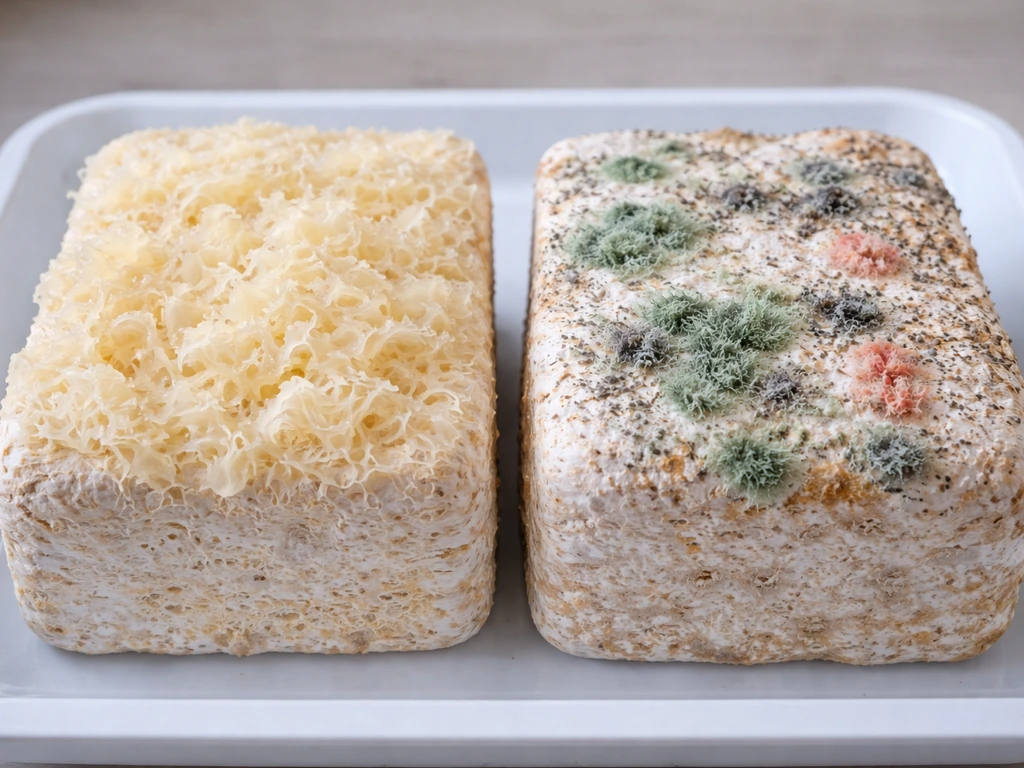
This is the most common failure point with Tremella and it almost always traces back to one of three causes: insufficient sterilization, poor inoculation technique, or a spawn rate that was too low. If you see green (Trichoderma) or black mold, the block is almost certainly lost. Remove it from your grow space immediately in a sealed bag. For your next attempt, extend sterilization time by 30 minutes, tighten up your still-air box technique, and bump your spawn rate up to 20%. Also double-check that your substrate moisture is not too high (above 65% moisture content), as overly wet blocks are more contamination-prone.
Slow or patchy colonization
If your block looks barely colonized after 4 to 6 weeks, the most likely culprit is temperature. Tremella is slow below 22°C. Move your blocks somewhere warmer or add a seedling heat mat set to 24 to 26°C beneath them. If colonization still looks weak after 10 weeks, the spawn may have been non-viable or single-species only (lacking the Annulohypoxylon partner). Unfortunately a poorly colonized block at that stage is usually not worth continuing with, start fresh with confirmed dual-species spawn from a different supplier.
Fully colonized block but no fruiting
This happens when the fruiting trigger conditions are not met. Check all of the following: Is your humidity actually hitting 85 to 95% (do not rely on estimates, use a hygrometer)? Is temperature in the 22 to 26°C range? Are you getting any fresh air exchange? Is the block surface exposed and not still sealed in plastic? Sometimes a colonized block just needs more time at correct fruiting conditions, give it 3 full weeks before concluding there is a problem. Also make sure the block surface is not dry: if the mycelium feels powdery rather than moist, increase misting frequency.
Small, malformed, or yellowing fruiting bodies
Yellowing or stunted clusters usually mean insufficient humidity, excessive direct misting (water pooling on the clusters), or harvesting too late. Adjust your misting to target the block surface and chamber walls rather than the clusters themselves. If fruiting bodies yellow quickly after emerging, increase humidity and check that your fruiting space is not getting direct airflow from a fan. Small, stunted clusters can also indicate the block is already exhausted, especially on second and third flushes.
Scaling up once you have a working setup
Once you have gotten two or three successful harvests, scaling up is straightforward. The most efficient move is to run multiple blocks on a staggered inoculation schedule so you have blocks entering the fruiting stage on a rolling basis rather than all at once. A basic Martha tent can hold 6 to 12 blocks and maintain humidity efficiently with an ultrasonic humidifier on a timer. Because Tremella's long incubation period is the main bottleneck, keeping a steady inoculation rhythm every 4 to 6 weeks is more important than trying to rush any single block.
If you want to expand into log cultivation alongside your block operation, the low-maintenance nature of outdoor logs makes them a good complement. While your indoor blocks are cycling through incubation and fruiting, your log yard works in the background. Just note that Tremella log cultivation, like outdoor log cultivation in general, depends heavily on your local climate and is a different kind of patience than running indoor blocks. The biology is the same, but the pace and the hands-on involvement are very different.
Tremella is genuinely one of the more unusual and satisfying fungi to grow at home, partly because its dual-species biology makes it feel like more of an ecosystem than a single crop. Once you have the right spawn and you understand what the two fungi are doing together in that block, the whole process makes sense and the troubleshooting becomes much more logical. Get the spawn right, keep it warm and humid, and give it time.
The silver ear clusters you get at the end are worth every day of that 90-day wait. A quick, step-by-step overview will help you map all the stages, from sourcing dual-species spawn to fruiting, so you know how to grow truffle in practice.
FAQ
How can I tell if my spawn is actually dual-culture (Tremella plus the Annulohypoxylon partner)?
Look for explicit wording like “dual-culture,” “combined spawn,” or naming both species. In addition, during early incubation you should eventually see a second mycelium type (often darker brownish) alongside the Tremella’s lighter white to cream growth, which suggests both organisms are present. If you see only one mycelium type throughout colonization, assume you are missing the host partner and plan for likely non-fruiting.
Can I reuse or recycle the spent substrate blocks after a flush?
You can often get 2 to 3 flushes, but once the block is exhausted it usually becomes contamination-prone. Re-inoculating an exhausted block is unreliable because you cannot sterilize it in a home setup to the same standard used initially, and competitors (molds) take over during the long incubation. For best results, plan on starting new blocks when performance drops and saving time on reattempts.
What humidity level should I use during incubation versus fruiting?
During incubation you want moderate humidity (about 65 to 75%) and you should not aim for fruiting-level humidity. During fruiting, target roughly 85 to 95% humidity and use a hygrometer to confirm it, because Tremella clusters can yellow or collapse if the air is too dry even for short periods. The key is separating “slow colonization” conditions from “trigger fruiting” conditions.
My blocks are colonizing but never pin. What are the most common hidden mistakes?
First, confirm the fruiting trigger conditions, especially high humidity measured with a hygrometer, and check that the surface is actually exposed (cuts or bag opening) rather than staying sealed. Second, verify you are not overdoing temperature, since extended heat above about 30°C can damage mycelium. Third, make sure you did not over-wet the substrate initially, because chronic excess moisture can create a weak culture that looks colonized but cannot fruit.
Do I need light for Tremella to fruit?
Tremella does not require intense lighting, but complete darkness during fruiting can reduce performance for some setups. A practical approach is to use dim indirect light or brief gentle lighting, while relying mainly on humidity and fresh air for the trigger. If you have strong airflow, reduce direct fan exposure because it can dry the clusters.
Can I use distilled or tap water, and does water quality matter?
Water quality matters most for consistent humidity. Tap water with heavy minerals can leave residue on surfaces and may contribute to uneven drying or biofilm buildup in humid tents. Distilled or filtered water is often easier to manage for a cleaner fruiting chamber, especially if you are using frequent misting.
How much should I mist during fruiting, and how do I avoid water pooling on the clusters?
Misting should keep the block surface and chamber walls moist, not soak the emerging clusters. Use a light, frequent misting schedule, and if you see droplets forming pools on gelatinous tissue, cut back. A good rule is to adjust until droplets appear briefly after misting and then disperse, rather than staying visible on the clusters.
What should I do if my block turns green or black during the incubation phase?
Remove it immediately from your grow area and seal it in a bag to prevent spores from spreading. For your next attempt, tighten sanitation at inoculation (clean surfaces, minimize time tools are open to air) and consider extending sterilization time. Also check substrate moisture, because blocks that are too wet tend to invite competitors earlier in the 60 to 90 day colonization window.
If my block is barely colonized after 4 to 6 weeks, is it always too late?
Not always. If temperature is below about 22°C, Tremella may look slow but can recover once warmed. Move the blocks to 24 to 26°C using a seedling heat mat under the containers, then reassess after about 10 weeks. If you still see minimal colonization by then, the spawn may be non-viable or missing the host partner, and starting fresh is usually the most efficient choice.
Why do my clusters yellow quickly after emerging?
Rapid yellowing usually points to low humidity, excessive direct airflow, or harvesting too late. Also check misting style, because direct heavy misting can damage clusters or keep them too wet in a way that accelerates deterioration. Harvest as soon as clusters are fully expanded but before they begin to yellow or collapse.
How can I prevent contamination when I do not have a flow hood?
Use a still-air box (a simple glovebox style setup), sanitize tools and surfaces, and minimize open-time of jars or bags. Flame-sterilize inoculation tools and let them cool before touching spawn to avoid killing live mycelium. Work quickly, keep movements calm, and avoid placing the setup near busy doors, vents, or fans that stir airborne spores.
What is a good spawn rate target, and what happens if I use less?
A practical target is about 10 to 20% spawn relative to total substrate weight, with higher rates improving competition during long incubation. Using less than the recommended range often leads to slow or incomplete colonization, and even if the block appears colonized, the culture can be too weak to trigger consistent fruiting. If you suspect slow colonization, bumping spawn rate to the upper end on the next batch can be more effective than changing fruiting conditions.