
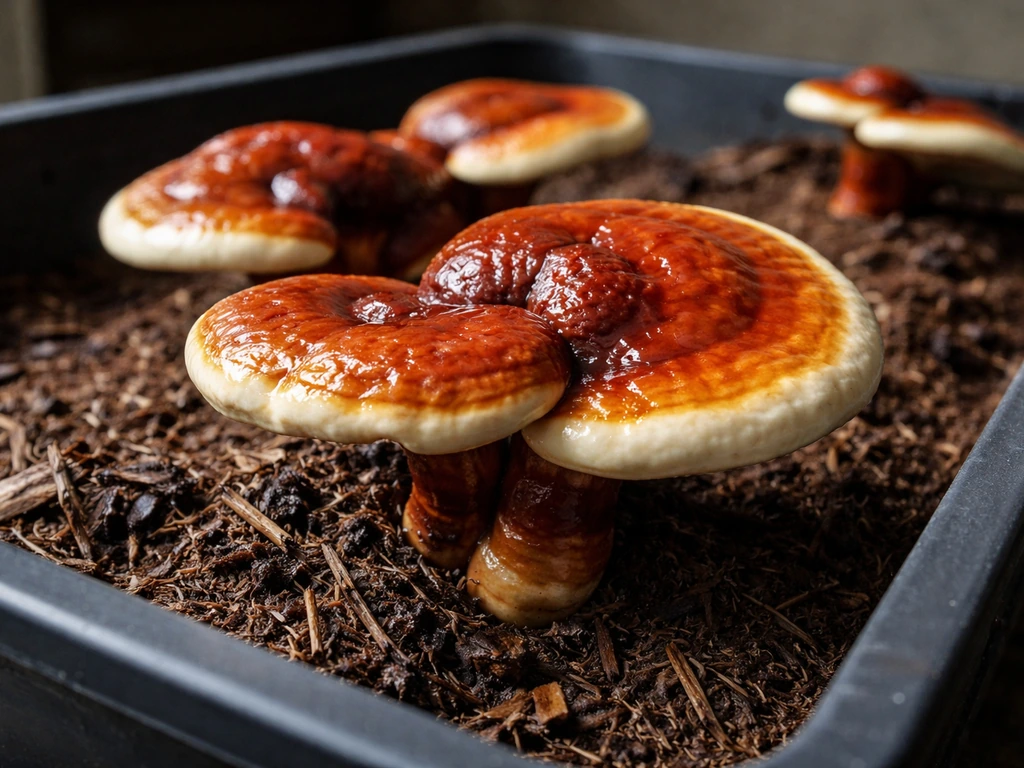
If you want to grow red mushrooms at home, the most rewarding path is red reishi (Ganoderma lucidum), the brick-red medicinal mushroom with a lacquered cap that looks almost too beautiful to be real. It takes longer than oysters or lion's mane, typically 60 to 120-plus days from inoculation to first harvest on a sawdust block, but the process is straightforward once you understand what reishi actually needs: sterilized hardwood sawdust substrate, high humidity around 85 to 95%, temperatures between 19 and 28°C (66 to 82°F), good fresh air exchange, and a lot of patience.
How to Grow Red Mushrooms at Home: Red Reishi Guide
Marcus Holloway
13 May 2026
Which 'red mushroom' are we actually talking about?
This is worth sorting out before you buy anything. If you found this guide after searching for red mushrooms in a general sense, you might be thinking of several different things. In the Minecraft world, crimson fungus and warped fungus are their own topic entirely, and those follow completely different rules than real-world cultivation. In Minecraft, growing warped fungus follows in-game rules, so the real-world steps in this guide will not apply.
In the Minecraft world, crimson fungus and warped fungus are their own topic entirely, and those follow completely different rules than real-world cultivation how to grow crimson fungus. In the overworld, crimson fungus has its own mechanics and growth limits, so the setup you use will differ from real-world reishi cultivation. In Minecraft, warped fungus has its own distinct growing rules, so it helps to follow the right guide for that specific fungus.
If you're interested in growing those, there are separate guides covering how to grow crimson fungus and related in-game fungi. If you want to learn the basics of fungal cultivation overall, start with this step-by-step guide on how to grow fungi how to grow crimson fungus. For the real-world home grower, 'red mushroom' almost always points to reishi.
Red reishi refers to Ganoderma lucidum, a wood-rotting polypore that grows bright red at maturity, passing through white and yellow phases as it develops. It's also called lingzhi or ling chih, and there's a fair amount of taxonomic confusion in the market: many products labeled 'G. lucidum' may actually be related Ganoderma species used interchangeably in traditional medicine. For practical home cultivation purposes, any supplier selling 'red reishi' or 'Reishi RED' as Ganoderma lucidum will give you essentially the same growing experience. Just buy from a reputable spawn vendor and you'll be fine.
There are other genuinely red-capped edible mushrooms out there, such as certain wax caps or red-staining species, but none of them have anywhere near the same cultivation infrastructure, spawn availability, or documented home-grow workflows as reishi. For practical purposes, this guide focuses on red reishi from start to finish. If you want a broader fungi learning path, the basics behind how to grow toadstools can help you think through setup, humidity, and timing across different edible types.
What you need to get started today
You don't need a lab or expensive equipment to grow red reishi at home, but you do need to source a few key things before your first inoculation day. Here's what to gather:
Strain and spawn format
Start with grain spawn or a ready-to-fruit block if you're a beginner. Vendors like North Spore, Field and Forest Products (GL94 strain), and Mushroom Mountain all carry red reishi in multiple formats: grain spawn, sawdust spawn, plug spawn, and pre-colonized ready-to-fruit blocks. Grain spawn (typically made from millet and wheat berries) is the most versatile because you can mix it into your own sterilized sawdust substrate. If you want the fastest path to your first harvest with the least risk of failure, buy a ready-to-fruit block. If you want to build the skill and scale up later, start with grain spawn and make your own blocks.
You can also start from liquid culture (LC) syringes, which introduce reishi mycelium directly into sterilized grain or sawdust. A 10 to 12 cc syringe per 3 to 5 lb block is a standard inoculation rate. Liquid culture is popular with intermediate growers because it's faster than waiting for grain spawn to ship and arrives in a sterile syringe ready to inject. Either way, avoid buying reishi spores as your starting point if you're a beginner. Spore inoculation is primarily used for long-form log cultivation, not indoor blocks, and the timeline stretches to 9 to 12 months.
Tools and materials checklist
- Red reishi grain spawn or a ready-to-fruit reishi block (1 to 5 lbs to start)
- Hardwood sawdust (oak, maple, or alder; avoid cedar or pine) and wheat bran or rice bran as a nutrient supplement
- Autoclavable or heat-safe polypropylene grow bags with filter patches
- Pressure cooker (at least 16 qt) for sterilization, or access to an autoclave
- Isopropyl alcohol (70%) and disposable gloves for sanitation
- Still air box or flow hood for inoculation
- Humidity source: a small ultrasonic humidifier, spray bottle, or a humidity tent made from a clear plastic bag
- Thermometer and hygrometer to monitor your fruiting environment
- Indirect light source: a simple LED grow light or placement near a north-facing window works
Space requirements
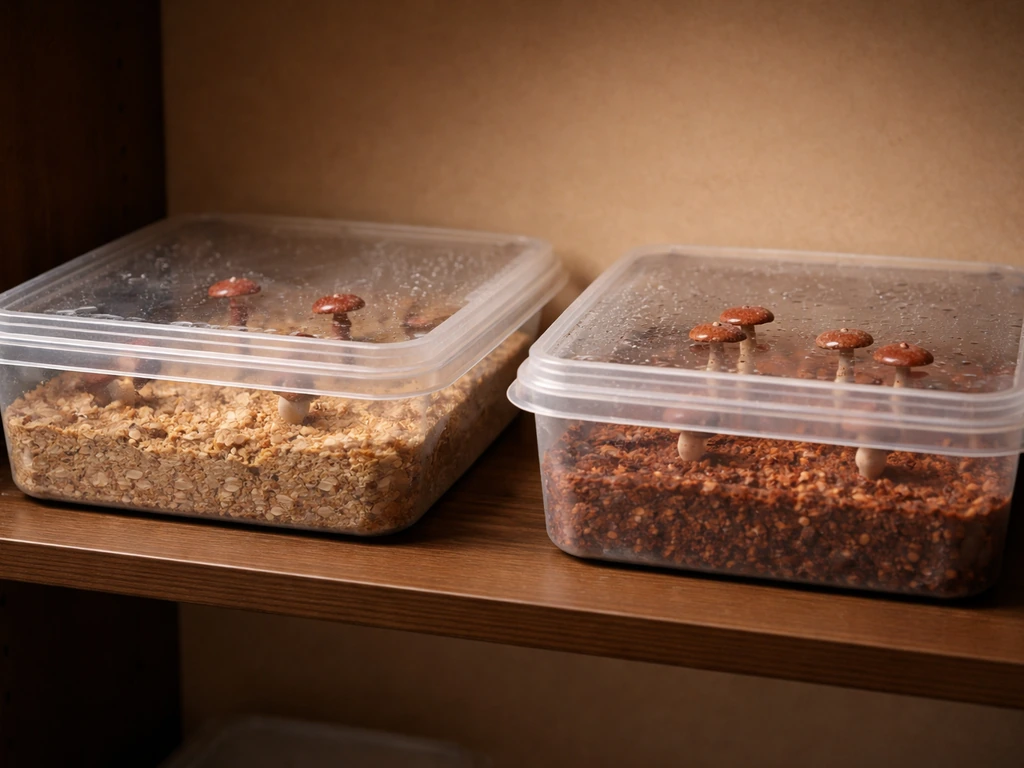
Reishi colonizes in a warm dark space (a closet shelf works great) and fruits in a spot where you can maintain high humidity and get some air circulation. A spare bathroom, a grow tent, or even a large plastic storage bin with drilled holes can work as a fruiting chamber. You don't need much space: a single 5 lb block takes up about the same footprint as a shoebox.
Substrate setup: reishi versus other red mushroom options
Reishi is a wood-lover through and through. Its preferred substrate is hardwood sawdust supplemented with wheat bran or rice bran at roughly 10 to 20% by dry weight. A common mix is 80% hardwood sawdust and 20% wheat bran with enough water to reach about 60 to 65% moisture content (the squeeze test: a hard squeeze produces just a few drops, not a stream). Getting moisture right is critical. Too wet and you're inviting bacterial contamination; too dry and the mycelium won't colonize properly.
For a comparison between the two main cultivation routes:
| Method | Substrate | Sterilization | Time to First Harvest | Best For |
|---|---|---|---|---|
| Sawdust block (indoor) | Hardwood sawdust + wheat bran | Pressure cook 2.5 hrs at 15 psi | 60–120 days | Beginners, indoor growers |
| Log inoculation (outdoor) | Hardwood logs (oak, alder) | Not sterilized; use fresh-cut logs | 9–12 months | Long-term outdoor setups |
| Ready-to-fruit kit | Pre-mixed, pre-sterilized block | Already done by supplier | 14–21 days from kit arrival | Absolute beginners, fastest results |
If you want a recommendation: go with the sawdust block method indoors. Log cultivation is a beautiful long-game approach and works well in a shaded garden or greenhouse with 70 to 75% shade cloth, but the 9 to 12 month wait before your first mushroom is a hard sell when you're just getting started. The indoor sawdust block gives you a real harvest within 2 to 4 months and teaches you every skill you need to scale up later.
Snow fungus (Tremella) and other specialty varieties are sometimes lumped into the 'white or unusual mushroom' category and have their own substrate requirements, but for red-colored cultivated mushrooms, reishi on hardwood sawdust is the clear standard. Snow fungus (Tremella) has different needs than reishi, so you will want to adjust your substrate and humidity targets accordingly.
Inoculation and colonization, step by step
Sterilize first, inoculate second
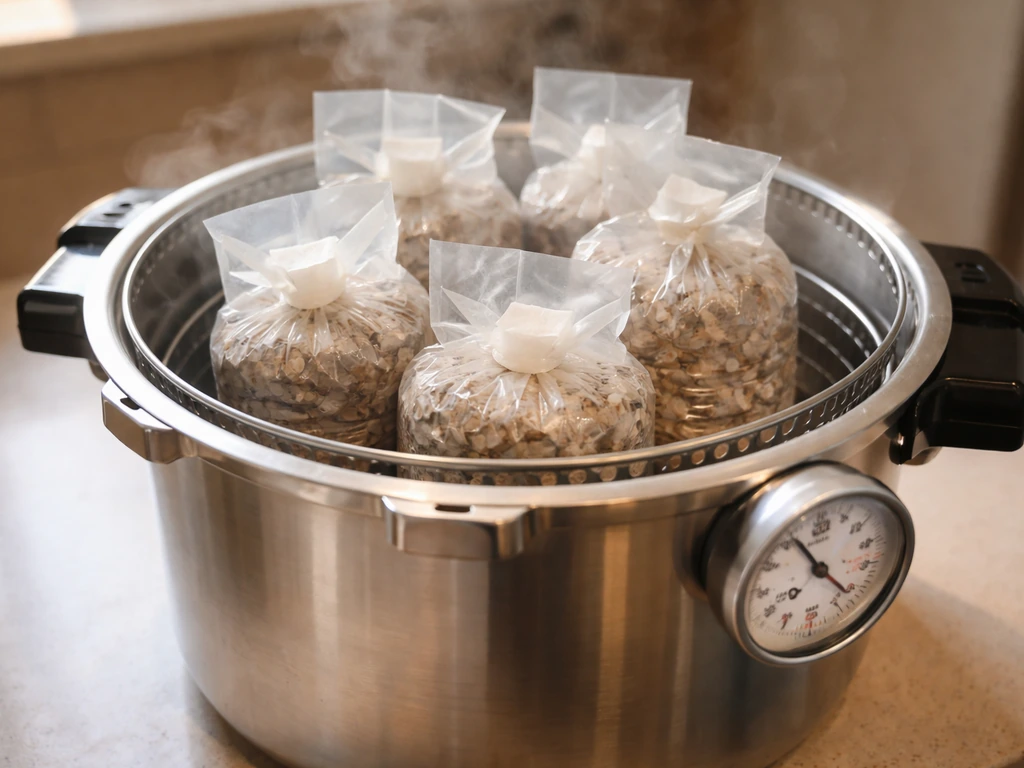
- Mix your hardwood sawdust and wheat bran dry, then add water until you hit 60–65% moisture content. Pack loosely into polypropylene grow bags.
- Pressure cook the bags at 15 psi for 2.5 hours. Let them cool completely to room temperature (below 21°C / 70°F) before inoculating. Inoculating hot substrate kills your spawn.
- Set up your still air box or flow hood. Wipe down all surfaces with 70% isopropyl alcohol, put on clean gloves, and work quickly.
- If using grain spawn: open the cooled bag in your clean zone and pour in roughly 10 to 20% grain spawn by weight relative to substrate. Seal the bag with an impulse sealer or fold and clip.
- If using liquid culture: flame-sterilize your needle, let it cool, inject 10 to 12 cc per bag through the filter patch or a self-healing injection port.
- Label each bag with the date and strain. Place in a dark warm space at 21 to 27°C (70 to 80°F) to colonize.
What happens during colonization
Reishi mycelium is white and often described as 'ropy' or 'cottony' as it spreads through the sawdust. On a well-inoculated block at the right temperature, you should see visible growth within 1 to 2 weeks. Full colonization typically takes 20 to 30 days for a supplemented sawdust block. The block will look fully white and feel firm when it's ready to fruit. Do not rush this stage. Reishi is slower to develop than oysters or shiitake, and moving to fruiting conditions before full colonization usually results in poor yields or contamination.
Keep the colonizing bags away from direct light and resist the urge to open them. Every time you open a bag during colonization you introduce contamination risk. Check visually through the bag. If you see green, black, or pink patches, that's mold contamination and the bag should be removed from your grow space immediately.
Fruiting environment: getting the conditions right
Once your block is fully colonized and you're ready to trigger fruiting, you need to shift the environment. Reishi responds to changes in CO2, humidity, fresh air, and light to know it's time to form mushrooms. Here are the targets:
| Parameter | Target Range | Notes |
|---|---|---|
| Temperature | 19–28°C (66–82°F) | Consistent warmth; avoid cold drafts |
| Relative Humidity | 85–95% | Higher end for primordia initiation |
| CO2 Level | Below 2000 ppm (ideally below 0.1%) | Fresh air exchange is critical |
| Light | 600–1,750 lux, 10+ hours indirect daily | No direct sun; LED or north-facing window |
| Fresh Air Exchanges | 4–6x per day minimum | Fan or manual fanning reduces CO2 buildup |
How to set up your fruiting chamber
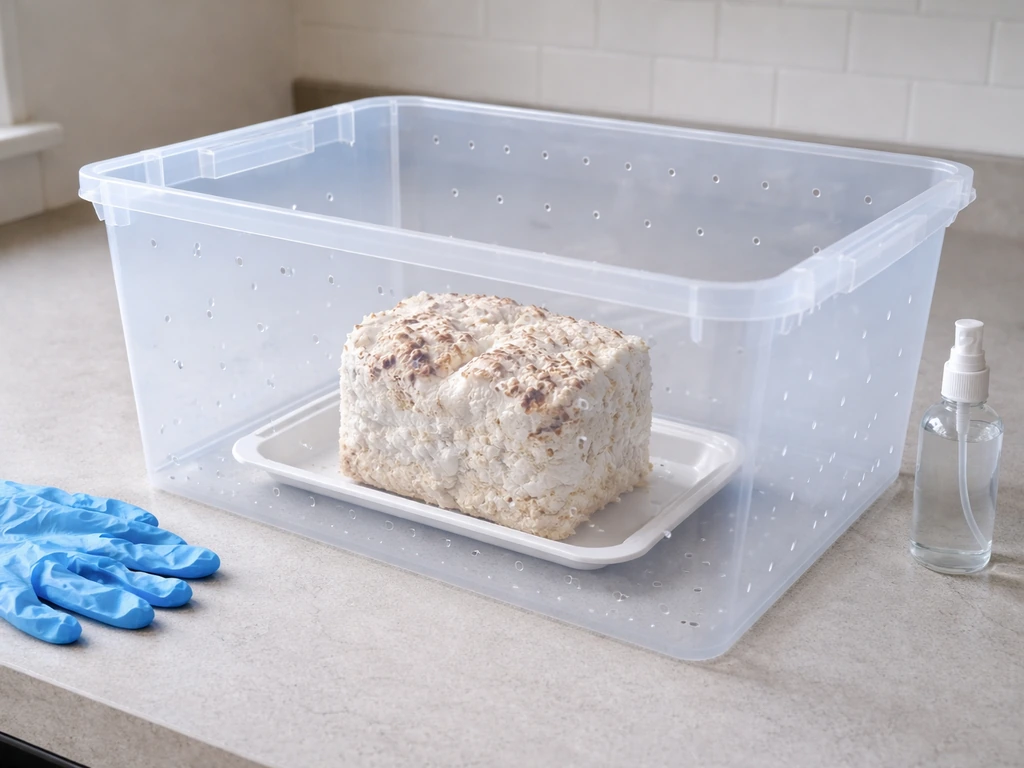
The easiest beginner fruiting chamber is a clear plastic storage bin (a 'shotgun fruiting chamber' or SGFC) with holes drilled on all four sides and the bottom, filled 3 to 4 inches deep with perlite moistened with water. The perlite acts as a passive humidity reservoir. Place your opened or cut block on a mesh shelf above the perlite, mist the walls 2 to 3 times a day, and fan the chamber for 30 to 60 seconds each time you mist to exchange CO2 for fresh air. This is cheap, effective, and reishi grows very well in it.
To trigger fruiting from a fully colonized block, make four staggered 'X' shaped cuts (about 1 inch by 1 inch) through the bag. This creates the exit points where antler-like primordia will first emerge. High CO2 during this early antler stage causes reishi to grow in long stalks; good fresh air exchange signals the mushroom to flatten into its characteristic shelf shape. If you want classically shaped reishi caps, prioritize air exchange once the stalks appear.
A small grow tent with an inline fan and a timer is a step up from the storage bin approach, and it makes humidity and fresh air management much easier if you plan to grow multiple blocks. A humidifier set to maintain 85 to 90% RH and a fan running on a 15-minutes-on, 45-minutes-off cycle covers most of what reishi needs.
Harvesting, drying, and storing your red reishi
Knowing when to harvest
Red reishi is ready to harvest before the cap margins fully lift and curl upward. The outer edge of the cap starts white or cream-colored as it grows, then deepens to orange and finally that characteristic bright red-lacquered color at maturity. Harvest when the cap is fully red but the margin still shows a thin cream or pale edge. If the margin disappears entirely and you start seeing spores (a fine rust-brown powder coating everything nearby), you've waited a bit too long, but the mushroom is still usable. Unlike oysters or lion's mane, reishi doesn't need to be harvested at peak speed. You have a wider window.
Twist and pull gently at the base of the stalk, or cut cleanly with a sterilized knife. After harvest, let the block rest in darkness for 4 to 7 days at a temperature slightly below your fruiting range, then resaturate it by soaking in clean water for 8 to 12 hours, drain, and return it to fruiting conditions. Most reishi blocks will give 2 to 3 flushes, though yields typically decrease with each successive flush.
Drying and storage
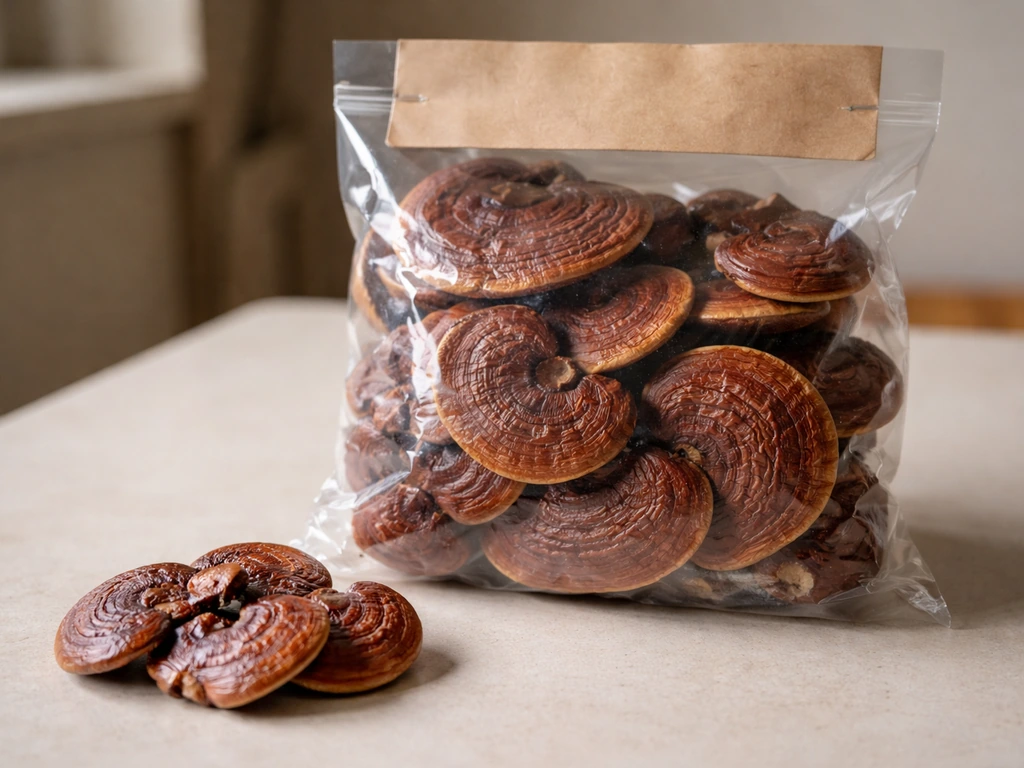
Fresh reishi is tough and woody, so you'll almost always dry it rather than eat it fresh. The key rule: keep drying temperature at or below 40°C (104°F). Higher temperatures start degrading the bioactive compounds (triterpenes, beta-glucans) that make reishi worth growing in the first place. The research on hot-air drying supports a range of 40 to 60°C with air movement, but for home growers preserving medicinal quality, staying closer to 40°C is the safer call.
Slice the cap into 1 to 2 cm pieces to speed drying. Use a food dehydrator set to 35 to 40°C for 18 to 24 hours, or an oven on its lowest setting with the door slightly ajar. The mushroom is fully dry when it's brittle and snaps cleanly rather than bending. Store in airtight glass jars away from light and moisture. Properly dried reishi keeps for 1 to 2 years without significant potency loss. Most people grind it into powder for tea, tinctures, or capsules.
Troubleshooting common problems
Contamination and mold
The number one failure in mushroom cultivation, full stop, is contamination. You're growing mycelium in a nutrient-rich environment that competing molds absolutely love. Green mold (Trichoderma) is the most common culprit. It typically shows up when sterilization was incomplete, substrate moisture was too high, or inoculation wasn't done in a clean enough environment. The rule is simple: cleanliness is the most important variable. Wipe everything with 70% isopropyl. Work fast. Don't breathe directly over open substrate. If a bag looks suspicious, isolate it immediately. Mold spreads.
Substrate moisture deserves special attention. Too much water creates the anaerobic, bacteria-friendly conditions that contamination loves. If you squeeze a handful of mixed substrate and water streams out, it's too wet. Add more dry sawdust and recheck. If you see no moisture at all when you squeeze hard, add water in small amounts. That zone where only a few drops release under firm pressure is where you want to be.
No growth or slow colonization
If you see no mycelium activity after two weeks, the most likely causes are: substrate that was too hot when inoculated (killing the spawn), substrate that is too dry, or spawn that was old or mishandled. Check your temperatures and make sure your storage space is consistently above 18°C. Reishi is slower than oysters but should still show visible white growth within 10 to 14 days on a properly prepared block.
Antlers instead of caps, or no fruiting
If your reishi grows long stalky antlers but never flattens into a cap, CO2 is too high. Increase your fresh air exchanges. Fan more aggressively, open vents, or add a small fan to your chamber. Antlers are actually a well-known reishi growth form and some growers deliberately encourage them, but if you want the classic fan-shaped cap, fresh air is the lever to pull. If you see no fruiting at all after 30 days of colonization, confirm your humidity is actually at 85% or above (hygrometers can drift, so calibrate yours) and make sure you've physically opened or cut the bag to give the mushroom an exit point.
Spore dumps
Reishi releases massive amounts of rust-brown spores at maturity. If you let this happen indoors, it coats every surface in your grow space and can be a respiratory irritant. Harvest before the spore dump, or tent the block with a light plastic bag to catch them. This is one of those things you only learn after your first grow leaves a fine brown haze all over your shelves.
Your grow plan at a glance
Here's a realistic workflow checklist for your first red reishi grow from scratch:
- Order red reishi grain spawn (Ganoderma lucidum) from a reputable vendor. While waiting, gather your materials.
- Mix hardwood sawdust and wheat bran (80/20), add water to 60–65% moisture, pack into grow bags.
- Pressure cook at 15 psi for 2.5 hours. Cool to room temperature.
- Inoculate in a still air box using clean technique. Add 10–20% grain spawn by weight, or inject 10–12 cc liquid culture per bag.
- Colonize in a dark, warm space at 21–27°C for 20–35 days. Check visually; don't open bags.
- Once fully white and firm, move to fruiting chamber. Cut four small 'X' incisions in the bag.
- Maintain 85–95% RH, 19–28°C, 600–1,750 lux indirect light for 10+ hours daily, and fan at least 4–6 times per day.
- Watch for primordia (small white bumps at the cuts), then stalks, then cap development over the next 3 to 6 weeks.
- Harvest when the cap is fully red with a thin pale margin remaining. Twist off or cut cleanly.
- Rest the block in darkness for 4–7 days, soak in water for 8–12 hours, return to fruiting conditions for flush two.
- Slice harvested mushrooms and dry at 35–40°C for 18–24 hours until brittle. Store in sealed glass jars.
Total time from inoculation to first harvest on a sawdust block runs 60 to 120 days depending on your conditions and block size. If you use a ready-to-fruit kit, you're looking at blank" rel="noopener noreferrer">14 to 21 days to first mushrooms. Either way, red reishi rewards the patient grower, and once you've seen that first lacquered red cap emerge from a block you made yourself, the timeline feels completely worth it. If you are wondering how do toadstools grow, the basics overlap, but mushroom species and growing conditions can vary a lot.
FAQ
Can I grow red reishi without sterilizing substrate at home?
Yes, but start with the cleanest option. If you use grain spawn or liquid culture, you still need to sterilize your hardwood sawdust well enough to prevent bacterial and mold takeover, otherwise the slower reishi timeline gives competitors time to establish. A practical compromise is buying a ready-to-fruit block for your first attempt, then learn sterilization and supplementation once you know your environment is stable.
What should I do if humidity is high but my blocks never fruit well?
If your humidity looks right but you still get poor fruiting, check surface wetness and airflow balance. Over-misting can leave pooled water on the block, which raises bacterial risk. Aim for damp walls and frequent light fanning, keep the block exposed to moving fresh air, and avoid spraying directly onto the cut sections for extended periods.
Can I grow red mushrooms if my room temperature drops at night?
It is possible, but it usually increases risk. Red reishi is slow enough that temperature swings allow contamination to catch up, and it also affects colonization speed. If you do supplement with bracing heat, use stable ambient temperatures, avoid hot spots near heaters, and confirm with a thermometer placed at block height.
How do I know when a reishi block is ready to go from colonization to fruiting?
Because reishi can be visually slow, you may need to judge colonization by firmness and coverage, not only color. A block that is fully white and feels firm is typically ready, but if only the edges look colonized, cut-and-trigging fruiting early often leads to low yields or contamination. Wait until the whole block is colonized before changing to fruiting conditions.
Is it okay to remove the bag right away during fruiting, or should I keep it on?
Cutting the bag after full colonization is important, but you should avoid large openings or frequent re-peeking. Make the staggered X cuts and then minimize handling until you see primordia. If you remove the bag completely, use your fruiting chamber to maintain humidity and fresh air, and keep the block from drying out at the cut sites.
Do I need bright light to get red reishi caps, or is humidity enough?
Light affects behavior, but fresh air is the main trigger. You can grow in a bright, indirect area without direct sun, and your SGFC or tent should still be vented. If you get long antlers with no shelf formation, your chamber likely has insufficient exchange, not insufficient light.
Can I eat reishi fresh instead of drying it, or store it in the fridge?
You can, but protect the result. After harvest, reishi should dry thoroughly, then be stored sealed from moisture and light. If you refrigerate fresh or partially dried material, it can soften and mold easily. A good workflow is drying to brittle, then powdering only after it is fully dry.
How can I tell the difference between normal reishi changes and contamination?
Use color and aroma as practical indicators, not just time. If you see green, black, or pink patches during colonization, or the substrate smells sour or unusually strong, isolate the block immediately. For fruiting, a thin rust-brown haze is more likely spore release, but if the block looks patchy with fuzzy growth, treat it as contamination.
What is the best way to get a second and third flush from a reishi block?
Often, yes. Reishi can fruit in multiple flushes, but the second and third flush usually depend on proper rest and rehydration. After the first harvest, rest the block in darkness at slightly below fruiting conditions for several days, then soak 8 to 12 hours, drain well, and return to your standard humidity and fresh air targets.
Why am I only getting long stalks (antlers) that never turn into caps?
If you see antlers but no cap flattening, increase fresh air exchange early and steadily, and reduce the time between misting and fanning. A timer-based fan cycle often helps because reishi responds to consistent CO2 changes. Confirm your chamber is actually venting, not just circulating the same humid air internally.
How do I prevent reishi spores from coating my whole grow space?
Reishi spores are a real indoor cleanup problem. Harvest before caps fully mature and start dumping spores, and if you miss the window, treat the entire grow space as contaminated, wipe surfaces, and avoid disturbing dust. Consider running the fruiting chamber inside a controlled area until harvest is complete.