You can grow truffles in North Carolina, and the state is actually one of the better places in the eastern U.S. to try. NC State University has active research orchards producing multiple truffle species, and commercial operations like Carolina Truffières have proven it works here. That said, this is a multi-year commitment tied to establishing living host trees, not something you set up over a weekend. If you want to apply these same principles to your own property in India, follow a region-specific plan for host trees, soil pH, and inoculated seedlings how to grow truffles in India. If you go in with clear expectations, the right site, and good inoculated plants, North Carolina gives you a real shot at producing truffles.
How to Grow Truffles in North Carolina: A Step-by-Step Guide
Marcus Holloway
24 May 2026
Truffles vs typical mushrooms: how "growing" really works
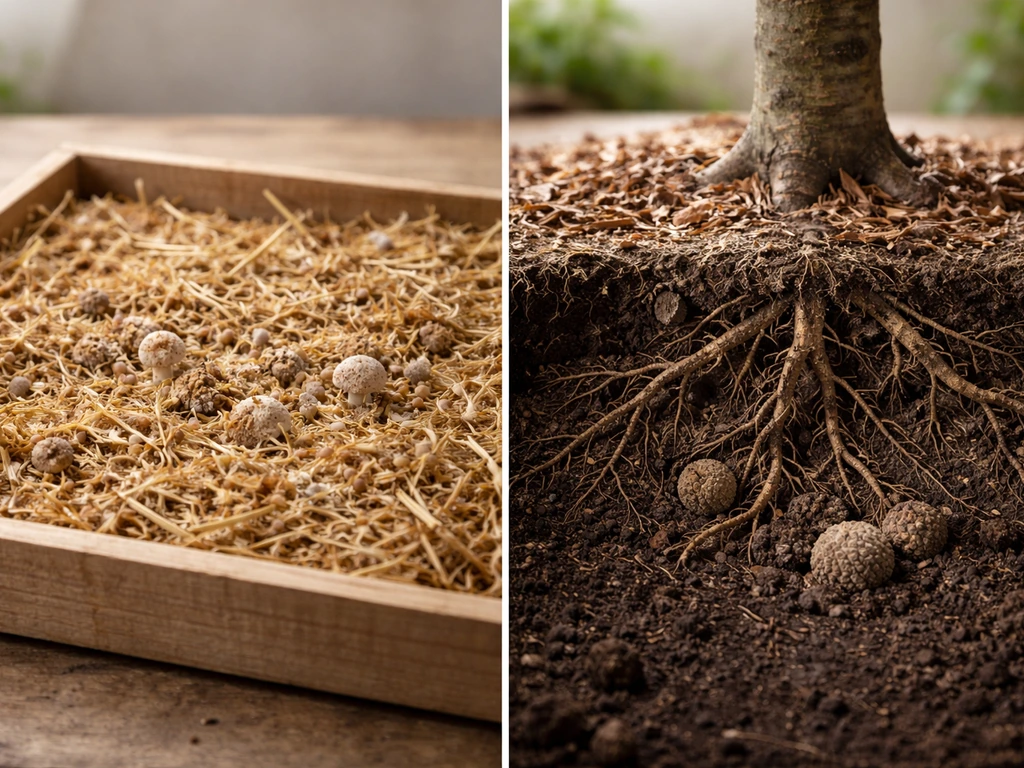
Most mushrooms you can cultivate at home grow on a substrate: logs, straw, sawdust, grain. You introduce spawn, keep humidity up, and wait. Truffles work completely differently. They are ectomycorrhizal fungi, meaning they live symbiotically in the roots of specific host trees. The truffle mycelium wraps around and grows between root cells, trading mineral nutrients for sugars from the tree. You cannot grow truffles in a bag of substrate or a bucket. Because hydroponics is still a container or substrate-based system, it does not match the way truffles need to grow with living host tree roots You cannot grow truffles in a bag of substrate or a bucket.. The tree is the growing medium.
What this means practically is that you are establishing an orchard, not a mushroom bed. You plant inoculated host tree seedlings, whose roots have been colonized with truffle mycelium before you ever buy them. Then you maintain the soil chemistry, drainage, and low-disturbance environment that keeps that mycelium healthy for years, until it eventually produces fruiting bodies underground. The truffles are those fruiting bodies. You are farming a tree-fungus relationship, and everything in your management strategy is aimed at keeping that relationship intact.
North Carolina suitability: climate, soil, and choosing the right truffle and host
North Carolina's climate is genuinely well-suited to truffle cultivation, particularly in the Piedmont and western mountain foothills. Winters are cold enough to trigger truffle maturation without being brutally harsh, and summers are warm but not as extreme as states further south. The state has limestone-rich soils in parts of the Piedmont that can be amended to the alkaline pH truffles demand. That said, the specific conditions matter a lot.
Which truffle species to target in NC
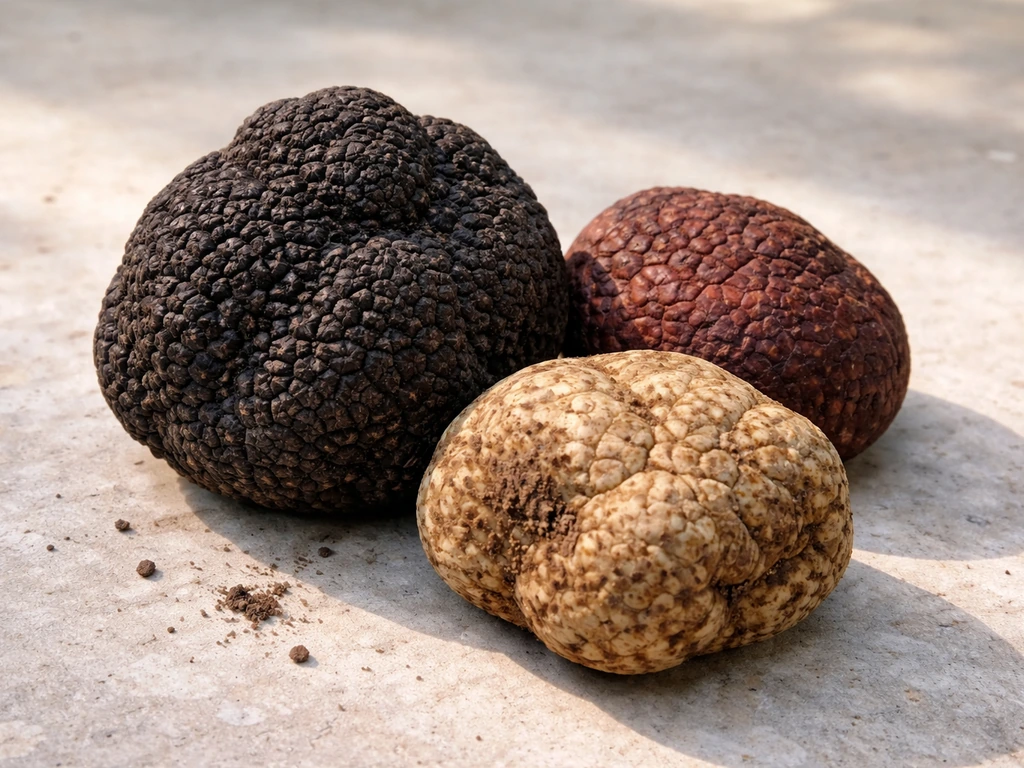
Three species are realistic candidates for NC cultivation. The black Périgord truffle (Tuber melanosporum) is the most commercially valuable and has the most research backing from NC State. It requires the highest pH and the most careful management, but it's proven viable here. The burgundy or summer truffle (Tuber aestivum) is a more forgiving option, tolerates a slightly wider range of conditions, and based on NC State's orchard data can be harvested as early as May through summer into fall. NC State Extension also reports that harvest timing in its research truffle orchard can begin as early as May for Tuber aestivum, continues through November for Tuber canaliculatum, and extends into winter for Tuber melanosporum through February harvest as early as May through summer into fall. There's also Tuber canaliculatum, a native Appalachian truffle that NC State is actively researching, with harvest continuing into November. If you want the highest-value crop and are willing to commit to strict soil management, go with T. melanosporum. If you want something with a better margin of error, T. aestivum is worth considering.
Host tree options
Filberts (hazelnuts, Corylus species) have historically been the most common host tree used in NC orchards, and for good reason: they grow quickly, tolerate NC's conditions well, and have a solid track record with T. melanosporum inoculation. Oak species are increasingly being planted as well, including English oak (Quercus robur) and other oaks. Oaks are slower to establish but produce a longer-lived orchard. Many growers plant a mix: faster-establishing hazelnuts for earlier production and oaks for long-term yield. Choose based on your timeline and the specific inoculated seedlings available from your supplier.
The soil pH reality
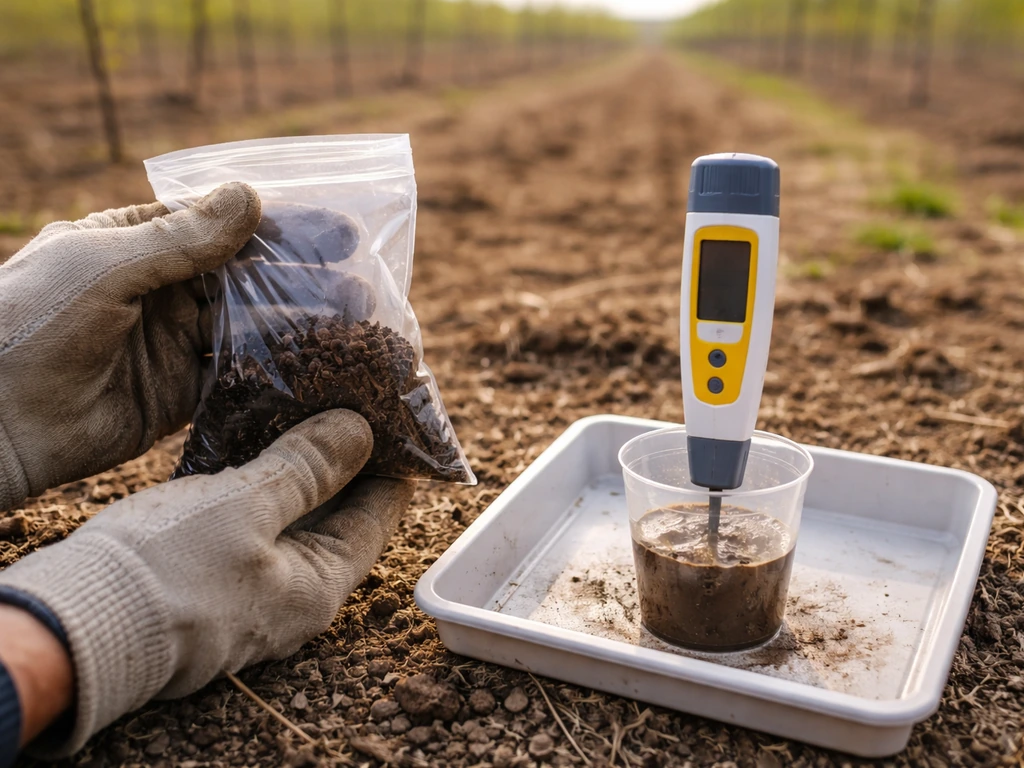
This is where most NC growers run into their first hard constraint. Tuber melanosporum requires a soil pH of roughly 7.6 to 8.1 according to NC State's research, with other sources pointing to 7.5 to 8.3 as the productive range. Most NC soils, especially in the eastern Piedmont and coastal plain, are naturally acidic. You will almost certainly need to amend with agricultural lime and possibly calcium carbonate to get there. This is not a one-time fix either: you have to test and maintain pH year after year. T. aestivum is somewhat more tolerant but still prefers alkaline conditions. Budget for repeated soil testing and amendments from the start.
Sourcing inoculated plants and planning your site layout
The single most important purchase you will make is the inoculated seedling. Do not try to inoculate your own seedlings unless you have laboratory access. Buy from a reputable supplier who can document the inoculation process and ideally provide qPCR testing confirmation that the seedlings actually contain viable T. melanosporum or T. aestivum mycelium. Carolina Truffières is the most established NC-based source. There are also suppliers in Oregon and Europe. When importing plants from outside the U.S., be aware that USDA APHIS regulates plant and plant product imports, so any seedlings from overseas sources need to comply with import inspection requirements. The USDA APHIS guidance on importing plants and plant products into the United States outlines the import process and the plant inspection standards that apply at entry USDA APHIS regulates plant and plant product imports, so any seedlings from overseas sources need to comply with import inspection requirements..
One critical warning: there are documented cases of inoculated seedlings sold as T. melanosporum that were actually colonized by Tuber brumale, a less desirable European truffle. A 2020 study documented T. brumale being accidentally introduced into North Carolina orchards through contaminated inoculum. This can lead you to invest years of management into trees producing the wrong truffle. Confirm species identity at the source and consider soil testing through NC State's Meadows Truffle Testing Service, which uses qPCR assays to detect and quantify T. melanosporum and T. aestivum in orchard soil, before and after planting.
Site layout and spacing
Plan for orchard-style spacing. Hazelnut hosts are typically spaced around 10 to 15 feet apart in rows 15 to 20 feet apart, allowing light cultivation equipment and air circulation. Oaks need more room and grow more slowly. A small hobby orchard might be 20 to 30 trees on a quarter acre. Larger commercial-scale plantings obviously scale up from there. Choose a south-facing slope if possible for maximum sun exposure and to help with drainage. Avoid frost pockets and areas with seasonal waterlogging.
Soil prep and site setup (pH, amendments, drainage, weed control)
Start soil preparation at least six months before planting, and ideally a full year out. Here is the sequence to follow:
- Get a comprehensive soil test: submit to NC State Extension or a private lab. You need pH, calcium, magnesium, phosphorus, potassium, and organic matter levels. NC State's Meadows Truffle Testing Service can also screen for native competing mycorrhizal fungi that might already be in your soil.
- Raise pH with agricultural limestone or calcium carbonate. If you are starting from typical NC Piedmont soil in the 5.5 to 6.5 range, expect to apply substantial amounts of lime. Follow your soil test recommendations, not guesswork. It takes months for lime to fully react with soil, which is why you start early.
- Till and incorporate amendments deeply: at least 12 inches, ideally 18 inches. Truffle mycelium and feeder roots operate in this zone. You want the amended pH throughout the rooting depth.
- Address drainage. NC State notes orchards need to be well-drained. If your site has clay hardpan or seasonal saturation, install drainage tile or raise your planting beds slightly. Standing water will kill your orchard.
- Control weeds aggressively before planting. Competing grass and broadleaf weeds will compete with your host trees and disrupt the low-disturbance conditions truffles need. Sheet mulching, solarization, or herbicide application months before planting all work. The goal is a clean site at planting time.
- Avoid adding high-phosphorus fertilizers or fresh manure. Excess phosphorus suppresses mycorrhizal fungi, including your truffle mycelium. This is a consistent failure point.
Planting and establishment care (watering, mulching, fertility do's and don'ts)
Plant inoculated seedlings in late winter to early spring, when trees are still dormant or just breaking dormancy. Handle root balls carefully: rough handling can disrupt the fragile mycorrhizal mantle on the roots. Dig holes just large enough for the root ball, set the tree at the same depth it was growing in the nursery container, and backfill with the amended native soil. Do not add potting mix, peat, or compost into the planting hole. Foreign organic matter in the hole can encourage competing fungi and disrupt pH right at the root zone.
Watering
Consistent moisture is essential, especially in the first two to three years while trees establish. NC State notes orchards should be irrigated. Drip irrigation is ideal: it keeps water off foliage and maintains even soil moisture without creating the waterlogged conditions that suffocate mycorrhizal roots. In NC summers, plan to irrigate weekly if rainfall drops below an inch per week. During winter dormancy you can back off significantly, but do not let the soil dry out completely during truffle development (December through February for T. melanosporum).
Mulching
Apply a 2 to 3 inch layer of gravel or coarse limestone chips around each tree, keeping it a few inches back from the trunk. Avoid wood chip or organic mulches near the trees: they decompose and acidify the soil, exactly the opposite of what you need. Some growers use a thin layer of straw during establishment, but limestone gravel is the standard recommendation for long-term pH maintenance and weed suppression.
Fertility and what to avoid
Keep fertilization minimal and targeted. If tree growth is poor, a low-phosphorus nitrogen source like calcium nitrate can be used sparingly. Never apply high-phosphorus fertilizers, fresh manure, or composted organics near the root zone. These all either suppress mycorrhizal colonization or acidify soil over time. Your main fertility intervention will be maintaining pH through annual lime applications based on soil tests, not feeding the trees with conventional fertilizer programs.
Light cultivation
NC State's research program recommends light soil cultivation several times per year in the orchard. This is not deep tilling: it is shallow surface disturbance, often just scratching the top inch or two, to manage weeds and maintain soil structure without destroying the truffle mycelium network below. Do this with a rake or a light-pass cultivator, keeping cultivation shallow and away from the immediate trunk zone.
Troubleshooting when truffles don't fruit
The PubMed research on North Carolina orchards documented exactly the kind of inconsistency you should expect and plan for: in one orchard, T. melanosporum was detected on all trees, but in another it was found on only 2 of 15 trees. That is the reality. Here are the most common failure points and what to do about them.
| Problem | Likely Cause | Fix |
|---|---|---|
| No truffle mycelium detected in soil tests | Poor inoculation on purchased seedlings or T. brumale contamination | Test seedlings via qPCR before planting; buy from verified supplier; retest soil |
| Trees growing but no fruiting after 7+ years | pH too low, competing mycorrhizal fungi displacing T. melanosporum | Annual soil tests; lime to maintain 7.6–8.1; reduce phosphorus; shallow cultivation |
| Patchy establishment across trees | Soil variability, drainage differences, or uneven inoculation quality | Soil test individual tree zones; add lime to low-pH spots; improve drainage in wet areas |
| Competing fungi taking over | Native ectomycorrhizal fungi outcompeting truffle; soil pH drifting down | Maintain strict pH discipline; avoid organic amendments that drop pH |
| Animal disturbance and digging | Squirrels, deer, wild pigs, dogs following truffle scent | Install fencing; use fine mesh at soil surface near trees during harvest season |
| Tree decline or poor growth | Root disease, waterlogging, or herbicide drift | Improve drainage; review any chemical applications near the orchard; test for pathogens |
The competing mycorrhizal fungi issue deserves extra attention. Native soil in North Carolina is already loaded with ectomycorrhizal fungi that will colonize your host tree roots if given the opportunity. Maintaining the correct alkaline pH is your primary weapon: most native competitors prefer more acidic conditions, so keeping pH at 7.6 or above actively selects for T. melanosporum over competitors. If pH drifts down to 7.0 or below, expect the truffle mycelium to lose ground fast.
Harvest timing and practical harvesting methods in NC
Harvest timing in North Carolina depends on which species you planted. Based on NC State's research orchard observations across the year, here is what to expect:
| Species | Harvest Season in NC | Notes |
|---|---|---|
| Tuber aestivum (summer/burgundy truffle) | May through summer | Earlier harvest window; more forgiving species |
| Tuber canaliculatum (Appalachian truffle) | Through November | Native species; NC State actively researching |
| Tuber melanosporum (black Périgord) | December through late February / early March | Peak quality in midwinter; highest value |
For T. melanosporum, Carolina Truffières confirms the peak harvest window runs December through late February, sometimes into early March. The truffles mature underground and are ready when they develop their characteristic pungent, earthy aroma. Ripe truffles have a firm but slightly yielding texture and black interior marbled with white veins.
How to actually find and harvest them
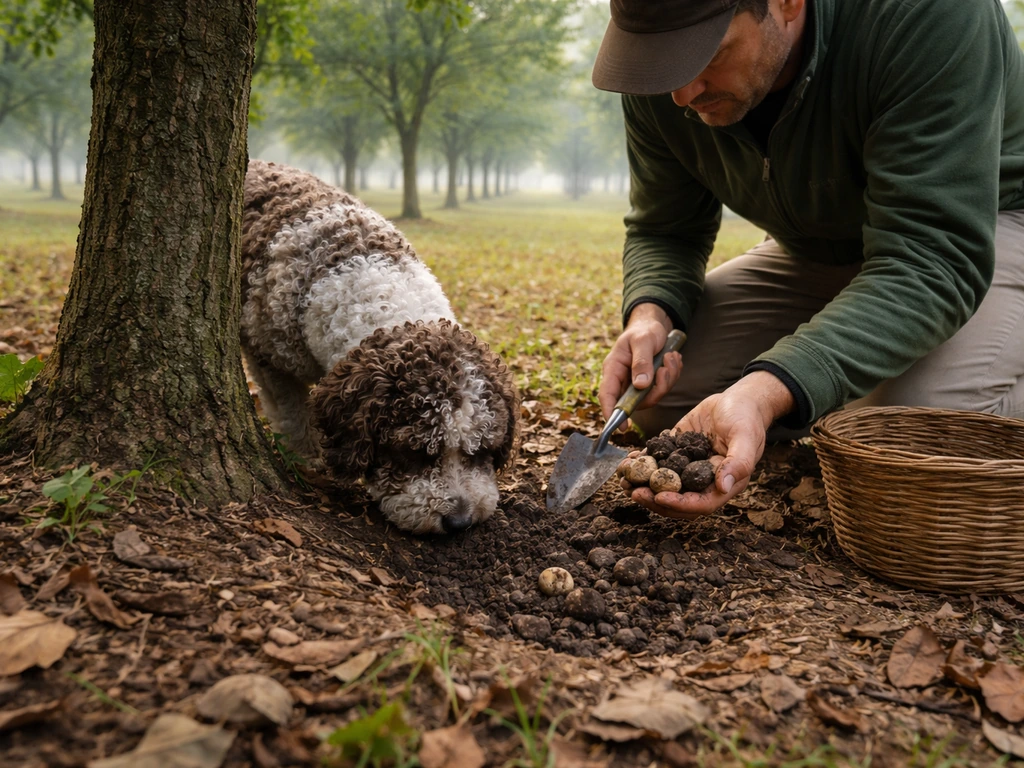
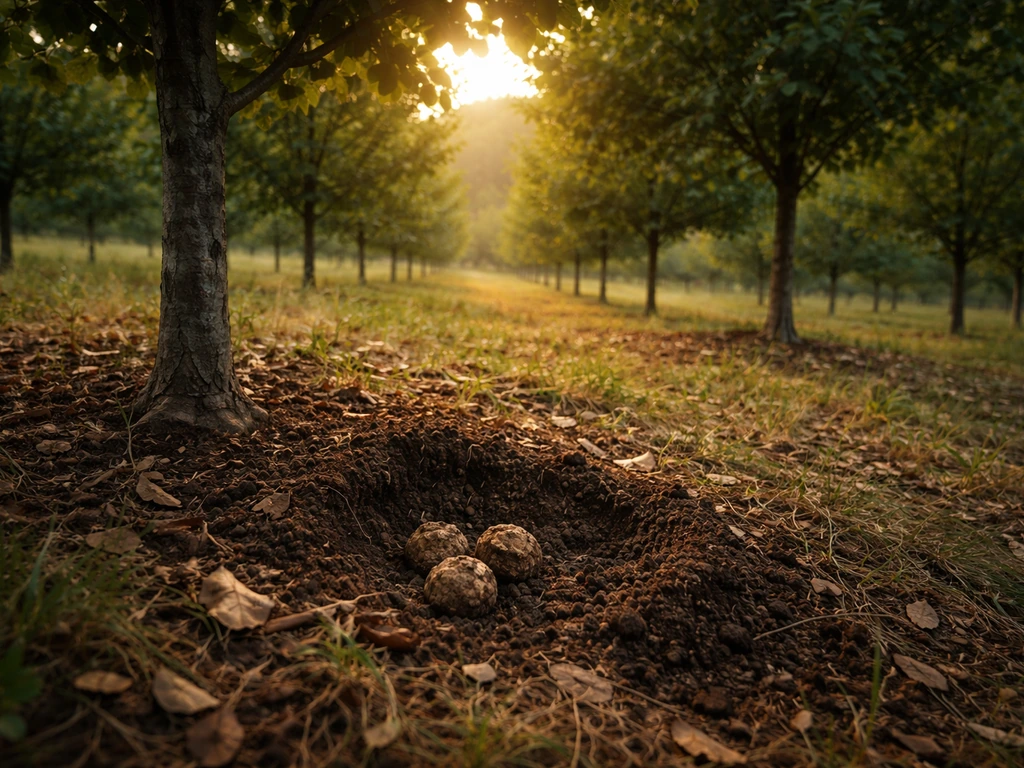
The traditional method is trained dogs. A well-trained truffle dog (Lagotto Romagnolo is the classic breed, but many mixed-breed dogs learn the scent) will identify ripe truffles without destroying anything. This is the method used by serious NC orchardists. Pigs were once used but they eat the truffles and cause far more root damage.
If you do not have a trained dog, you can probe gently with a blunt rod near the tree's drip line, feeling for firm objects 2 to 6 inches below the surface. When you locate one, excavate carefully by hand with a small trowel. Replace the soil after harvesting and firm it back down gently. Be cautious with any raking method: ethical harvesting guidance from truffle researchers cautions that aggressive raking damages tree roots, mycelium, and the local environment. Minimal disturbance is the right approach.
Timeline expectations and how to scale and improve results
Here is the honest timeline: first truffle production typically begins somewhere between year 6 and year 10 after planting. International research on T. melanosporum cultivation puts the onset of fruiting in the 6 to 10 year range, which aligns with NC State's orchard observations. Do not expect anything in the first five years. During that period, your job is purely maintenance: keep pH right, keep moisture consistent, keep competing vegetation under control, and do not disturb the root zone. If you are specifically planning for Wisconsin, you will need to match your orchard plan to that state’s climate and soil pH constraints Wisconsin truffle growing.
Use the Meadows Truffle Testing Service at NC State's Mountain Research Lab to test your orchard soil every one to two years. This qPCR testing service detects and quantifies T. melanosporum and T. aestivum mycelium in soil samples, telling you whether the fungus is present and roughly how much. It is the only way to know if your orchard is on track before the first truffle appears. The lab provides a sample submission form and instructions for how to collect and submit soil cores from individual trees.
Scaling up and improving year over year
Once your orchard starts producing, annual practices after the fruiting season include light pruning of host trees to maintain canopy openness and shallow soil tillage. Scientific research on established T. melanosporum orchards identifies these post-fruiting soil and canopy management steps as standard practice. Some growers also use localized peat-based soil amendments near the tree base to maintain moisture and slightly adjust local soil chemistry: research has explored this approach, though results vary. Keep detailed records of which trees produce, their soil pH, and annual yield. Productivity varies significantly tree to tree, and your records will tell you where to concentrate management.
If you want to expand, plant additional trees in newly prepared areas using the same soil prep protocol. Each new block of trees restarts the 6 to 10 year clock, so staggering plantings over time gives you a pipeline of orchards at different production stages. Growers in similar climates in Georgia are working through the same timeline and challenges, so connecting with the regional truffle grower community gives you access to shared lessons from nearby sites. Even though this guide focuses on North Carolina, Georgia growers follow the same orchard-and-mycelium basics and can use the local climate and soil constraints to tailor their host trees, pH management, and irrigation.
Realistic constraints to accept upfront
Inoculated seedlings are not widely available at local nurseries. You will likely order from specialty suppliers with limited stock and seasonal availability windows. Costs per seedling are significant compared to conventional trees, often $20 to $50 or more per plant from reputable sources. The long time-to-harvest means you are committing land and resources for most of a decade before seeing a return. And despite doing everything right, some trees simply may not produce, either because of subtle soil variation, competing fungi, or inoculation failures. The research data from NC orchards makes this clear. The growers who succeed treat it like a perennial crop investment: patient, systematic, data-driven, and willing to iterate. In Stardew Valley, purple mushrooms are grown differently than truffles, since you typically cultivate them through in-game mushroom logs and conditions purple mushrooms in Stardew Valley.
FAQ
Can I plant truffle seedlings in containers and then move them into my orchard later?
For most home growers, it is better to plant directly into the prepared orchard site. The mycorrhizal mantle can be stressed by repeated root disturbance, and potting mixes or added organics can shift pH and encourage competing fungi. If you must stage plants, keep them in the original nursery medium, minimize root disturbance, and transplant only during late winter to early spring to reduce shock.
What soil pH target should I use in North Carolina, and how strict do I need to be?
For black Périgord truffles, the practical target is roughly 7.6 to 8.1 (with productive range sometimes reported slightly wider). You do not just “set and forget,” pH drift can happen with rainfall, irrigation water chemistry, and continued competition from native ectomycorrhizal fungi. Plan to retest at least annually at first, and do corrective lime in small, measured steps rather than large one-time changes.
How do I know if my trees are colonized before I see truffles?
Use soil testing rather than waiting for fruiting. NC State’s Meadows Truffle Testing Service can use qPCR to detect and quantify specific truffle mycelium in soil samples. Collect samples by tree (not just one mixed bag for the whole block), so you can identify which trees are on track and which need troubleshooting.
Will adding compost, manure, or peat help my truffle orchard because it improves fertility?
Usually no, especially near the tree base. High-organic inputs and fresh or composted manures tend to acidify the root zone and can shift the fungal community away from the truffle. If you need any organic adjustments, keep them away from the immediate root area, and verify the impact with soil pH tests rather than assuming they will “help.”
Is weekly irrigation always required in North Carolina?
Not always, but consistent moisture in the first 2 to 3 years is crucial. A useful rule is to base irrigation on rainfall and soil drying, not the calendar, because heavy clay sites can stay wet too long while sandy soils dry quickly. Use drip irrigation to avoid leaf wetness and aim to prevent both prolonged drying and waterlogging during the key truffle development period.
What is the best way to manage weed control without damaging the truffle mycelium network?
Use shallow, infrequent surface disturbance and avoid digging or deep tillage near the trunk zone. Limestone gravel or coarse chip mulches away from the trunk can suppress weeds and reduce the need for aggressive cultivation. If you need spot control, target weeds with careful hand removal rather than broad soil disturbance that can break up the fungal network.
Can I rake aggressively to speed up harvest or expose truffles?
It is risky. Aggressive raking and repeated root-zone disturbance can damage tree roots and reduce mycorrhizal stability, which can delay future production. Prefer trained-dog identification, or if you probe, excavate gently by hand, then firm the soil back carefully to avoid leaving loose pockets.
How far apart should I plant, and what changes if I’m using oak instead of hazelnut?
Hazelnuts are commonly spaced about 10 to 15 feet apart in rows 15 to 20 feet apart to balance orchard access and air flow. Oaks generally need more room and establish more slowly, so you should use wider spacing and plan for more light management over time to keep canopy openness without constant disturbance.
What should I do if my soil tests show truffle presence on only a few trees?
Treat it as normal variability, but respond with data. Recheck pH and moisture practices for the underperforming trees, compare drainage and slope position across the orchard, and retest at the tree level. If you notice one area consistently lagging, consider whether it is receiving different irrigation, shade, or fertilizer contamination, since these can quickly tip the competitive balance.
How do I avoid buying the wrong truffle species from inoculated seedlings?
Ask the supplier to document the inoculation method and, ideally, provide molecular confirmation such as qPCR testing. Also consider verifying through follow-up soil testing after planting. This matters because there have been cases where orchards intended for Tuber melanosporum were colonized by other, less desirable truffles.
What is the first harvest timeline realistically, and when should I stop expecting production?
A common expectation for black Périgord is fruiting starting between years 6 and 10. Truffles can still fail to appear even after that if colonization was incomplete or conditions drifted (pH, moisture, competition). Use qPCR soil tests to confirm whether the fungus is present before assuming the orchard has “failed,” since that can change your next steps.
Where exactly should the limestone gravel or coarse chips go, and can I use wood mulch instead?
Keep the coarse limestone or gravel a few inches back from the trunk and as a band around each tree to support pH maintenance and weed suppression. Avoid wood chips or organic mulches near the trees because decomposition can acidify soil, undermining the alkaline conditions the truffle needs.
If my trees are not growing well, can I fix that with phosphorus-heavy fertilizer?
Avoid high-phosphorus fertilizers and manure or composted organics near the root zone. If growth is poor, use targeted, low-phosphorus options sparingly and rely on soil testing for both pH and nutrient needs. In many orchards, “tree growth issues” are actually soil chemistry or drainage problems that require adjusting the orchard environment rather than feeding.
Should I start a new block of trees after my first harvest begins?
Yes, staggering is a strong strategy because each new planting area essentially restarts the timeline to first production. It helps smooth income and gives you opportunities to compare what works across slightly different micro-sites, since North Carolina soils can vary a lot even across nearby plots.