You can grow truffles in Georgia, but it takes years of patience, the right soil chemistry, and a fundamentally different mindset than growing shiitakes or oysters on a log. Truffles are ectomycorrhizal fungi, they live on the roots of specific host trees, not on prepared substrates or in grow bags. In general, you cannot grow truffles hydroponically because they require a living host tree root system to form ectomycorrhizae.
How to Grow Truffles in Georgia: Step-by-Step Guide
Marcus Holloway
7 Jun 2026
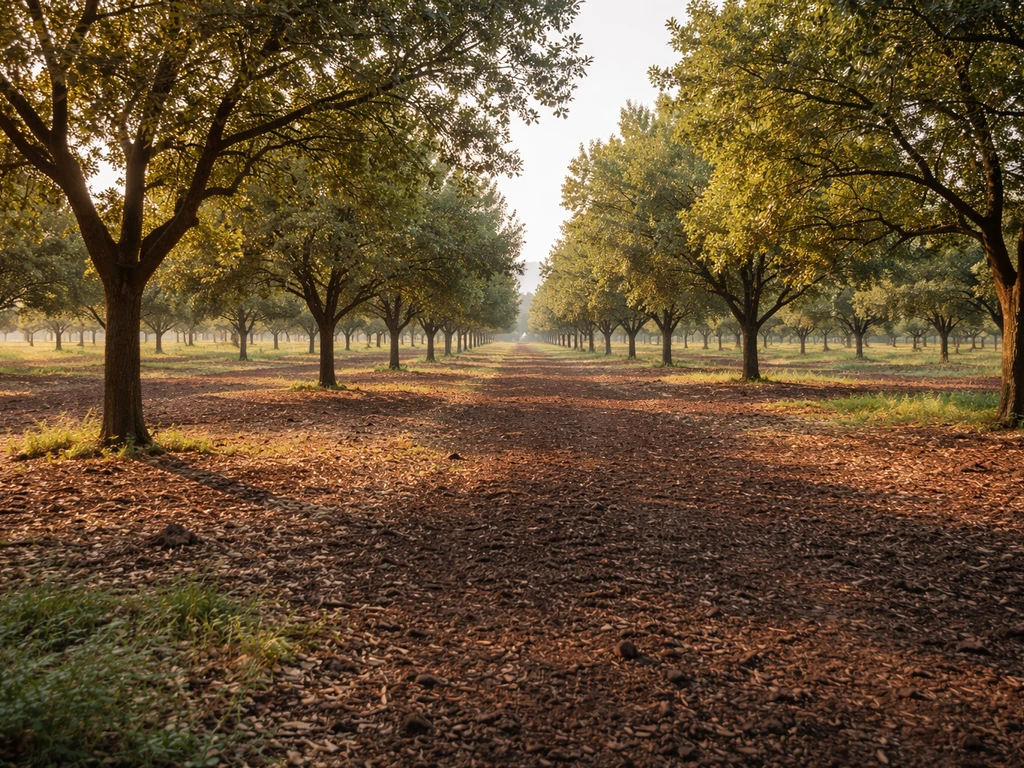
To 'grow' them, you plant inoculated tree seedlings into a carefully prepared outdoor orchard, manage that orchard for years, and eventually harvest subterranean fruiting bodies from the soil. The earliest realistic first harvest is around five to six years after planting; peak production takes closer to ten or more.
That said, Georgia's climate and diverse soils do make certain truffle species genuinely feasible here, and growers in neighboring states like North Carolina have already demonstrated it's possible with the right setup. If you're specifically wondering how to grow truffles in North Carolina, the same long-term ECM orchard approach can work in the piedmont and mountain regions with proper soil pH and host tree choices.
Truffles are not like other mushrooms you can grow
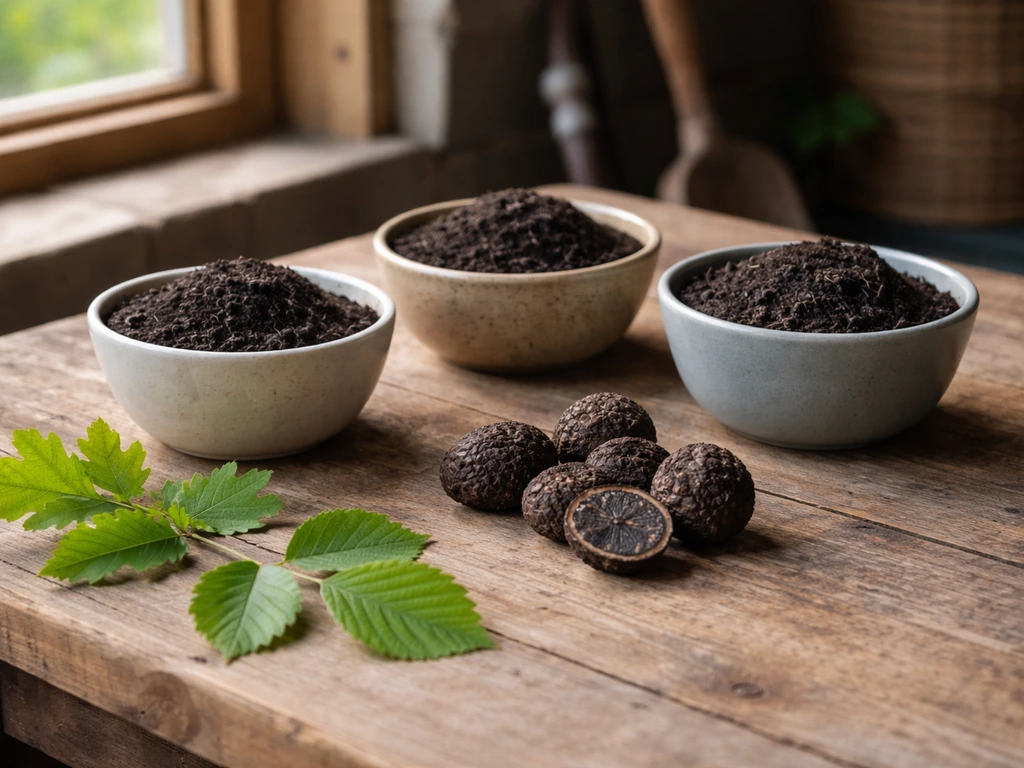
If you've grown oyster mushrooms or lion's mane before, truffle cultivation will feel like a completely different discipline. Most edible mushrooms are saprotrophic, they break down dead organic matter and can be grown on straw, sawdust, or logs. Truffles are obligate ectomycorrhizal (ECM) fungi, meaning they cannot survive or fruit without a living host tree root system. You cannot grow Tuber melanosporum (the prized black Périgord truffle) in a grow tent, a raised bed, or a tub of substrate. The fungus wraps around the fine root tips of specific tree species, forming a symbiotic relationship that exchanges minerals from the soil for carbohydrates from the tree. That symbiosis is what eventually produces the truffle fruiting bodies underground.
The way you 'plant' truffles is by sourcing nursery seedlings whose roots have already been inoculated with truffle mycelium, then establishing those trees in a prepared outdoor orchard. Everything else, soil prep, irrigation, weed control, fertilization restrictions, is in service of keeping that tree-fungus relationship healthy long enough for fruiting to happen. Think of yourself as managing a long-term symbiosis, not a substrate grow. In Stardew Valley, you can learn the basics of truffle farming by planting the right seeds and using the correct approach to keep your farm productive truffle farming in Stardew Valley.
Which truffle species actually works in Georgia
Georgia's climate is the first filter. The state spans USDA hardiness zones 6b through 9a, with hot, humid summers, mild winters in the south, and occasional hard freezes in the north. The piedmont and mountain regions of north Georgia offer the most realistic shot at black truffle production because summers are somewhat cooler and winters are cold enough to provide the seasonal cycling that Tuber melanosporum requires.
| Truffle Species | Common Name | Georgia Fit | Key Host Trees | Soil pH Target |
|---|---|---|---|---|
| Tuber melanosporum | Black Périgord | Best fit in north/piedmont Georgia; needs seasonal cycling and calcareous soils | English oak, holm oak, hazel | 7.5–8.3 (optimal 7.7–8.0) |
| Tuber aestivum | Burgundy/Summer Black | Moderate fit; slightly more tolerant of varied soils; good for humid-temperate conditions | Oak, hazel, hornbeam, beech | 7.0–8.5 |
| Tuber borchii | Bianchetto | Limited commercial interest; more forgiving pH range; lower value | Pine, oak, hazel | 6.5–8.0 |
For most Georgia growers aiming at commercial or premium-quality production, Tuber melanosporum is the target. Tuber aestivum (the Burgundy truffle) is a solid alternative if your soils are harder to alkalinize or your site is in the warmer central or southern part of the state, it's also the species Missouri Extension has documented in agroforestry applications in humid-temperate climates, which is climatically closer to Georgia than France. Avoid chasing Tuber magnatum (white Alba truffle) for now: its requirements are extremely narrow and it is not a realistic starting point for most landowners.
Site selection: where to put your truffle orchard
Site selection is the decision that will define whether your orchard has a realistic shot. Pick this wrong and no amount of amendments, irrigation, or quality inoculated seedlings will save you. Here's what you're looking for:
- Full sun to very light partial shade — mature truffle orchards are open, sun-exposed. Dense canopy shade suppresses both the host trees and the fungal network.
- South or southeast-facing slope if possible — promotes drainage, sun exposure, and slightly warmer soil temperatures in winter. Georgia's piedmont has plenty of gently rolling terrain that fits this well.
- Well-drained soil — this is non-negotiable. Truffle mycelium cannot tolerate waterlogged roots. Avoid low spots, clay-heavy bottomland, or any area with seasonal flooding. Sandy loam to loam soils are ideal.
- Minimal existing ECM tree competition — planting near established oaks or pines means existing competing ectomycorrhizal fungi are already in the soil and will try to colonize your seedlings' roots instead of your target truffle.
- Accessible to irrigation — Georgia summers regularly exceed 35°C (95°F), and drought stress is a real threat. You need to be able to deliver supplemental water reliably.
Soil testing: the step most people skip
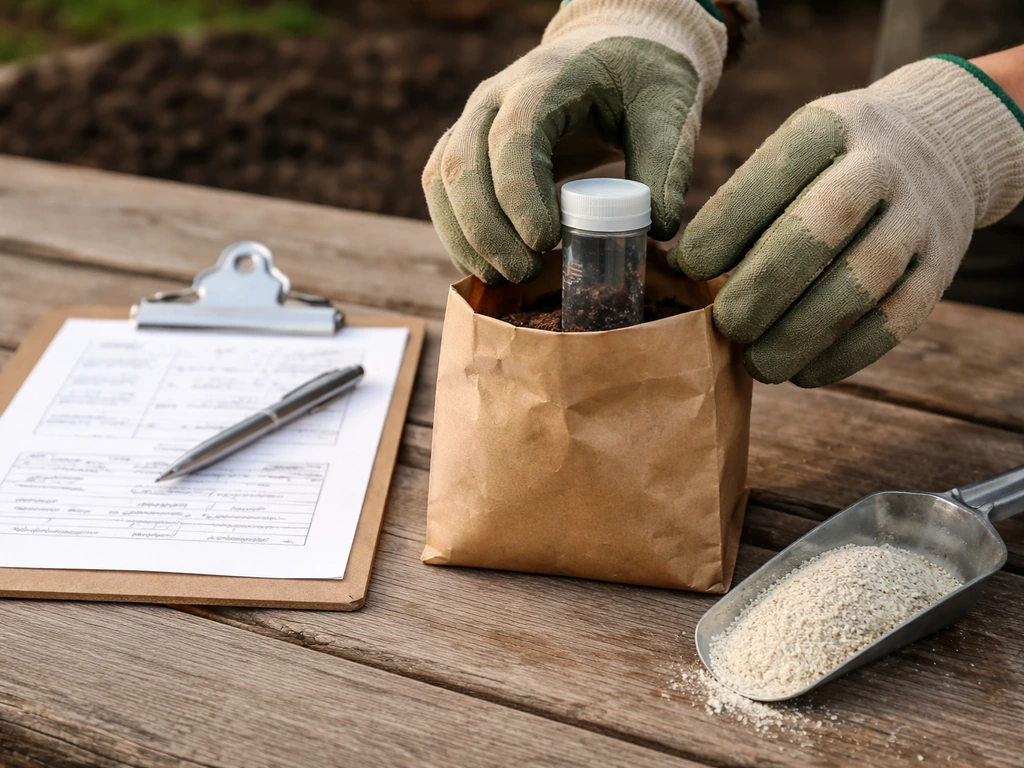
Do not plant inoculated seedlings before you have a soil test in hand. Georgia's native soils are typically acidic, often in the pH 5.0–6.5 range, which is the opposite of what truffles need. Tuber melanosporum requires a soil pH of 7.5–8.3, with 7.7–8.0 being optimal. The University of Georgia Cooperative Extension offers soil testing through your county office, and a standard test will give you pH, nutrient levels, and a lime recommendation. Get the full panel including calcium and magnesium.
Once you have your results, the primary amendment job is liming. Agricultural lime (calcium carbonate) raises pH, and you'll likely need significant applications to go from Georgia's typical 5.5–6.0 range up toward 7.8. Dolomitic lime works well and adds magnesium alongside calcium, which truffles appreciate. Pulverized limestone or agricultural lime should be tilled into the top 20–30 cm of soil, ideally 6–12 months before planting. Retest pH before you plant. If your pH overshoots and needs to come down slightly, elemental sulfur will lower it, but that scenario is rare starting from Georgia soils. The calcareous parent material that European truffle terroir relies on is not native to most of Georgia, so you're essentially creating it artificially through liming.
Beyond pH, avoid high-phosphorus fertilizers at this stage. Excess phosphorus suppresses ECM fungi. Do not amend with heavy composts or high-nitrogen organic matter either, truffle orchards want lean, well-aerated, alkaline soil, not rich garden soil. If drainage is a problem, address it structurally (subsoil aeration, raised row planting, or tile drainage) rather than with organic amendments.
Sourcing inoculated seedlings and setting up your planting layout
The single most critical purchase you'll make is quality inoculated seedlings. This is not a DIY step for beginners. The inoculation process involves applying truffle mycelium (from verified truffle stock) to sterilized nursery seedlings under controlled conditions, then confirming colonization before sale. When buying, ask specifically whether the inoculation has been DNA-verified, reputable suppliers like American Truffle Company use DNA testing and nursery quality control to confirm the fungal identity of their inoculum. An inoculated seedling that carries contaminating ECM fungi or was poorly inoculated is nearly worthless.
Common host tree species for black truffle in North America include English oak (Quercus robur), downy oak (Quercus pubescens), holm oak (Quercus ilex), European hazel (Corylus avellana), and occasionally filbert. For Georgia's climate, English oak and European hazel are the most practical starting points. When your seedlings arrive with bare roots, wash the root systems gently but thoroughly with clean water before planting. This removes any native nursery soil that could be carrying competing ECM fungi that would displace your truffle inoculation.
For orchard layout, space trees 13–20 feet apart. Closer spacing (around 13 feet) gives you more trees per acre and more potential colonized root surface area early on, but requires more management as trees mature and canopies begin to close. Rows oriented north-south maximize sun exposure across the orchard. A small test planting of 20–50 trees is a reasonable starting scale for most Georgia homeowners, enough to be meaningful without risking a large investment on a site that hasn't been proven.
Plant in early spring (March to April in north Georgia) or early autumn (October). Spring planting lets seedlings establish before summer heat; autumn planting in Georgia takes advantage of mild winters and allows root development before the following summer's stress period. Either window works, just don't plant into waterlogged or frozen soil.
Orchard care over the long haul
Truffle orchards are managed for years, and management decisions compound. Here's what ongoing care actually looks like:
Weed control
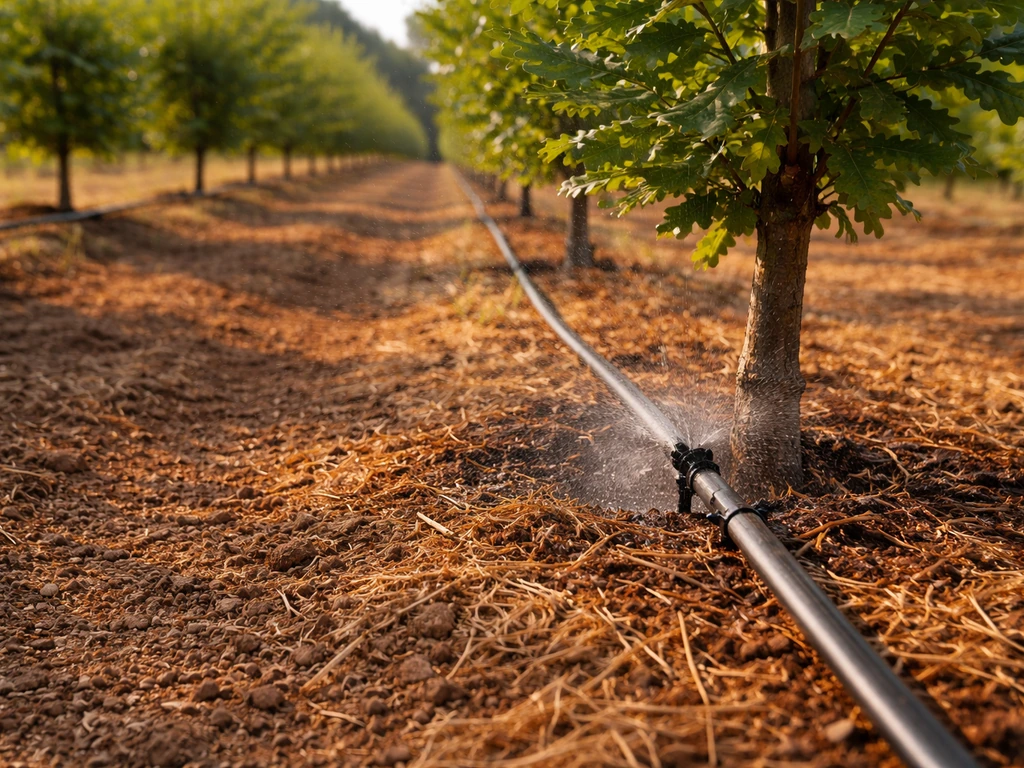
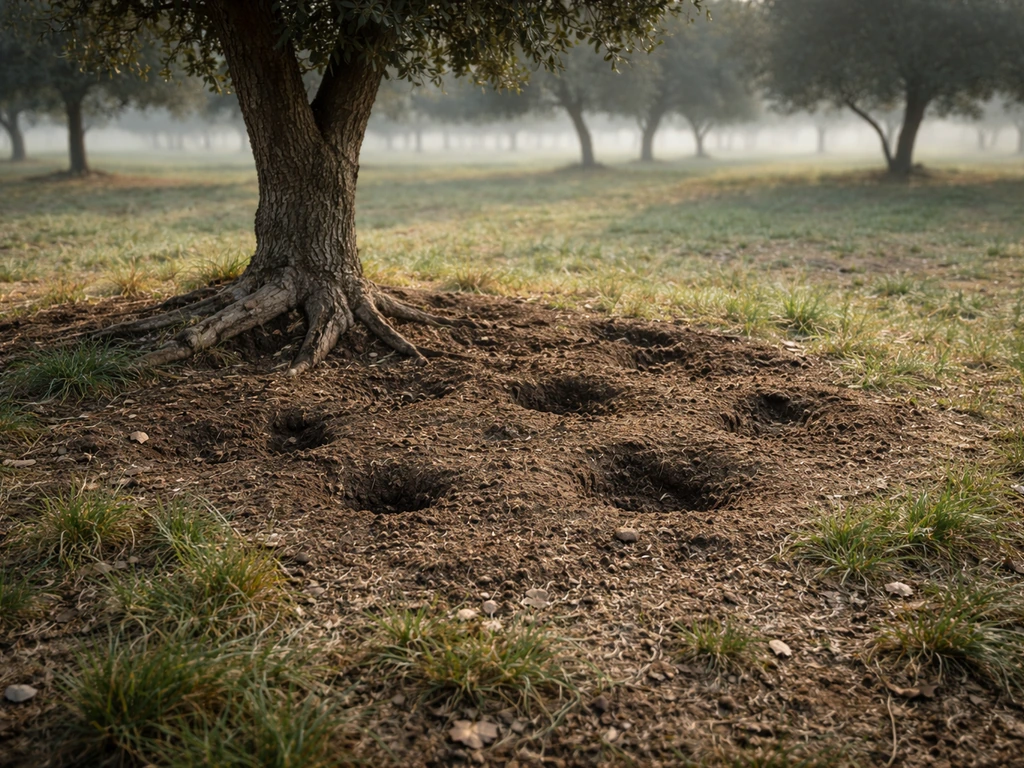
Weed pressure is one of the biggest practical challenges in Georgia truffle orchards given the state's vigorous warm-season growth. Competing vegetation competes with your host trees and also alters soil conditions. A combination of wood chip mulch (applied 3–4 inches deep in a ring around each tree, keeping mulch away from the trunk) and preemergence herbicide in the orchard alleyways is a standard approach. Avoid herbicide contact with tree trunks. Hand-pull or mow aggressively in the first three years when trees are most vulnerable. Once the characteristic bare truffle 'brûlé' (the scorched-earth zone of suppressed vegetation around colonized trees) begins to develop, that itself is one of your first signs that the truffle mycelium is active.
Irrigation
Georgia summers are brutal for truffle orchards. When sustained temperatures exceed 35°C (95°F), soil moisture becomes critical, both drought stress and oversaturation can damage the fungal network around your trees. Drip irrigation is the preferred method: it delivers water directly to the root zone without wetting the soil surface broadly, which would promote weed germination. During establishment years (1–4), keep soil moisture consistent. As the orchard matures, strategic irrigation timed to mimic seasonal rainfall patterns can actually influence yield, experienced truffle farmers use irrigation as a production lever, not just a safety net.
Fertility and what not to apply
Truffle orchards are deliberately kept lean. Avoid nitrogen-heavy fertilizers entirely, they promote competing fungi and excessive tree vegetative growth at the expense of the symbiosis. Do not apply fresh compost, manure, or high-phosphorus products. If soil pH drops back below 7.5 (retest annually), apply additional lime to bring it back into range. Light calcium applications are acceptable and generally beneficial. That's about all the fertility management most truffle orchards need.
Tree pruning and canopy management
Prune host trees to maintain an open, airy canopy structure. You want sunlight reaching the soil under and around your trees. Remove crossing branches, water sprouts, and any understory vegetation that begins to shade the orchard floor. This is light, routine pruning, not hard cutting. Heavy pruning stress can disrupt the tree's ability to support the ECM partnership.
How long this actually takes and what success looks like
Be honest with yourself about the timeline before you invest. The first potential harvest with Tuber melanosporum is around five to six years after planting well-established inoculated trees in ideal conditions. Ten or more years is when peak production typically begins. These aren't pessimistic estimates, they're the biological reality of a multi-year ECM symbiosis. Growers in North Carolina, which has similar climate potential in its piedmont and mountain regions, report similar windows.
The earliest concrete sign of success is the appearance of the brûlé, a roughly circular area of suppressed or dead vegetation around the base of colonized trees, caused by the truffle mycelium altering soil chemistry and outcompeting surface plants. If you start seeing brûlé zones developing around year 3–5, that's a genuinely encouraging sign. Tuber melanosporum truiting bodies begin forming in late spring (late May to early June in North American conditions) and can produce multiple summer flushes. Ripe truffles are typically harvested November through February by probing the brûlé zone with a thin rod and feeling for the marble-to-golf-ball-sized subterranean bodies at 5–15 cm depth, or by using a trained truffle dog.
Troubleshooting the most common problems
No colonization or brûlé after several years
The most common cause is competing ECM fungi that colonized your seedlings' roots before or after planting. This happens when inoculated seedlings are planted into soil already carrying native ECM fungi, or when bare roots weren't washed before planting. It can also happen with poor-quality inoculated seedlings where the truffle inoculation was weak or misidentified. If you suspect colonization failure, NC State University's Meadows Truffle Testing Service offers DNA-based root testing that can confirm whether your trees actually carry Tuber melanosporum on their roots. There's no fix for a fully outcompeted tree other than replanting with properly prepared stock into amended soil.
Trees are colonized but no fruiting bodies appear
This is a less obvious but real failure mode. Tuber melanosporum has mating-type requirements, you need compatible strains present in the orchard for sexual reproduction and fruiting to occur. If all your inoculated seedlings came from a single-strain source, fruiting may not happen even with good colonization. Ask your supplier explicitly whether their inoculum includes compatible mating types. Planting seedlings from more than one inoculated source can reduce this risk.
Soil pH drifting back down
Georgia's naturally acidic soils will tend to push pH back down over time, especially in areas with high rainfall. Test pH every year and apply corrective lime as needed. Don't wait for symptoms, a pH drop from 7.8 to 7.0 happens silently and sets back your timeline significantly.
Heat and drought stress
Georgia's summers will test your irrigation system. Consistent moisture stress during July and August can weaken the ECM network or kill young trees outright. If trees are showing leaf scorch or wilting despite irrigation, check your drip emitters for clogging and make sure soil moisture is consistent at 15–20 cm depth, not just at the surface.
Wildlife foraging
Deer, wild hogs, and squirrels are all real problems in Georgia truffle orchards. Deer will browse young tree saplings relentlessly in the first three years. Tree tubes or wire cages around individual seedlings are worth the cost. Wild hogs (a serious problem in much of rural Georgia) will root up entire brûlé zones searching for truffles and other underground food sources. Heavy-gauge perimeter fencing around the orchard is the only reliable solution.
False truffle confusion
Georgia's forests do contain native false truffles and hypogeous (underground) fungi that superficially resemble edible truffles but are not. Do not harvest and sell or consume anything you cannot positively identify. Georgia's Department of Agriculture requires trained identification and recordkeeping for wild-harvested mushrooms sold commercially, and that standard applies here. If you're selling product, use DNA testing to verify species identity, not just appearance and smell.
Your Georgia truffle orchard checklist for this season
If you're starting today (June 2026), here's exactly what to focus on this season to be ready for autumn planting:
- Submit a soil test to the UGA Cooperative Extension through your county office. Get pH, macro/micronutrients, and a lime recommendation. Do this in June or July so you have results by August.
- Identify and walk your candidate orchard site. Check drainage after rain, confirm sun exposure, and note any existing ECM trees (oaks, pines) nearby that could contaminate your soil.
- Start lime applications based on your soil test results as soon as possible. You want 2–4 months of incorporation before planting. Use agricultural or dolomitic lime tilled into the top 25–30 cm.
- Contact reputable inoculated seedling suppliers (American Truffle Company is one; search for others with verifiable DNA-testing and nursery QC documentation) and place your order for autumn delivery. Demand documentation of truffle species and inoculation method.
- Plan your irrigation setup. At minimum, have drip lines and a timer-controlled system designed before trees go in the ground.
- Source deer protection materials: tree tubes, wire cages, or perimeter fencing depending on your site and local deer/hog pressure.
- Decide on your tree spacing (13–20 feet) and mark out your planting grid before seedlings arrive.
- Plan for a second soil pH test just before planting to confirm pH has reached the 7.5–8.0 target range.
- Set a reminder to contact NC State's Meadows Truffle Testing Service or a similar root-testing lab in year 3–4 to confirm ECM colonization status on your trees.
- Join a truffle grower network or forum (the North American Truffle Growers Guild is one resource) to connect with others attempting production in the Southeast.
Truffle growing in Georgia is genuinely possible, but it rewards the methodical and patient. The growers who succeed are the ones who treat it like a long-term land investment rather than a quick harvest project. Get your soil right before anything else goes in the ground, source your inoculated trees from a verified supplier, and protect them aggressively in the first few years. Everything after that is monitoring, adjusting, and waiting, which is most of the job. If you are specifically looking for purple mushrooms in Stardew Valley, follow the game’s mushroom growing steps and harvesting schedule for the best results how to grow purple mushrooms stardew valley.
FAQ
How far in advance should I do soil testing before planting how to grow truffles in georgia trees?
Test at least once well before buying seedlings, ideally a few months ahead of your target planting window, then retest right before planting. Lime takes time to react and can be expensive to overcorrect, so you want your final pH target based on the soil status at planting, not just last season’s numbers.
What soil pH target should I aim for in Georgia for Tuber melanosporum, and what if I overshoot?
Aim for roughly 7.7 to 8.0 where possible, and generally 7.5 or higher to keep the orchard moving forward. If you overshoot slightly, use elemental sulfur cautiously and confirm with a follow-up test, because repeated sulfur applications without testing can push pH too far down and set you back years.
Can I use my existing orchard trees to inoculate them instead of starting with inoculated seedlings?
Usually no. The practical route is to plant trees whose roots are already colonized by the correct truffle inoculum. Existing trees often already host competing ectomycorrhizal fungi, so adding inoculum later rarely displaces what is already established, and you may pay for “inoculated” work that never produces fruiting.
How do I confirm I’m not buying low-quality or misidentified inoculated seedlings?
Ask for documentation that the inoculation was verified, preferably using DNA testing of the fungal identity, and ask whether colonization was confirmed before shipment. Also plan to inspect roots on arrival, if the roots look poorly developed, overly dried, or the seedling supplier cannot explain their verification process, treat it as a red flag.
Why do some orchards show delayed brûlé, even when the seedlings seem healthy?
Brûlé can take longer if pH drifts down, if phosphorus or nitrogen is applied, or if weed competition and soil moisture swings stress the fungal network. Recheck pH with your annual soil panel, review your fertility and herbicide practices, and verify drip function and emitter spacing during the hottest months.
Do I need to fertilize at all in the first few years when learning how to grow truffles in georgia?
Most orchards stay lean, but you should correct major nutrient problems only if your soil test shows them. Avoid nitrogen and high-phosphorus products, and focus on lime management and structural drainage if needed. If you have micronutrient issues, keep amendments minimal and target what the lab report indicates.
What’s the best way to irrigate without encouraging weeds or harming the ectomycorrhizae?
Use drip irrigation so water reaches the root zone rather than broad soil surfaces. Use timing and scheduling based on soil moisture conditions, during establishment years keep moisture more consistent, and when it’s extremely hot aim to prevent both drought stress and oversaturation. Periodically check for clogged emitters and confirm wetting depth (not just surface wetness).
How do I manage cover crops or ground vegetation in a truffle orchard?
In early years you generally want minimal competition, so use a weed control strategy that keeps the soil surface from becoming overly vegetated. Mulch in rings around trees helps, and alleyways are commonly managed with mowing plus selective herbicide where appropriate. Avoid letting a thick cover crop establish right around the host roots, because it can alter soil moisture, take nutrients, and reduce the establishment and activity of the fungal network.
Can I grow truffles in containers or raised beds in Georgia?
Not realistically for the target species. Truffles require a living host root system with active ectomycorrhizae, so grow tents, tubs, and typical container substrates do not provide the correct biology. If you want a small-scale start, focus on a small outdoor test orchard planted in amended, well-draining ground with inoculated trees.
What spacing should I use if I’m starting with a small trial of how to grow truffles in georgia?
A common approach is 13 to 20 feet between trees, closer spacing increases potential early root contact but requires more long-term management as canopies expand. Start small if you’re unsure about site performance, for example 20 to 50 trees, but keep your spacing consistent so the orchard can be evaluated as a real system.
What wildlife protection is most effective in Georgia for young orchards?
For deer, individual tree protection like tubes or wire cages is often worth it in the first three years. For wild hogs, perimeter fencing is the reliable solution, because hogs can root up entire orchard zones and destroy the developing brûlé areas. Plan protection before planting, not after damage occurs.
If my trees don’t fruit, how can I troubleshoot whether it’s a colonization problem?
First verify soil management factors, pH stability, and whether you inadvertently used nitrogen or high-phosphorus inputs. If those are correct, the next step is root testing for DNA confirmation of truffle identity and colonization. If the orchard is fully outcompeted, the only true remedy is replanting with properly prepared inoculated stock into correctly amended soil.
Why might truffles fail even with good colonization?
Mating-type compatibility can limit fruiting if all seedlings originate from a single strain set. If you’re buying inoculated trees, ask whether the supplier’s inoculum includes compatible mating types and whether they diversify strain sources across plants, this reduces the risk of “right fungus, wrong mating.”
How deep are truffles in Georgia and what’s the safest way to harvest?
Harvest depth commonly ranges about 5 to 15 cm in many orchard situations, and ripe truffles are typically found within the active brûlé zone. Use careful probing to avoid damaging host roots, and if you’re marketing product, harvest handling matters, but your key goal is to minimize root disruption while checking multiple times during the late fall to winter window.
Are Georgia “false truffles” a real risk, and how should I handle identification before consuming or selling?
Yes, Georgia has underground fungi that can look similar but are not edible truffles. Do not rely on appearance alone. If you plan to consume or sell, use DNA-based verification for species identity, and keep records that match Georgia’s requirements for trained identification and documentation when selling wild-harvested mushrooms commercially.