
Legality and Safety in Illinois: Read This First
As of March 2026, psilocybin and psilocin are [classified as Schedule I controlled substances](https://www. law. cornell. edu/cfr/text/21/1308.
As of March 2026, psilocybin and psilocin are [classified as Schedule I controlled substances](https://www. law. cornell. edu/cfr/text/21/1308.
11) under both Illinois state law (720 ILCS 570) and federal law. 21 U. S. C.
§ 812 establishes the federal schedules of controlled substances, which provides the statutory basis for listing Schedule I drugs like psilocybin/psilocyn [psilocybin and psilocin are classified as Schedule I controlled substances under both Illinois state law (720 ILCS 570) and federal law. ](https://uscode. house. gov/view.
xhtml? req=%28title%3A21+section%3A812+edition%3Aprelim%29). That means growing, possessing, or distributing psilocybin mushrooms is illegal in Illinois at both the state and federal level. There is no current legal exemption for home cultivation, recreational use, or personal possession of any amount.
Illinois has seen active legislative movement, including Senate Bill 2612 (103rd General Assembly), which proposed a psilocybin regulatory and advisory framework, and House Bill 1143 filed in January 2025 to decriminalize and tax psilocybin products for adults 21 and older. Neither of those bills has been enacted into law as of this writing.
That landscape can shift quickly, so before you do anything, check the current status of Illinois law directly through the Illinois General Assembly website and consult a licensed Illinois attorney if you have questions about your specific situation.
Illinois law enforcement has actively pursued psilocybin mushroom cases, including prosecutions involving mushrooms shipped through the mail. Manufacturing or delivering a Schedule I substance under 720 ILCS 570/401 carries serious criminal penalties. Spore syringes are sold legally for microscopy purposes in many states, but the moment you use them to cultivate a psilocybin-producing mushroom, you are crossing into illegal territory under current Illinois and federal law. This is why people ask how to grow psychedelic mushrooms in Maine.
If you are looking for a state-specific walkthrough, see the related guide on how to grow psychedelic mushrooms in wisconsin as a comparison point how to grow psychedelic mushrooms in Maine. This article is written for educational and informational purposes, consistent with the broader mushroom cultivation content on this site. It is your responsibility to understand and comply with the laws in your jurisdiction before attempting cultivation.
For a deeper look at the cultivation process, see our guide on how to grow psychedelic mushrooms.
Beyond the legal picture, there are real health considerations worth taking seriously. Mushroom cultivation involves working with spores, mycelium, and sometimes contaminating molds. Breathing in fungal spores is a genuine risk, particularly for anyone who is immunocompromised, has asthma, or has underlying respiratory conditions. The CDC specifically flags inhaled mold spores as dangerous for people with weakened immune systems.
Wear a properly fitted N95 respirator any time you are working with spores, opening grain jars, or dealing with contaminated substrate. Nitrile gloves and eye protection are also worth adding. Keep your grow space clean, ventilated, and separate from living areas to reduce cross-contamination. Do not cut corners on sanitation.
A contaminated grow is not just a failed harvest, it is also a potential health hazard sitting in your home.
For beginners, Psilocybe cubensis is the standard starting point for indoor cultivation worldwide, and for good reason. It colonizes reliably at temperatures most homes already reach, tolerates beginner mistakes better than most species, and fruits relatively quickly. It does not grow well outdoors in Illinois because it needs tropical soil conditions that the Midwest simply does not provide naturally.
If you are interested in outdoor cultivation, P. cyanescens and P. azurescens are wood-loving species that can thrive in mulched garden beds in temperate climates like Illinois. P. cyanescens colonizes wood chips readily and fruits when temperatures drop in autumn. P. azurescens typically fruits from late September through late December or early January, making it a reasonable match for Illinois falls. Both species are harder to establish than a cubensis indoor grow, require patience across an entire season, and have a more complicated inoculation process involving outdoor wood chip beds. For most beginners, starting indoors with cubensis and getting that process down before attempting outdoor species is the smarter path.
| Species | Grow Method | Substrate | Fruiting Temp | Difficulty | Timeline |
|---|---|---|---|---|---|
| P. cubensis | Indoor | Grain/BRF/bulk (coco coir, straw) | 74–82°F (23–28°C) | Beginner-friendly | 6–10 weeks seed-to-harvest |
| P. cyanescens | Outdoor | Hardwood chips/mulch | 50–65°F (10–18°C) | Intermediate | One full season |
| P. azurescens | Outdoor | Alder/hardwood chips | 45–60°F (7–16°C) | Intermediate–Advanced | One full season, fruits fall–early winter |
For Illinois specifically, an indoor P. cubensis setup gives you the most control over outcomes and the tightest feedback loop for learning. Outdoor beds can work well in central and northern Illinois given the climate, but you are committing to a project that spans months with less ability to intervene when things go wrong. If you are newer to growing mushrooms of any kind, spending time with a beginner edible species first (like oyster mushrooms, which are entirely legal) will teach you substrate prep, contamination prevention, and environmental control before the stakes feel higher.
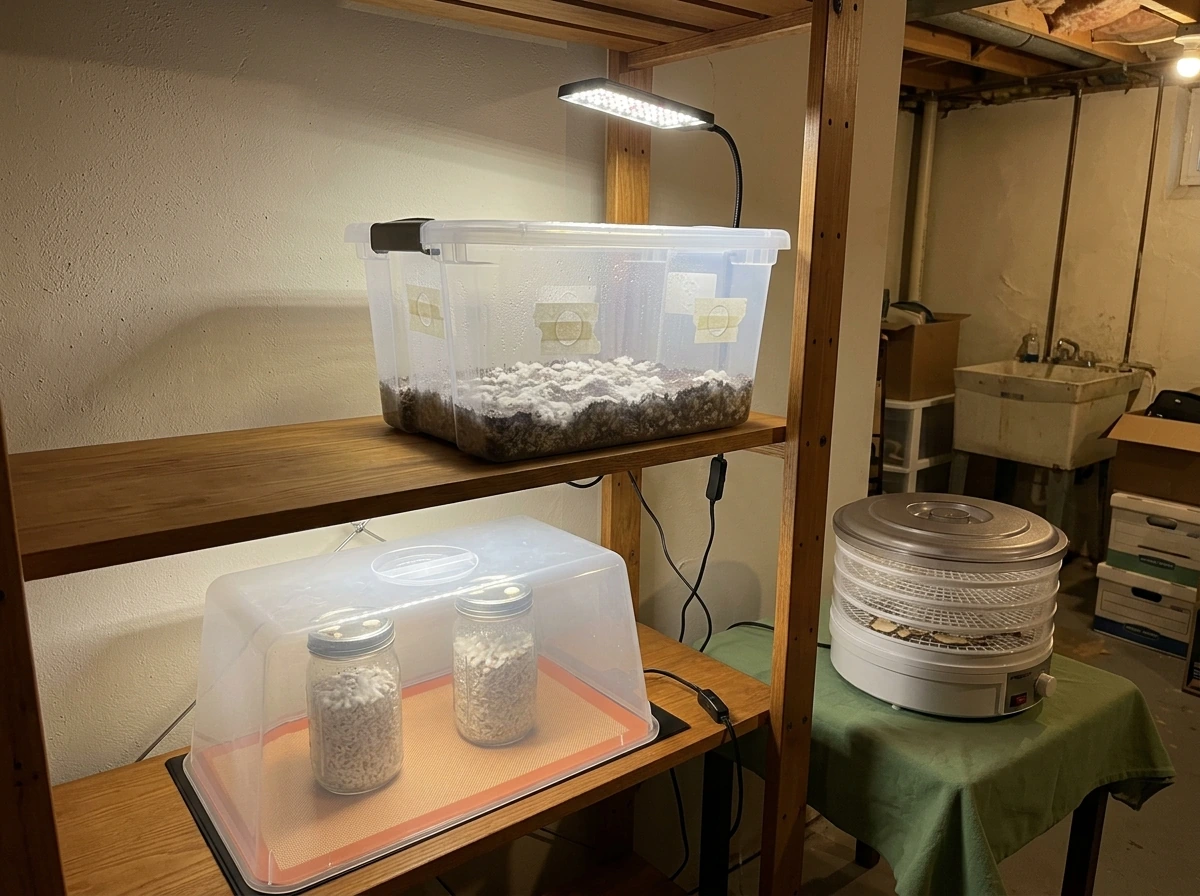
Spore syringes and spore prints are sold by online vendors for microscopy purposes. They are legal to purchase in most U.S. states, and Illinois does not currently have a specific law prohibiting spore possession in the same way that California, Georgia, and Idaho do. However, as noted above, using those spores to grow psilocybin mushrooms crosses into illegal territory. Spore syringes typically come loaded in 10–12 mL of sterilized water and are used to inoculate grain jars or agar plates. If you have already established mycelium from a previous grow and want to scale, grain-to-grain transfers let you expand spawn without purchasing new syringes repeatedly.
The most beginner-friendly substrate for P. cubensis is a bulk coco coir and vermiculite mix, which is cheap, easy to pasteurize, and resistant to contamination. For colonization jars (the first stage), brown rice flour and vermiculite (BRF tek) or sterilized grain (rye, oat, or millet) are both widely used. Grain spawn is faster to colonize and easier to work with for bulk grows. For outdoor wood-loving species, hardwood chip mulch sourced from untreated wood is your substrate. Avoid cedar, black walnut, or any treated/dyed wood chips.
You can source most of this from Amazon, local hardware stores, and homebrew supply shops in Illinois. Restaurant supply stores in Chicago and other major metro areas carry mason jars and food-safe containers cheaply. A pressure cooker is non-negotiable for grain sterilization. Skipping it is the single most common reason beginners get contamination.
Rinse your grain (rye berries work great) and simmer it for 15–20 minutes until the kernels are hydrated but not split open. Drain and dry the surface until the grain looks matte with no visible moisture on the outside. Load into mason jars to about two-thirds full, cap with lids that have an injection port (a self-healing silicone port made from a silicone sealant bead) and a polyfill filter patch for gas exchange. Pressure cook at 15 PSI: 60 minutes for half-pint jars, 90 minutes for quarts. Let jars cool completely, ideally overnight, before inoculating.
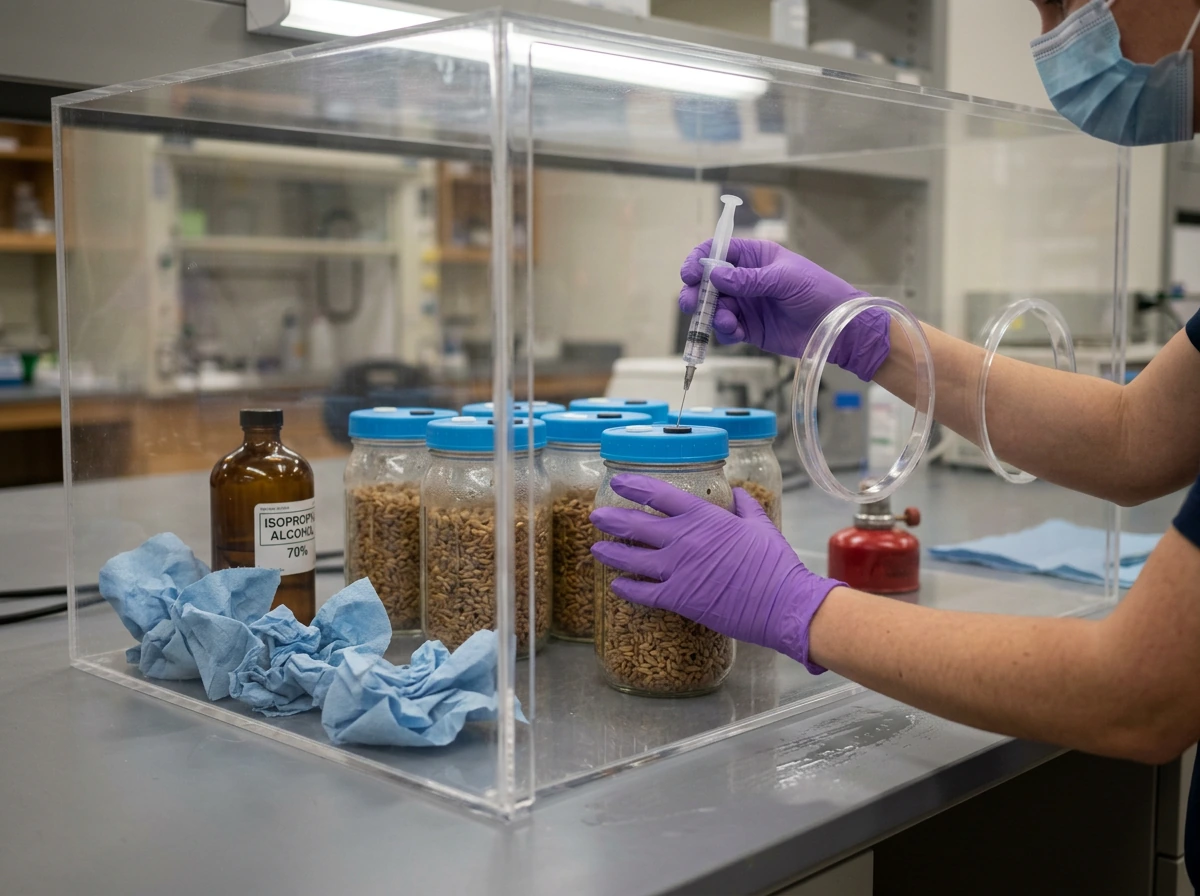
Work in a Still Air Box or in front of a flow hood. Wipe all surfaces with 70% isopropyl alcohol. Flame-sterilize the needle until it glows, let it cool for a few seconds, then wipe with alcohol. Inject 1–2 mL of spore solution per quart jar through the injection port. Distribute the inoculation points around the jar if possible. Shake the jars gently after 3–5 days if you see early colonization, which helps speed things along by distributing mycelium through the grain mass.
Move jars to a warm, dark location at roughly 75–81°F (24–27°C). A seedling heat mat under the jars works well if your home runs cool. Colonization typically takes 2–4 weeks depending on inoculation density, temperature, and genetics. You are looking for white, ropy mycelium spreading through the grain. Anything green, black, pink, or slimy is contamination: remove those jars immediately, seal them in a bag, and dispose of them outside. Do not open contaminated jars indoors.
Once grain jars are fully colonized (solid white throughout with no off colors), it is time to move to bulk substrate. A standard beginner bulk substrate is coco coir and vermiculite mixed at roughly 1:1 by volume, hydrated to field capacity (water should not drip freely when you squeeze a handful) and pasteurized by pouring boiling water over it, covering it, and letting it sit for 1–2 hours. Let it cool to room temperature before mixing with grain spawn. A common spawn-to-substrate ratio is about 1:2 to 1:4 by volume. Mix in a clean plastic tote, spread to roughly 4–6 inches deep, and cover with a thin layer of plain coco coir as a casing layer.
Keep the tote at 75–80°F and leave it mostly undisturbed for 5–14 days while mycelium colonizes the bulk. Once the surface is fully covered in white mycelium, it is time to trigger fruiting. Move the tote to your fruiting chamber, drop the temperature to around 74–76°F, introduce fresh air exchanges (more on that below), and maintain high humidity. Pins (tiny mushroom primordia) usually appear within 5–10 days of fruiting conditions being established. From pins to full-sized mushrooms is typically another 5–10 days.
Realistically, from the day you inoculate grain jars to your first harvest is typically 6–10 weeks for P. cubensis under good conditions. Grain colonization takes 2–4 weeks, bulk colonization another 1–2 weeks, and fruiting body development another 1–2 weeks after pinning begins. Budget 8 weeks as your baseline expectation the first time through.
This is where most home grows succeed or fail. Getting the numbers right is not hard once you understand what you are actually trying to achieve at each stage.
| Stage | Temperature | Relative Humidity | Fresh Air Exchange | Light |
|---|---|---|---|---|
| Colonization (grain/bulk) | 75–81°F (24–27°C) | ~90% inside substrate block; ambient not critical | Minimal; polyfill filter provides passive exchange | Dark or ambient room light is fine |
| Fruiting | 74–78°F (23–26°C) | 85–95% RH in fruiting chamber | 4–6 fan-assisted exchanges per day; avoid direct airflow on pins | Indirect light 12 hrs/day acts as a direction cue |
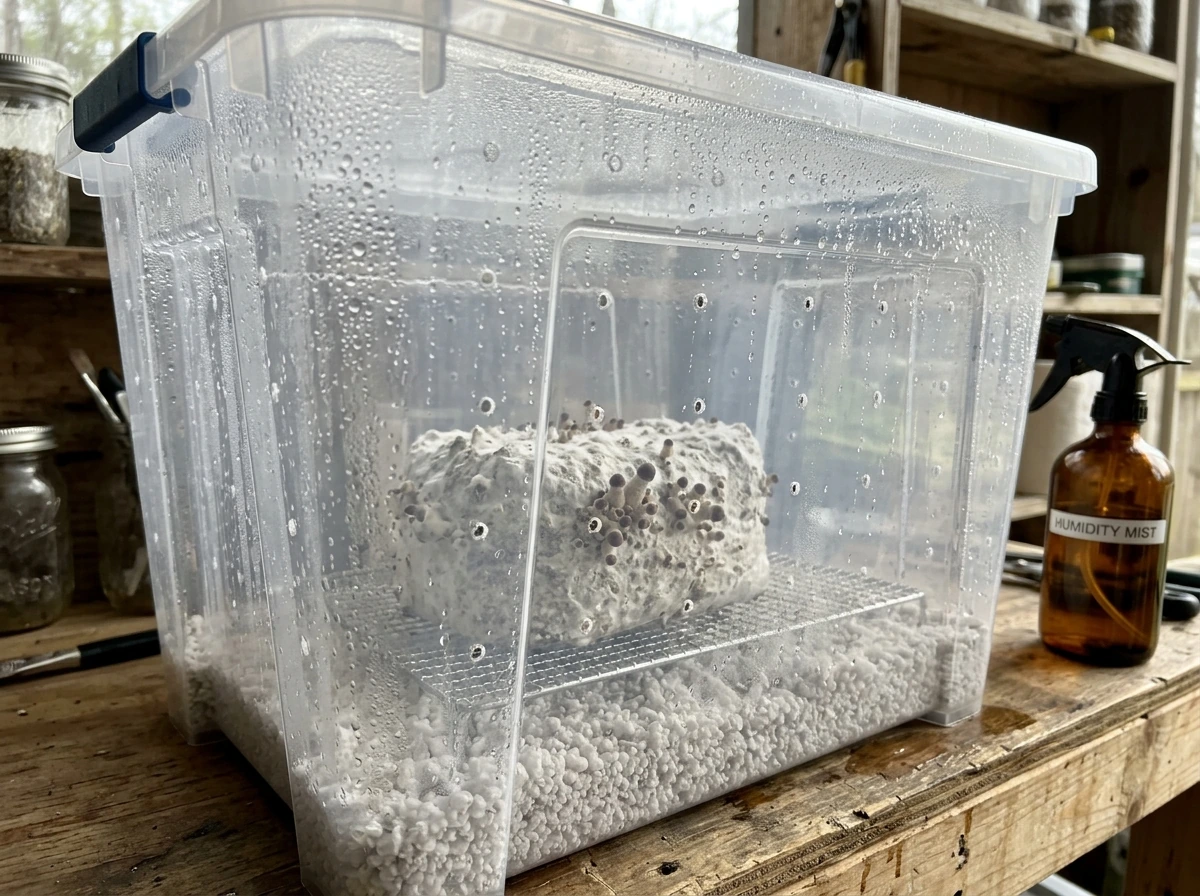
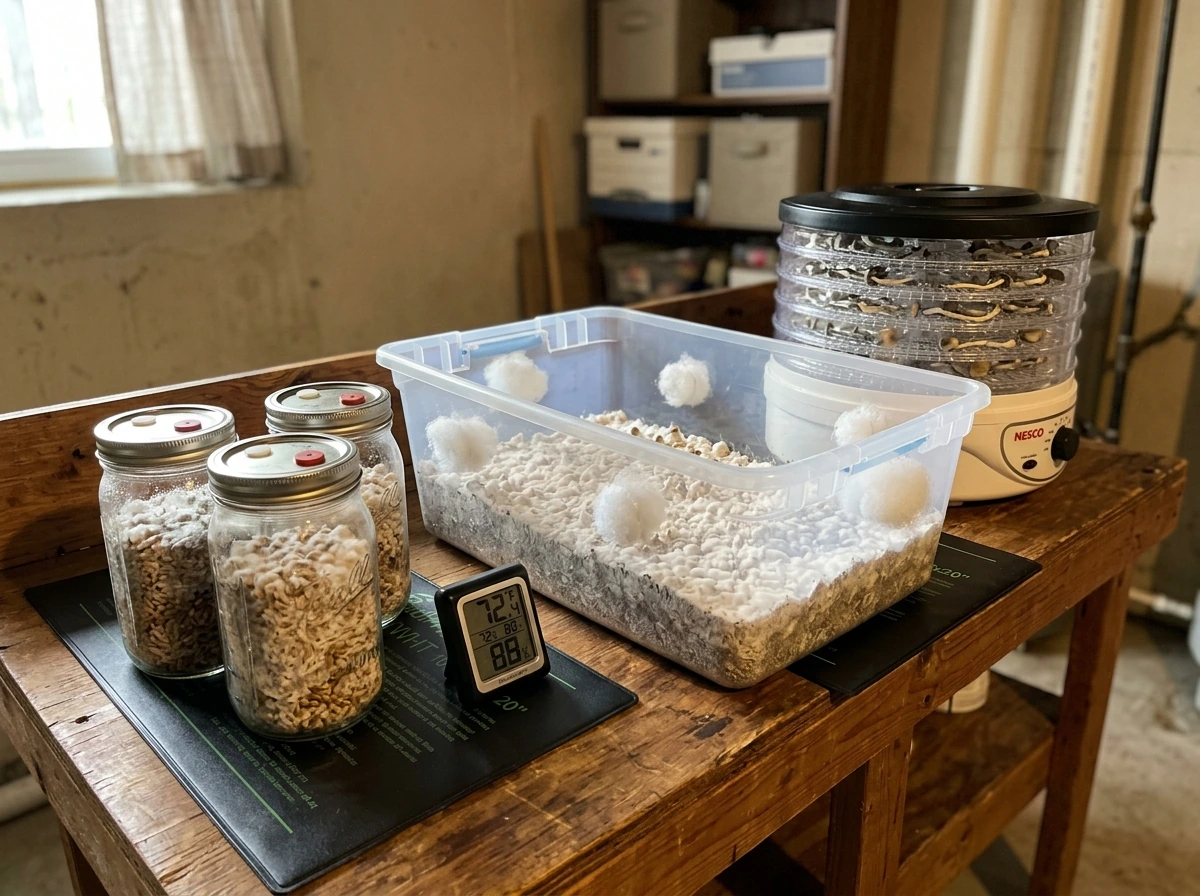
In your fruiting chamber, you want 85–95% relative humidity consistently. The easiest low-tech approach is a shotgun fruiting chamber (SGFC): a clear 50–66 quart tote with 0.25-inch holes drilled every 2 inches on all four sides and the bottom, stuffed with dry perlite on the bottom (which holds moisture and humidifies passively as water evaporates), and misted with a hand sprayer 2–4 times a day. A cheap digital hygrometer clipped to the inside wall tells you where you actually are. If you are getting below 80%, mist more often or add a small ultrasonic humidifier on a timer. If condensation is constantly pooling on your mushroom caps, your humidity is too high or airflow is too low.
Mushrooms exhale CO2 as they grow, and high CO2 produces long, leggy stems with underdeveloped caps. Fresh air exchange is what prevents this. For a basic SGFC, simply fanning the lid open and waving fresh air in 4–6 times a day is sufficient. If you are running a more automated setup or a larger Martha tent, a small USB fan on a timer cycling every few hours works well. The key is not blasting pins with direct airflow, which dries them out and can cause aborts. Move air around the chamber, not directly across the substrate surface.
Illinois homes tend to run 68–72°F in winter months, which is slightly cool for optimal cubensis colonization. A seedling heat mat under colonizing grain jars, or a small space heater with a thermostat in a dedicated closet, gets you to the target range without heating your whole house. During fruiting, most Illinois homes in spring and fall naturally sit within the ideal fruiting temperature range, which is a useful coincidence. Summer air conditioning can actually push rooms too cold if set low, so monitor your grow space temperature separately from your thermostat.
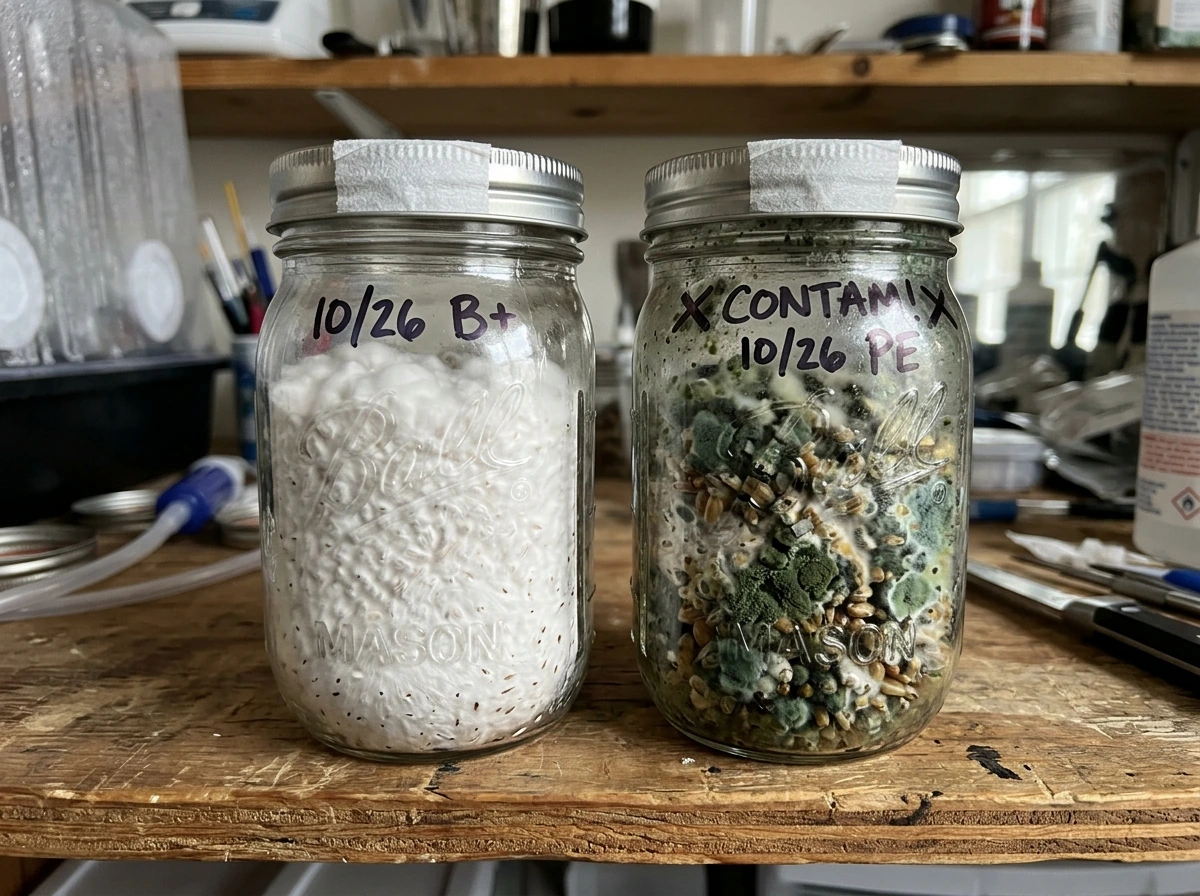
Green mold (usually Trichoderma) is the most common contamination in mushroom grows. It means either your sterilization was insufficient, your grain had too much surface moisture, or your inoculation technique introduced contaminants. If you see green on a grain jar, seal it immediately in a zip-lock bag without opening it, and get it out of your grow space. Do not try to salvage it. Wipe down every surface your jars touched with 70% isopropyl, and review your sterilization times and pressure. If contamination keeps happening, start pressure cooking longer, and double-check your pressure cooker is actually reaching 15 PSI.
If colonization stops progressing after 2 weeks and you do not see contamination, temperature is usually the culprit. Grain jars sitting at 65°F will colonize at a crawl. Get a thermometer on your incubation shelf, not just a room thermostat. Another cause is grain that was too wet at loading, which creates anaerobic pockets where mycelium cannot thrive. The solution for next time is to dry your grain more thoroughly before loading jars.
The most common reason a fully colonized block refuses to pin is insufficient FAE or not enough of a temperature or humidity shift to signal the change from colonization to fruiting. Try introducing more fresh air exchanges, dropping temperature by a few degrees, and ensuring your humidity is genuinely above 85%. Some blocks also need a cold shock: place the tote in the fridge at 50–55°F for 12–24 hours, then return it to fruiting conditions. That temperature drop often kicks stubborn cakes into pinning.
Pin aborts (tiny pins that stop developing and die) are almost always caused by inconsistent humidity, too much direct airflow drying out pins, or CO2 levels that are too high. They look like small yellow or brown nubs stuck on the surface. Improve your FAE, dial back any direct fan exposure, and mist more consistently. Low overall yields usually point to low-quality genetics, over-wet substrate, or a substrate that did not hold enough nutrients. Using sterilized grain spawn instead of BRF cakes will generally give you heavier yields.
Wet spots are dark, slimy, foul-smelling patches of bacterial contamination, usually caused by grain that was too wet or not sterilized long enough. They spread fast and there is no saving a jar with a wet spot. Toss it, sanitize everything, and dry your grain more carefully next batch. If you are consistently getting wet spots, add a dry casing layer of vermiculite between your grain and the jar lid to act as a barrier.
Harvest P. cubensis just before or right as the veil underneath the cap begins to tear. Once the veil tears, the mushroom rapidly drops spores, which makes a mess of your fruiting chamber and can potentially inoculate future substrate with unwanted genetic material. Grasp each mushroom at the base, twist gently and pull rather than cutting, so you remove the entire stem without leaving a rotting stump that can invite bacteria. Harvest the entire flush at once or pick individuals as they reach the veil-break stage.
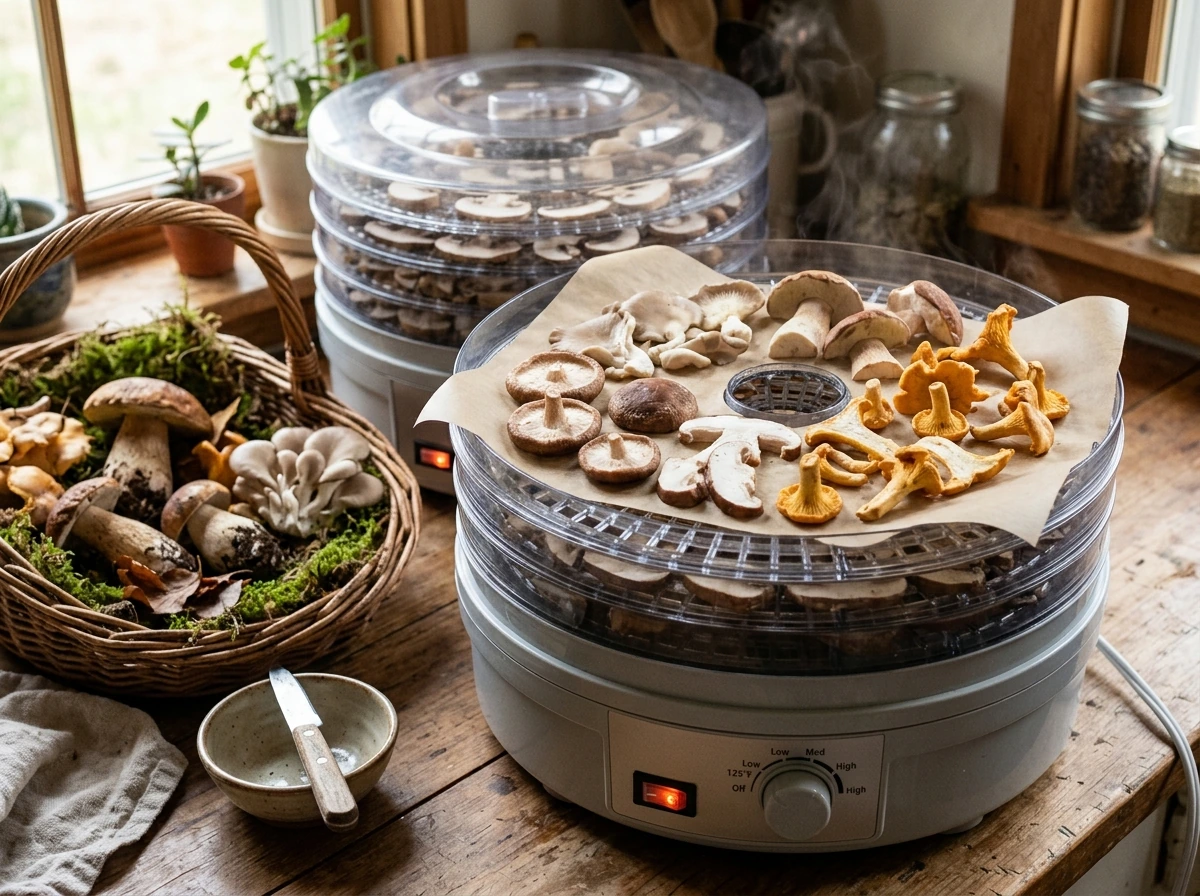
Fresh mushrooms are around 90% water. You need to get them down to cracker-dry (they snap rather than bend) for safe long-term storage. The best method is a food dehydrator set to 95–115°F (35–46°C) for 4–8 hours depending on cap size. In a pinch, a fan blowing over mushrooms laid on a wire rack at room temperature will get them most of the way there in 24–48 hours, but follow up with a short dehydrator pass to finish them. Do not use an oven: even the lowest settings on most ovens are too hot and will degrade heat-sensitive compounds.
Once cracker-dry, store mushrooms in an airtight glass jar with a food-grade desiccant packet (silica gel) in a cool, dark place. A mason jar in a cabinet or drawer away from heat and light works well. Properly dried and stored mushrooms can remain stable for 1–2 years or longer. The main enemies are moisture, heat, and light, so avoid the fridge (humidity swings during opening) and any spot that gets direct sunlight.
Most bulk substrate blocks will produce 2–4 flushes before the substrate is exhaustedMost bulk substrate blocks will produce 2–4 flushes before the substrate is exhausted. After each harvest, remove any remaining stump tissue, mist the surface, and return the block to fruiting conditions. Flushes typically arrive every 7–14 days.
After the last productive flush, you can case the spent block with a fresh casing layer of hydrated coco coir to try to squeeze out one more flush, but yields will drop. Oregon After each harvest, remove any remaining stump tissue, mist the surface, and return the block to fruiting conditions. Flushes typically arrive every 7–14 days.
After the last productive flush, you can case the spent block with a fresh casing layer of hydrated coco coir to try to squeeze out one more flush, but yields will drop.
For your next cycle, the biggest upgrade you can make after your first successful grow is learning agar work. Pouring agar plates, isolating healthy mycelium, and maintaining culture libraries lets you store and propagate genetics without buying new spore syringes every time. It also lets you identify and discard weak or contaminated sectors before they infect your grain jars. For your next cycle, the biggest upgrade you can make after your first successful grow is learning agar work.
Pouring agar plates, isolating healthy mycelium, and maintaining culture libraries lets you store and propagate genetics without buying new spore syringes every time. It also lets you identify and discard weak or contaminated sectors before they infect your grain jars.
If the general workflow above makes sense to you and you want to go deeper into the cultivation side of things, the broader guide on how to grow psychedelic mushrooms on this site covers culture work, agar tek, and multi-species approaches in more detail.
Illinois growers have access to everything they need for a fully functional home setup through general-purpose online retailers and local stores. The bottleneck is never equipment or materials. The bottleneck is patience, consistency, and taking contamination prevention seriously from the very first jar. Get those habits locked in on your first cycle and every grow after that gets faster and cleaner.
In Illinois, spore syringes are generally treated as legal to possess for microscopy purposes, but the legal risk changes once they are used to cultivate psilocybin-producing mushrooms. If you are ever unsure, keep your purchase receipts, avoid any preparation steps intended for cultivation, and consult an Illinois attorney about how your intended use could affect your situation.
Check the Illinois General Assembly bill status for the specific measures that have been discussed (and any newer updates since March 2026). Also look for enforcement guidance or amendments that change definitions, not just whether bills “decriminalize.” Because rules can shift after court decisions, it is smart to verify both state and federal posture the day you plan to start.
Do not share culture tools, substrate containers, or grow-space airflow between legal edible grows and any illegal cultivation attempt. Cross-contamination is not only a quality issue, it can also create serious legal and safety exposure if the same workbench or containers are reused. Set up separate spaces, labels, and storage if you ever run multiple species.
Early contamination often shows up as unexpected colors (green, black, pink) or foul smells, while healthy colonization looks uniformly white and ropy with steady spread. If any jar shows off-colors, do not open it to “check,” because you can aerosolize spores. Seal it in a bag immediately and remove it from the grow area.
No. Once green mold is visible, attempts to salvage typically worsen contamination and can spread spores to other jars and to your fruiting chamber. The practical approach is to isolate, seal, dispose outside, then disinfect every surface that jar contacted and review sterilization timing and moisture levels.
You can sometimes inoculate successfully without a hood, but a Still Air Box or flow hood materially reduces airborne contamination, especially for beginners. If you do not have one, you must compensate with stricter work discipline, fewer movements, better surface cleaning, and minimizing time that jars are open during inoculation.
Use a calibrated digital thermometer placed at the same height and location as the jars, not just the room thermostat. In Illinois winters, small temperature gradients are common, a shelf can run several degrees colder than the rest of the room, and grain jars will colonize much slower at cooler spots.
Beginners often over-mist or over-seal, leading to pooling droplets or constantly wet caps, which can worsen bacterial issues and still fail to provide adequate fresh air. Another common mistake is relying on “humidity readings” without checking airflow, if CO2 accumulates you get long stems and poor caps even when the chamber looks wet.
Stall can come from CO2 being too high (insufficient fresh air exchange), the humidity shift between colonization and fruiting not being strong enough, or the temperature not being in the right window for your specific genetics. If conditions seem correct, a cold shock (short refrigerated period followed by returning to fruiting conditions) sometimes kick-starts pinning, but only if your baseline hygiene and FAE are already solid.
Not always. Fans that blow directly across pins can dry them, causing aborts, and can create uneven conditions across the chamber. Better practice is to move air around the chamber indirectly, keep airflow gentle, and adjust based on pin appearance, if you see aborts, reduce direct airflow first.
Twisting and pulling is usually cleaner because it removes the stem base without leaving a rotting stump that can invite bacteria. Cutting can leave more tissue behind depending on how sharp and precise you are. Either way, avoid knocking loose spores, and harvest promptly at veil-break to reduce spore mess.
If you lack a dehydrator, use low, steady airflow on a wire rack to remove moisture gradually, then finish with a short dehydrator-style pass if you can. Avoid ovens entirely because typical oven temperatures are too high for heat-sensitive compounds. The key outcome is “cracker-dry,” when pieces snap and do not bend.
Store in airtight glass with a desiccant packet in a cool, dark area. Avoid frequent opening and do not store in the fridge, humidity swings when you open containers can rehydrate the mushrooms and reduce shelf stability. Label batches and use them in order so older stock is used before it deteriorates.
Learning agar work is the biggest next-step improvement. It lets you isolate healthier mycelium, prevent weak or contaminated sectors from spreading, and build a culture library so you do not have to repeatedly start from spores. That typically improves consistency across future cycles more than changing substrate or temperature alone.